
 By Marco Bösing
Failed Structure: When Breakouts Fail and Become the Best Entry
Failed structure trading is a strategy where you use breakout failures as high-probability entries. Instead of chasing the breakout, you wait for price to reclaim the broken level and trade the reversal, using the stop-losses of trapped traders as fuel for your move. It is one of the most reliable setups in orderflow trading.
Risk Disclaimer: Trading futures and other financial instruments involves significant risk of loss. Past results are not indicative of future performance. Only trade with capital you can afford to lose.
During my years on an institutional desk, failed structure was one of the patterns I saw play out most consistently. The mechanics are straightforward: breakout traders enter, the breakout doesn't hold, and their forced exits become the engine for the counter-move. This happens every day, in every liquid market, across every timeframe.
In this article, I'll walk you through why breakouts fail, how to spot the failure in the orderflow, and why this setup delivers some of the best risk-reward ratios you'll find.
Why Breakouts Fail
Most retail traders are taught to trade breakouts: price clears a level, you enter, and the trend runs. The problem is that a significant percentage of breakouts fail. The reasons are structural, not random.
Insufficient volume. A breakout without conviction isn't a real breakout. When price pushes above resistance but the delta stays flat or turns negative, there's no aggressive demand driving the move. Price moved higher because sellers stepped away, not because buyers stepped in. The moment sellers return, the move collapses.
Institutional liquidity sweeps. Professional participants know exactly where retail stops accumulate. Above obvious resistance levels, buy-stop orders pile up from traders anticipating the breakout. The market sweeps through that level, fills those stops, and then reverses into the actual intended direction. This isn't noise. It's by design.
Absorption at the breakout level. Sometimes a breakout looks convincing on the price chart, but the footprint tells a different story. Massive limit orders absorb every aggressive buyer. Price moves above the level, but the volume profile at the new price is thin. A low-volume node sitting right above the breakout level isn't strength. It's a trap.
How to Identify a Failed Structure in the Orderflow
You won't catch this on a naked price chart. The signal lives beneath the surface.
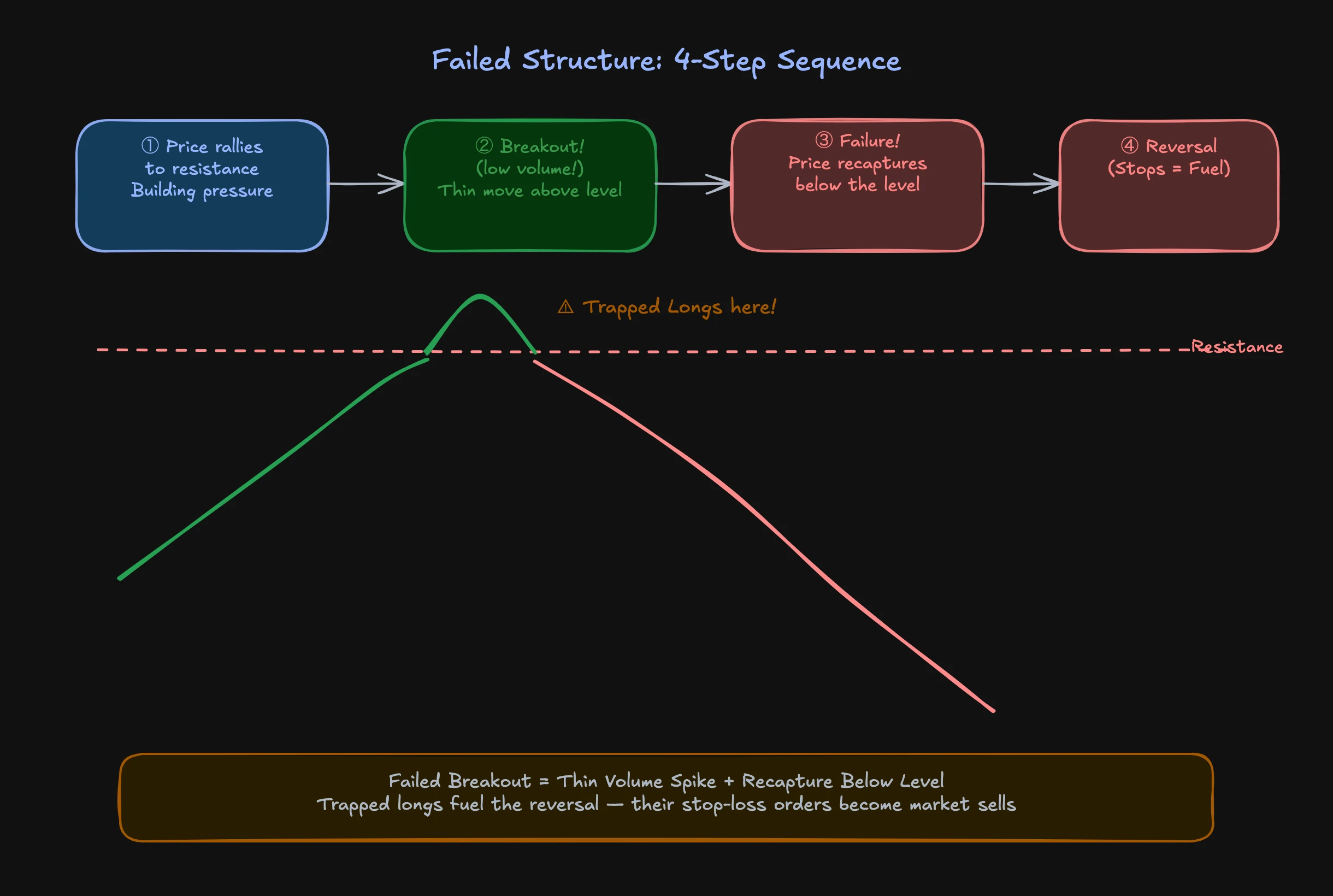
Step 1: Breakout with a weak profile. Price breaks above resistance or below support. But in the footprint chart, the delta at the breakout level doesn't match the price action. For an upside breakout, you'd expect strong positive delta. Instead, it's neutral or negative. That's your first warning.
Step 2: Volume profile rejection. At the new price level, no volume accumulates. The volume profile shows a thin, low-volume area directly above (or below) the broken level. The market is rejecting this price as fair value. Auction market theory calls this a rejection: price was tested and found unacceptable.
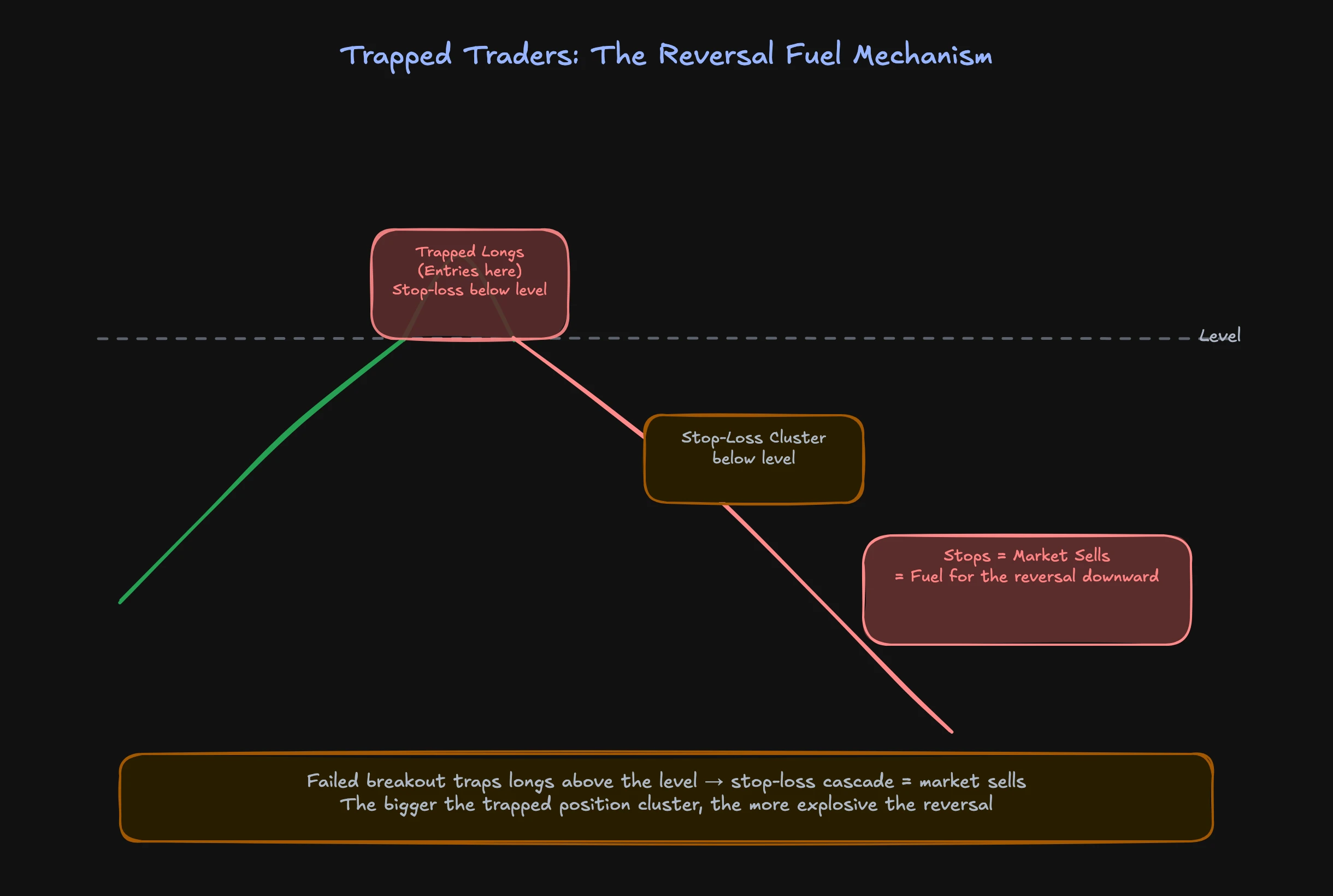
Step 3: Price reclaims the level. This is the trigger. Price drops back below the broken resistance (or rallies back above the broken support). Now the breakout traders are trapped. Their longs are underwater, and their stops sit just below the level. The moment price reaches that stop cluster, those stops fire and create additional selling pressure.
Step 4: The trapped-trader mechanism. The stops of trapped longs are market sell orders. They hit a market that's already turning, and they accelerate the move. That's the fuel you're using for your trade.
The Entry: Timing and Structure
Price reclaiming the broken level is your confirmation. But confirmation alone isn't enough. You need a plan.
The entry comes after price reclaims the level and the orderflow shows aggressive orders in your direction. For a short after a failed upside breakout, you wait for price to fall back below resistance and for delta to turn negative. That tells you real sellers are now active, not just absent buyers.
Your stop goes above the extreme of the failed breakout. This is one of the biggest advantages of failed structure: you have a crystal-clear invalidation point. If price exceeds the extreme, it wasn't a failed breakout after all. It was the real thing. Your loss is defined and tight.
The target is driven by structure. If the breakout failed out of a range, your first target sits at the opposite end of that range. The trapped traders supply the fuel to get there.
Why Failed Structure Produces High Win Rates
Three factors make this one of the highest-probability setups I know.
Trapped-trader fuel. Every failed breakout produces traders stuck on the wrong side. Their stops aren't optional. They have to exit. Those forced liquidations create momentum in your direction. You're not fighting the market. You're riding the wave of forced selling (or buying).
Clear invalidation. Your stop is objectively defined. There's no guessing, no "maybe it'll hold." If price exceeds the extreme, you're out. This clarity makes risk management simple and the trade repeatable.
Information asymmetry. Most retail traders only see price. They see a breakout and enter. You see the orderflow, the volume profile, the delta. You see the breakout is hollow before price reveals it. By the time the majority realizes they're on the wrong side, you're already positioned on the right one.
Failed structure connects naturally to other orderflow concepts. A failed breakout often shows absorption at the extreme. The stops of trapped traders appear as stacked imbalances in the footprint. And the sweep before the reversal is a textbook stop-run. Each piece reinforces the others.
FAQ
What's the difference between a failed structure and a normal pullback?
A pullback happens within an existing trend. Price retraces briefly, then continues in the trend direction. A failed structure is the opposite: price attempts to establish a new structural level, fails, and reverses. The key difference shows up in the orderflow. During a pullback, you still see strength in the trend direction. During a failed structure, you see weakness at the breakout level and stop clusters that become fuel for the reversal move.
Does failed structure trading work in all markets?
The principle works in any market with an order book and aggressive orders. I primarily use it in NQ and ES futures, but the logic applies to any liquid market. What changes are the thresholds for volume and delta. In a thinner market, you need less volume to identify a breakout as failed. The structure of the setup stays the same.
How often do failed structures occur?
More frequently than most traders expect. On an average NQ trading day, I see multiple potential failed structures across different timeframes. Not every one is tradeable because you need the right orderflow context. But as a setup category, failed structure is something you'll find every single day once you know what to look for.
In our mentoring program, you'll learn these concepts in over 1,500 video lessons with real chart examples.