
 By Marco Bösing
FOMC Trading: How to Trade Federal Reserve Rate Decisions
Eight times per year, the Federal Open Market Committee announces its rate decision, and the entire futures market holds its breath. FOMC days are the single most important recurring event for anyone trading NQ, ES, or /ZN. The FOMC trading strategy that works is not about predicting the decision. It is about understanding the phases of the day and knowing exactly when your edge exists, and when it does not.
Risk Disclaimer: Trading futures and other financial instruments involves significant risk of loss. Past results are not indicative of future performance. Only trade with capital you can afford to lose.
What Happens on an FOMC Day
Every FOMC meeting follows the same structure. The committee meets over two days, and on the second day the market gets three distinct information drops that each change the character of the trading session.
2:00 PM ET: The Rate Decision. The Fed releases its statement with the target rate, forward guidance language, and (four times per year) the Summary of Economic Projections including the dot plot. The dot plot shows where each committee member expects rates to be in coming years. This is the first shock. Algorithms parse the statement in milliseconds, and NQ can move 50-80 points in the first 30 seconds. /ZN (10-Year Treasury futures) reacts even faster since it is the purest expression of interest rate expectations. If you want the full picture of how Treasury futures work and why they matter for your index trading, I covered that in the guide on Trading Treasury Futures.
2:30 PM ET: The Press Conference. Fed Chair Powell takes questions from journalists. This is where the real volatility begins. A single sentence about "data dependence" or "further tightening" can reverse the entire move from 2:00 PM. The press conference typically runs 45-60 minutes, and the market reprices continuously as Powell speaks.
3:00-4:00 PM ET: The Real Move. After the press conference dust settles, institutional desks that were flat during the event start building positions. This is when the directional move of the day tends to establish itself. The last hour of trading on FOMC days often carries more volume than the rest of the session combined.
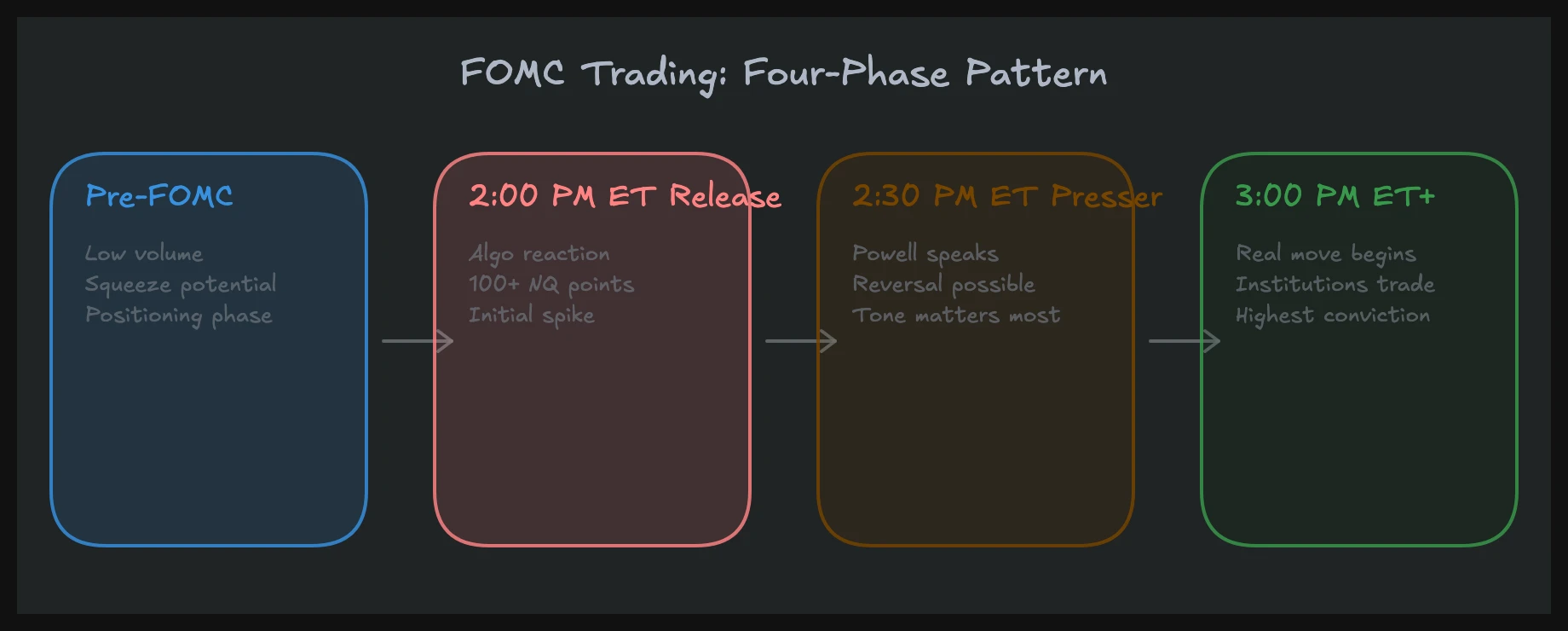
The Four-Phase Pattern of FOMC Days
Every FOMC day follows a remarkably consistent pattern. Understanding these phases is the foundation of any FOMC trading strategy.
-
Pre-FOMC Squeeze (9:30 AM - 2:00 PM ET). The morning session on FOMC days is characterized by low volume and a compressing range. Market makers pull liquidity as the announcement approaches. You will see NQ drift into a tighter and tighter range, often with a slow grind in one direction that has nothing to do with the eventual outcome. This pre-FOMC drift is a positioning artifact, not a directional signal. Shorts cover, longs trim, and the market squeezes toward a neutral zone. By noon, volume drops to a fraction of normal.
-
Algo Reaction (2:00 PM ET). The statement drops and algorithms fire. NQ spikes 40-80 points in the first minute. /ZN moves 8-16 ticks. ES follows NQ but with less amplitude. This move is driven entirely by automated parsing of the statement text. It is fast, violent, and frequently wrong about direction. The fills you get during this window are unreliable, spreads on NQ widen to 2-4 points, and slippage is severe.
-
Press Conference Reversal Zone (2:30 - 3:00 PM ET). Powell starts speaking. Here is the statistic that should change how you think about FOMC: the initial 2:00 PM move reverses approximately 60% of the time during or after the press conference. I watched this play out repeatedly during my institutional career. The algos react to the statement, but the statement rarely contains the full picture. Powell's tone, his choice of words in Q&A, the emphasis he places on specific risks, these are what the human traders and larger allocators respond to. And their response often contradicts the algo's first read.
-
Directional Resolution (3:00 - 4:00 PM ET). Once the press conference ends or reaches its substantive conclusion, the real positioning begins. Large institutional orders start flowing. The move from 3:00 PM to close tends to be the highest-conviction move of the day. This is where the money is made.
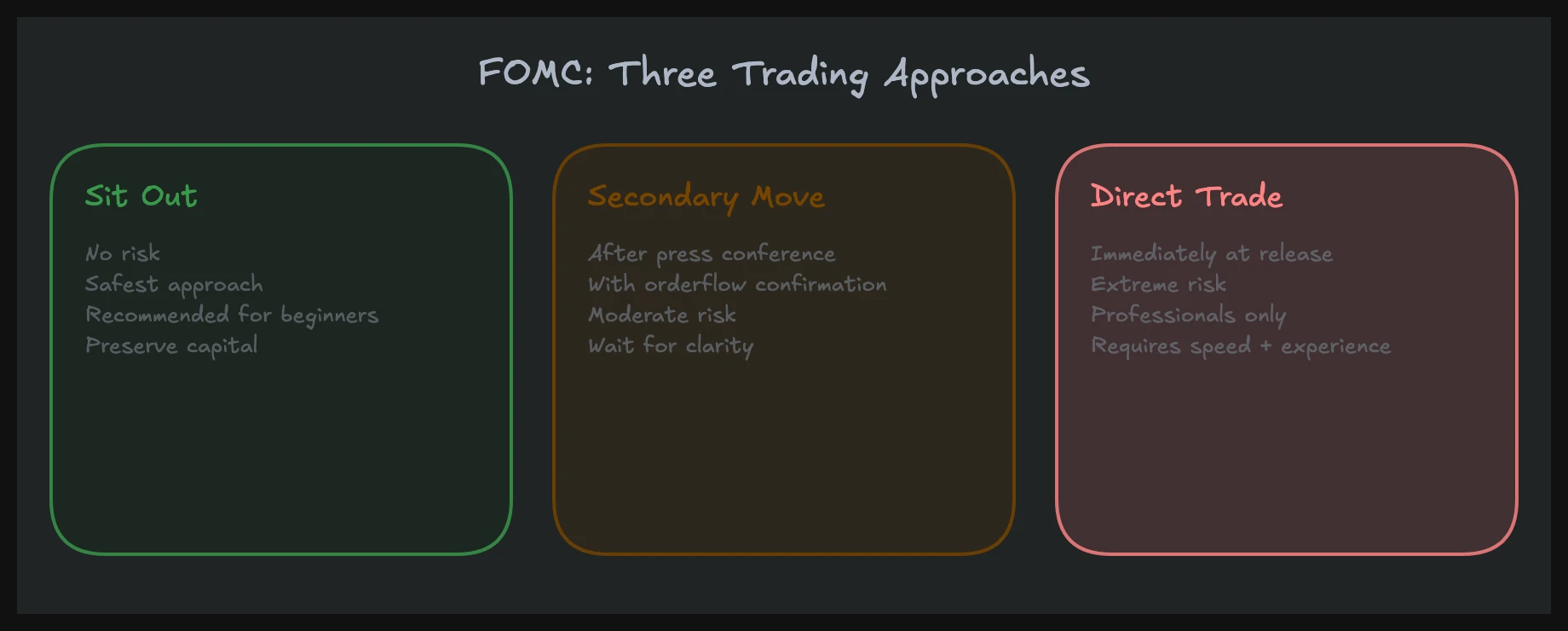
Three Approaches for FOMC Days
Not every trader should trade FOMC. In fact, the best FOMC trading strategy for most traders is to not trade at all during the event window. Here are three approaches ranked by risk.
Approach A: Sit Out 1:00 - 4:00 PM ET. This is what I recommend for anyone who has not traded at least 20 FOMC days live. Close positions by 12:30 PM, turn off the screens at 1:00 PM, review the outcome the next morning. You lose nothing by sitting out. The edge on FOMC days is thin even for experienced traders, and the risk of a catastrophic loss from a whipsaw is real. Your money management plan, if you have one, should already flag FOMC days as requiring adjusted risk parameters.
Approach B: Pre-FOMC Range Trade. Between 9:30 AM and 12:00 PM ET, NQ often trades within a defined range as the market compresses before the announcement. You can trade the edges of this range with tight stops, taking small profits as the market ping-pongs. The key rule: be flat by 1:00 PM ET at the latest. No exceptions. This approach works because the pre-FOMC range is driven by positioning mechanics, not directional flow. The range is your friend until it is not, and it stops being your friend about an hour before the announcement.
Approach C: Post-Conference Direction (3:00 PM+ ET). This is the approach I used institutionally and still consider the highest-probability FOMC trade. Wait for the press conference to end. Let the 2:00 PM reaction and the 2:30 PM reversal play out. Then, after 3:00 PM ET, look for the directional resolution. By this point, the statement is digested, Powell has spoken, and the smart money is positioning. You are trading with the institutional flow, not against the algorithm noise. Watch /ZN for confirmation. If NQ is rallying but /ZN is also rallying (rates falling), the move has legs. If NQ rallies while /ZN sells off, be skeptical. The bond market does not lie about rate expectations. Understanding how order flow confirms these moves gives you an additional layer of conviction.
The Biggest Mistake: Trading the 2:00 PM Move
I need to be direct about this because it is the single most expensive mistake I see retail traders make on FOMC days. They see the 2:00 PM spike, panic into a position chasing the move, and get destroyed by the reversal 30 minutes later.
The 2:00 PM move reverses roughly 60% of the time. That is not an edge. That is a coin flip with terrible execution. When you chase the 2:00 PM candle, you are buying the top of the algo reaction (or selling the bottom), paying wide spreads, getting poor fills, and then watching Powell reverse your position during the press conference. I saw this pattern destroy retail accounts consistently. The algo reaction is not information, it is noise with direction.
If you are in a position at 2:00 PM and the statement moves the market in your favor, the correct response is to take profit, not to add. If the market moves against you, the stop should already have been in place. There is no scenario where entering a new position at 2:00 PM ET on an FOMC day gives you a statistical advantage.
Using CME FedWatch to Set Expectations
Before every FOMC meeting, check the CME FedWatch Tool. It shows the probability-weighted expectations for the rate decision derived from Fed Funds futures pricing. This is not a forecast. It is the market's actual positioning expressed as probabilities.
When FedWatch shows a 95% probability of a hold, the rate decision itself is a non-event. The market has already priced it. What moves the market in that scenario is the dot plot, the forward guidance language, and Powell's tone about future decisions. When FedWatch shows a 70/30 split, the decision itself becomes the event and the 2:00 PM reaction will be more violent.
Your pre-FOMC preparation should always include: check FedWatch probabilities, read the previous statement for language changes, note where the dot plot consensus sits versus current rates, and identify the key questions journalists are likely to ask Powell. This preparation takes 15 minutes and separates informed trading from gambling.
FAQ
How long should I wait after the FOMC decision before trading?
At minimum, wait until 3:00 PM ET, which is 30 minutes after the press conference begins and typically when the initial reversal dynamics have played out. The safest window is 3:00 - 4:00 PM ET, after the press conference reaches its substantive conclusion. Many experienced traders wait until the following morning to trade the post-FOMC direction, which removes all event risk while still capturing the follow-through move.
Does the FOMC affect futures other than NQ and ES?
Every futures market reprices on FOMC, but the intensity varies. /ZN (10-Year Treasuries) and /ZB (30-Year Bonds) react first and most directly since they are pure interest rate instruments. NQ is the most sensitive equity index because of the high duration of tech stocks. ES follows NQ but with lower amplitude. Crude oil (/CL) and gold (/GC) also react, primarily through the dollar channel, as rate decisions directly affect USD strength.
Should I hold positions through an FOMC announcement?
No. Unless you have a specific macro thesis with defined risk and the position size to survive a 100+ point NQ whipsaw, holding through FOMC is unnecessary risk. In my institutional experience, we were flat before every announcement. The edge on FOMC days comes from reacting to information, not from predicting it. Close or hedge your positions by 1:00 PM ET and re-evaluate after 3:00 PM.
In our macroeconomics course with 20 video lessons, you'll learn how bonds, interest rates, and economic data shape the markets you trade every day.