
 By Marco Bösing
Best Futures Brokers for European Traders: A Comparison
Finding a futures broker for Europe is confusing. Most relevant providers are based in the USA, are not BaFin-regulated and don't provide German tax certificates. This comparison is based on actual use, not affiliate deals. The focus is on what really matters for order flow traders: platform compatibility, data feeds and actual monthly costs.
Risk Warning: Trading futures and other financial instruments carries significant risk of loss. Past performance is not indicative of future results. Only trade with capital you can afford to lose.
What Makes a Good Futures Broker
A good futures broker for European traders offers low commissions, compatibility with professional analysis platforms like ATAS or Bookmap, a reliable real-time data feed and transparent margin requirements. The tax situation and regulatory framework differ significantly depending on broker location.
Anyone not yet familiar with futures trading will find all the basics there. Not every broker is equally suitable for European traders. Commission per contract is important, but only part of the picture. Critical is which platforms the broker supports. Anyone who wants to trade order flow needs a broker that works with ATAS, Bookmap or Sierra Chart. Not every provider offers that.
The data feed is equally important. Rithmic and CQG are the two relevant standards. Rithmic offers MBO data (Market By Order) with full order book depth. CQG has a direct connection to Chicago and is the standard feed with some brokers. Which feed runs better depends on your location and platform.
Margin requirements differ significantly between brokers. For day traders, intraday margin counts: some brokers offer $50 to $100 per Micro contract, others demand $2,000 or more. Overnight margins are set by CME and similar everywhere.
One point that particularly affects European traders: US brokers are not BaFin-regulated. In practice, this means no deposit protection under German law. Instead, CFTC oversight applies: your money is held in segregated customer accounts and separated from the broker's company assets. That is solid, but different than with a German bank. And you don't get automatic tax certification; you must report your profits yourself in your tax return.
Anyone fundamentally asking why futures instead of CFDs: the article Futures vs CFD explains the differences in detail.
The Best Futures Brokers Compared
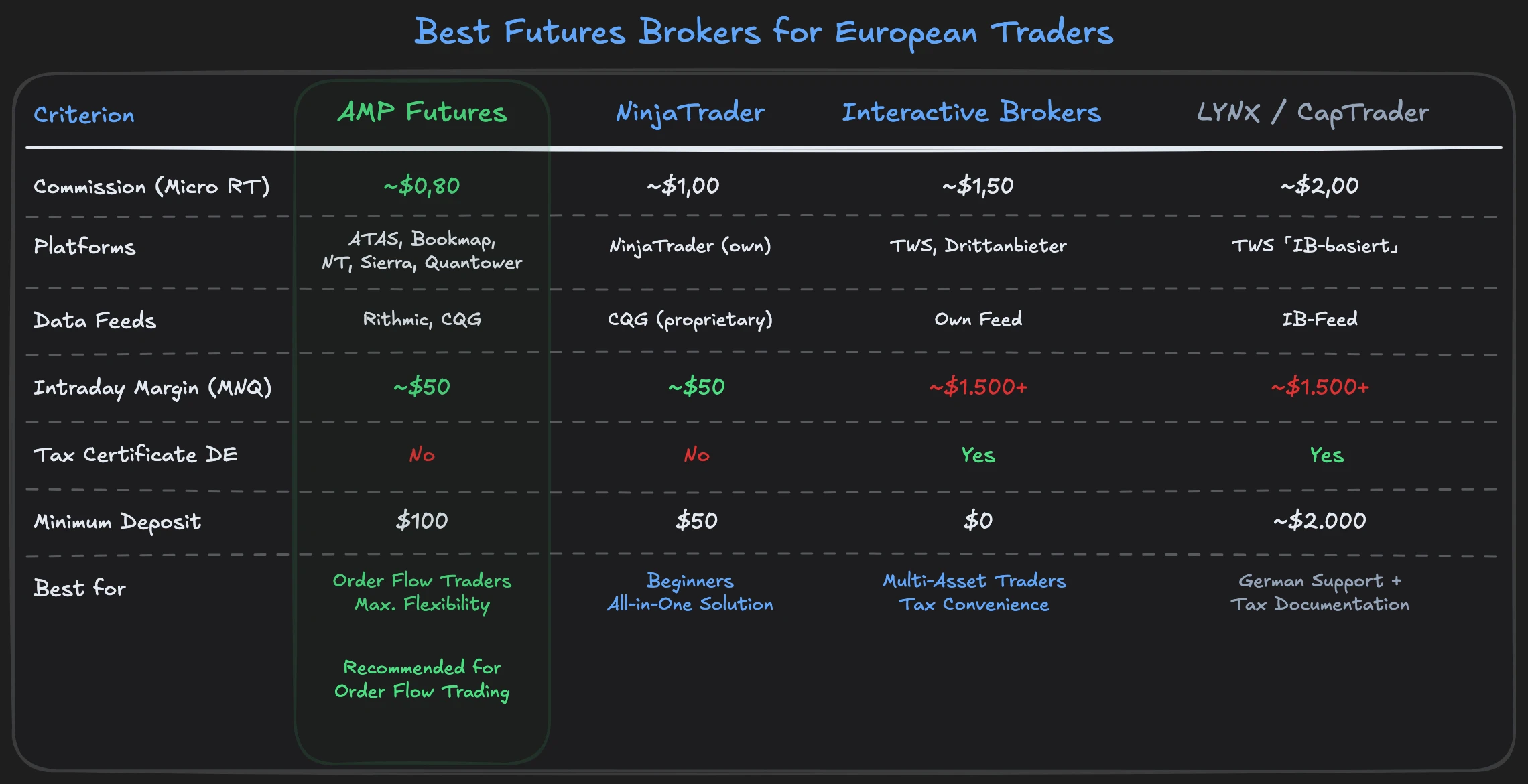
Four brokers seriously come into consideration for European futures traders. The differences lie in commissions, platform connection, available data feeds and tax handling. The following table gives a quick overview before I discuss each broker in detail:
| Criterion | AMP Futures | NinjaTrader | Interactive Brokers | LYNX / CapTrader |
|---|---|---|---|---|
| Commission (Micro RT) | ~$0.85 | ~$1.65 | ~$1.25 | ~$4.00 |
| Platforms | ATAS, Bookmap, NT, Sierra, Quantower | NinjaTrader (own) | TWS, some third-party | TWS (IB-based) |
| Data Feeds | Rithmic, CQG | CQG | Own Feed | IB-Feed |
| Intraday Margin (MNQ) | ~$100 | ~$50 | ~$2,100+ | ~$2,100+ |
| Tax Certificate DE | No | No | Yes (EU Entity) | Yes |
| Minimum Deposit | $100 | $0 | $0 | ~$2,000 |
| Location | USA | USA | USA/EU | Germany/NL |
AMP Futures
AMP is the broker most order flow traders use, and for good reason. I use AMP with Rithmic as my main setup. The combination of low commissions and full ATAS compatibility has proven to be the most stable setup in my experience. Critical is platform compatibility: AMP works with ATAS, Bookmap, NinjaTrader, Sierra Chart, Quantower and Tradovate. No other broker offers this breadth.
You have the choice between Rithmic and CQG as data feed. Intraday margins are aggressively low, which is important for day traders with smaller accounts. Account opening works without problems from Germany, even though AMP is based in the USA.
The downside: no tax certificate. You must document your trades yourself and report them in the Annex KAP. However, the platform provides monthly statements from which you can extract all necessary numbers.
Best for: Order flow traders who want maximum platform flexibility and low costs.
NinjaTrader
NinjaTrader is broker and platform in one. You open a brokerage account with no minimum deposit and get the NinjaTrader platform free. With the free plan, you pay about $1.65 per Micro round-turn. Who buys the Lifetime license ($1,499) reduces commission to under $0.90. The data feed runs through CQG (branded as "NinjaTrader Continuum").
The platform itself is solid for charting and order execution. However, there are limitations for precise order flow analysis: in my tests, I found that NinjaTrader sometimes misses contracts per minute in the volume data. For pure charting and trade execution, that is not a problem; for detailed Footprint analysis, it is not ideal.
Anyone who wants to use ATAS or Bookmap can do so through a separate data feed provider. NinjaTrader as a broker doesn't prevent you from using a different analysis platform.
Best for: Traders looking for a simple all-in-one solution who don't need specialized order flow tools.
Interactive Brokers
Interactive Brokers (IB) is the broker with the largest product range: futures, stocks, options, forex, everything from one account. When I switched from an institutional desk to a retail broker, IB was my first choice because of the product breadth. The Trader Workstation (TWS) is powerful but takes getting used to. The learning curve is steeper than with AMP or NinjaTrader.
The biggest advantage for European traders: IB has an EU entity (Interactive Brokers Ireland) and provides a tax certificate. That saves considerable effort in tax filing. Commissions are about $1.25 per Micro round-turn (all-in). Intraday margins are significantly higher at over $2,100 for one MNQ contract than with AMP or NinjaTrader. Day trading with small accounts is more difficult with IB.
Connecting third-party platforms is possible but not as smooth as with AMP through Rithmic. ATAS and Bookmap can run through IB, but the configuration is more complex.
Best for: Multi-asset traders who trade futures, stocks and options besides and want a German tax certificate.
LYNX and CapTrader
LYNX (Dutch-based, BaFin-regulated branch in Berlin) and CapTrader (Düsseldorf) are introducing brokers of Interactive Brokers. You get the same products and the same TWS platform, but with German-language support and a contact person in Germany.
The advantage: automatic annual tax certificate in German standard. No self-reporting, no manual adding up. For traders who don't want to deal with US tax forms, that is a real argument.
The disadvantage: significantly higher commissions than with IB directly. LYNX charges about €4.00 per Micro contract. You pay the premium for German service. Margin requirements and product range are identical to IB.
Best for: Traders who want German support and automatic tax documentation and are willing to pay higher commissions for it.
The Real Monthly Costs
Most beginners only look at commissions. But the actual fixed costs are elsewhere: platform licenses and real-time data feeds. Almost everyone overlooks this point.
Here is a realistic breakdown for two typical setups:
Minimal setup (NinjaTrader + basic data):
- Broker commissions (40 round-turns/month): ~$66
- Platform: $0 (NinjaTrader free with brokerage)
- CME real-time data bundle: ~$15/month
- Total: ~$81/month
Order flow setup (ATAS + Rithmic + Level 2):
- Broker commissions (40 round-turns/month): ~$34 (AMP)
- ATAS license (Pro): ~€70/month
- Rithmic data feed: ~$25/month
- CME exchange fees: ~$15/month
- Level-2 data (MBO): ~$15.50/month
- Total: ~$160/month
The difference is considerable. The minimal setup costs under $85 per month. A complete order flow setup with ATAS, Rithmic and Level-2 data is around $160. I always tell my mentoring members: calculate the real monthly costs before making your first trade.
The data feed is the item that beginners completely overlook. CME charges exchange fees for real-time data, and those apply with every broker and platform. Without a paid data feed, you get delayed data, and delayed data is useless for day trading.
The good news: you don't have to run the full order flow setup immediately. Start minimal, learn the basics and expand your setup step by step. Details on individual order flow platforms can be found in the separate comparison. And anyone who wants to keep costs low at the start uses Micro Futures so fixed costs aren't disproportionate to trading capital.
Taxes and Regulation for European Traders
US brokers like AMP and NinjaTrader are subject to CFTC oversight and registered with the NFA (National Futures Association), not BaFin. Your money is held in segregated customer accounts, separated from the broker's company assets. SIPC protection does not apply to futures accounts because SIPC only covers securities. Protection for futures comes through CFTC segregation regulations.
There is a decisive tax difference: US brokers don't withhold German capital gains tax. You are responsible for reporting your profits in your tax return (Annex KAP). That is not rocket science but requires clean bookkeeping. Download the statements monthly and document every trade.
Interactive Brokers and introducing brokers LYNX and CapTrader provide an annual tax certificate. With that, you have all numbers at a glance and can hand them directly to your tax advisor.
My advice: regardless of broker, keep your own trading journal with monthly P&L and commission overview. Then you are on the safe side, no matter which broker you use. More on trading taxes in Germany can be found in our detailed guide.
FAQ: Futures Brokers for Europe
Which futures broker has the lowest fees?
AMP Futures has the lowest commissions per contract. But commissions are only part of the costs. Add data feed, platform license and exchange fees. A "cheap" broker with expensive data feed can end up costing more than a broker with higher commissions and included feed.
Do I need a German broker for futures?
No. US brokers like AMP or NinjaTrader are easily usable from Europe and are often cheaper. The downside: you must report your taxes yourself. Anyone who wants automatic tax certification uses Interactive Brokers, LYNX or CapTrader.
Which broker works with AMP?
AMP Futures through Rithmic is the most common setup for ATAS. The connection is stable, configuration straightforward, and the combination of AMP commissions and Rithmic data quality is hard to beat. NinjaTrader and Interactive Brokers technically also work, but the connection is more complex.
In our mentoring program, you'll learn these concepts in over 1,500 video lessons with real chart examples. The software module shows you step by step which tools and data feeds we use daily and how to set up your setup from scratch. More info at united-daytraders.com.