
 By Marco Bösing
Futures vs CFDs: Which Is Better for Day Trading?
CFD prices are derived from futures prices. When you trade CFDs, you trade a copy of the real market against your broker as counterparty. Futures, on the other hand, offer a real order book, real volume and the transparency of a regulated exchange. Which instrument better fits you depends on your account, your goals and your trading style. In this article, I compare both instruments in detail.
Risk Warning: Trading futures and other financial instruments carries significant risk of loss. Past performance is not indicative of future results. Only trade with capital you can afford to lose.
The Fundamental Difference
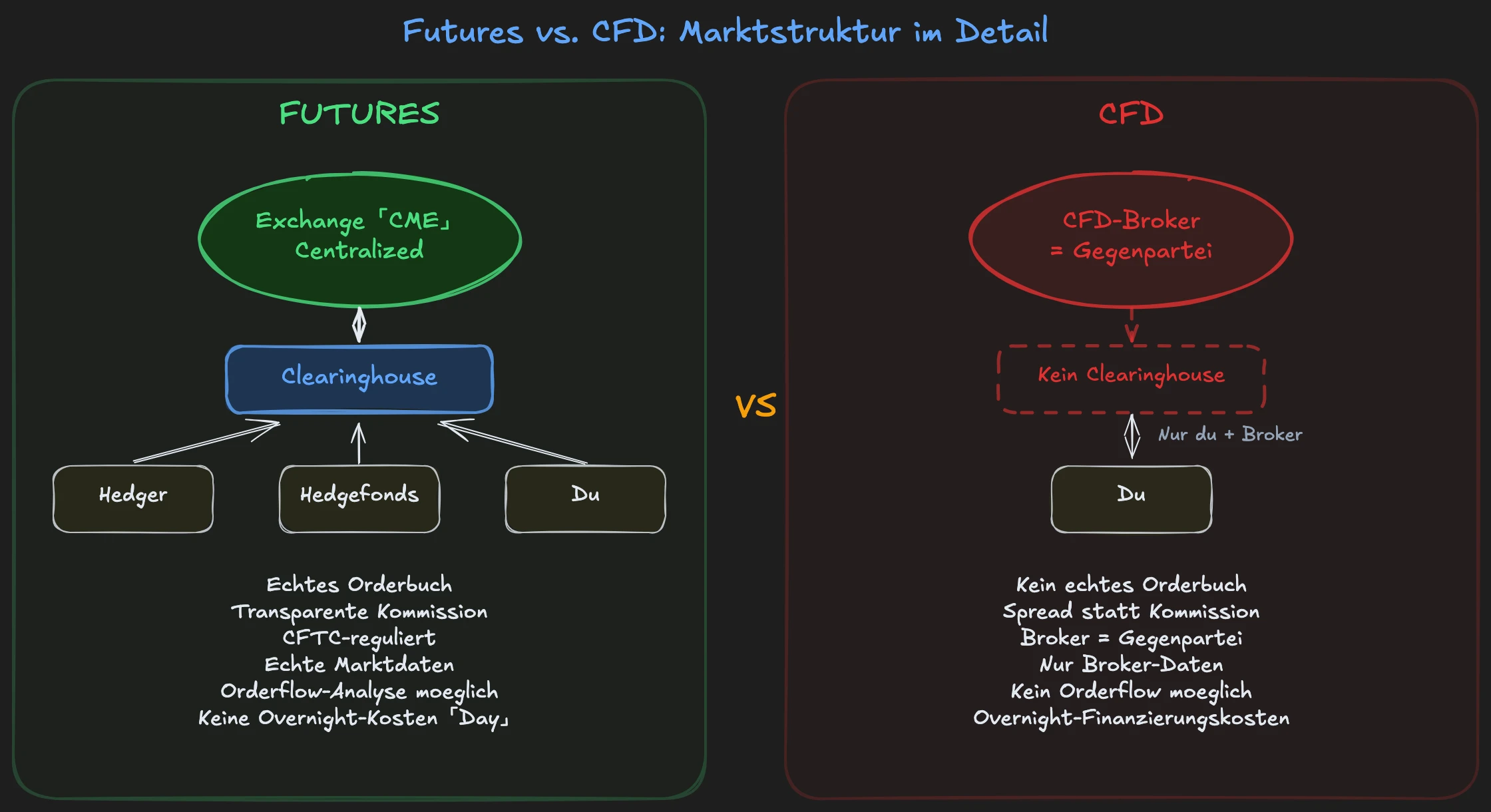
A future is a standardized futures contract traded on a regulated exchange. A CFD (Contract for Difference) is an OTC derivative where you trade against your broker as counterparty. This structural difference determines everything: price discovery, data quality, costs and transparency.
Most comparisons between futures and CFDs stay on the surface: "futures are exchange-traded, CFDs are OTC." That is true, but it doesn't explain why that makes a difference in practice.
With futures, you trade on a centralized exchange. CME Group in Chicago is the world's largest futures exchange.
Every market participant worldwide sees the same price, the same order book, the same tape. If an institutional trader in New York buys 500 NQ contracts, you see this transaction in real time on your screen in Germany. An independent clearinghouse guarantees the settlement of every single contract.
Your broker is only the intermediary, not your counterparty.
With CFDs, the world looks completely different. You trade OTC (Over the Counter), directly against your broker. The broker takes the real futures price from the CME, adds their spread and presents you with that price. There is no centralized order book. There is no real volume. The prices you see are your broker's prices, not the market's prices.
This means concretely: when you look at a "Nasdaq CFD" on your platform, you see your broker's version of what the NQ is doing on the CME at that moment. The real price is established at the exchange. Your CFD price is a derivation from it. You are trading a derivative of a derivative.
This is not an accusation against CFD brokers. That is the structure of the product. But this structure has consequences that every trader should understand.
Futures vs CFDs in Direct Comparison
Regulation, counterparty, data quality and costs: the differences between futures and CFDs run through every aspect of trading. The following table summarizes the most important points before I explain the three decisive factors in detail.
| Criterion | Futures | CFD |
|---|---|---|
| Exchange | Regulated exchange (CME) | OTC (against the broker) |
| Counterparty | Clearinghouse | Your broker |
| Order Book | Real, centralized order book | No real order book |
| Volume Data | Real transactions from all participants | Only your transactions with the broker |
| Spread | Market-based, typically 1 tick | Broker-based, often 1-3 ticks |
| Commission | ~$0.50-1.00 per Micro contract | Often "commission-free" (hidden in spread) |
| Overnight Costs | No financing fee (only margin requirement) | Swap/financing fee daily |
| Regulation | CFTC/CME (USA) | National regulators (BaFin, FCA, CySEC) |
| Order Flow Analysis | Fully possible | Not possible |
| Minimum Contract | 1 Micro (e.g., $0.50/tick MNQ) | Often freely selectable (0.01 lots) |
| Margin Call | Yes (USA), limited (EU via broker) | No (EU regulation since 2018) |
The table shows many differences. Three of them are decisive in practice:
1. Counterparty Risk
With futures, the CME clearinghouse stands between you and the market. It guarantees the fulfillment of every contract.
Even if your broker goes insolvent tomorrow, your positions and your money are protected (up to legal limits) because settlement goes through the clearinghouse.
With CFDs, you are completely dependent on your broker's creditworthiness. Your broker is both your trading partner and the manager of your money. History shows this is a real risk. When a CFD broker gets into financial difficulty, customer funds can be affected. Regulation in the EU has brought improvements here, but the structural dependency remains.
2. Data Transparency
Futures data shows you the real market. Every transaction, every order in the order book, every volume you see on your screen comes from real market participants on a regulated exchange. This transparency is the foundation for any form of order flow analysis.
CFD data shows you the activity between you and your broker. The volume you see does not represent the total market, only your broker's customers. For price charts, this often makes no visible difference. But as soon as you want to analyze deeper, you are missing the real data.
3. Cost Structure
CFDs advertise "commission-free" trading. In truth, the fee is hidden in the spread. A Nasdaq CFD with 2 ticks spread instead of 1 tick with futures means: you pay double the spread on every trade. Plus there are overnight financing fees (swaps) that become considerable with longer holding periods.
With futures, you pay a transparent commission per contract. With Micro futures, typically $0.50-1.00 per side. The spread is market-based and with liquid products like ES or NQ is almost always 1 tick. No hidden fees, no overnight costs for day traders.
Why Order Flow Trading Only Works with Futures
This single point is the decisive reason for many traders to switch from CFDs to futures.
Order Flow Trading is based on analyzing real transaction data from the exchange. You want to see who is buying, who is selling, where institutional volume enters the market and where large players build their positions. This information only exists on regulated exchanges.
Footprint Charts show you the delta between aggressive buyers and sellers at each price level. This data comes directly from the exchange tape. With CFD data, you only see the transactions between you and your broker. That has zero predictive value about the real market.
Volume Profile marks the price levels where the most volume was traded. Institutional traders leave their traces here. With CFD volume, you instead see where the retail customers of your broker were active. That is completely different information.
Big Trades identify the entry of large market participants in real time. When a hedge fund buys 200 NQ contracts at once, you see it immediately on the futures tape. On a CFD feed? Invisible.
The conclusion is simple: if you want to understand WHY the market is moving and not just THAT it is moving, you need futures data. CFDs show you the price. Futures show you the price and everything behind it.
What CFDs Do Better
Despite all the advantages of futures, there are situations where CFDs are the better choice. Saying that honestly is part of it.
Flexible position sizes. CFDs allow micro lots (0.01). With futures, you always trade whole contracts. A Micro NQ contract costs you $0.50 per tick.
This is not a problem for most traders, but with accounts under $2,000, CFDs offer more flexibility in position size.
Product variety. Individual stocks, crypto, exotic indices: not everything has a liquid futures market. If you want to trade Tesla or Bitcoin short-term, CFDs are often the only practical option.
No margin call in the EU. Since 2018, EU-regulated CFD brokers must close positions before your account goes negative.
With US futures accounts, your account can go negative in extreme scenarios (flash crash, gap overnight). In practice, this rarely happens, but the regulatory protection with CFDs is a point.
Lower entry costs. No data feed needed, no platform costs, many brokers offer free charts. Monthly fixed costs can be $0 with CFDs, while a futures setup costs $15-65 per month.
However, these advantages become less significant the more seriously you trade. Flexible lot sizes don't help if you can't see the real market.
When You Should Switch from CFDs to Futures
Switching from CFDs to futures is not a must. But there are clear signs that the time has come:
You want to use order flow analysis. If you start being interested in Footprint Charts, Volume Profiles or Big Trades, there is no way around futures. These tools only work with real exchange data.
You regularly trade indices. If you trade S&P 500, Nasdaq-100 or DAX anyway, with CFDs you are trading a copy. The futures version is the original with better execution and real data.
Your account is over $3,000. From this size, the contract size of Micro futures is no longer an obstacle. You can run clean position sizes with one or two MNQ contracts.
Overnight fees are eating your profits. If you regularly hold positions overnight, swap fees with CFDs add up quickly. With futures, there is no daily financing fee.
You notice your broker is working against you. Noticeable slippage during news events, sudden spread widening in quiet phases, suspicious requotes: these are typical signs that the OTC structure of CFDs is working against you.
My advice for the transition: open a futures demo account parallel to your CFD trading. Get familiar with the platform, the data feed setup and contract mechanics. When you feel confident, switch with real capital. You can find an overview of suitable providers in our Futures Broker Comparison for Germany.
The Cost Question: What Futures Trading Really Costs
A functioning futures setup costs $15-65 per month for data feed and platform. CFDs are on paper free, but wider spreads and overnight fees often make them more expensive in total for active traders. Here are the real numbers:
- Broker commission: ~$0.50-1.00 per Micro contract per side
- CME real-time data feed: ~$4-15/month (depending on package, Non-Professional)
- Trading platform (ATAS, NinjaTrader, etc.): $0-50/month depending on choice
- Total: $15-65/month for a functioning setup
For comparison: CFD trading is "free," but wider spreads and overnight fees often total MORE costs than futures. A Nasdaq CFD with 2 ticks spread instead of 1 tick costs you an additional tick on every round turn. With 10 trades per day with an MNQ equivalent, that is $5 per day or $100 per month, just from the wider spread.
The rule of thumb: from 5-10 trades per day, futures are cheaper in total costs than CFDs. The more actively you trade, the larger the cost advantage becomes.
FAQ: Futures vs CFDs
Is futures trading safer than CFD trading?
Not "safer," but more transparent. You see the real market, real prices and trade through a clearinghouse. The risk comes from position size and your risk management, not the instrument. Both can quickly cost you money if you don't control your risk.
Can I trade futures and CFDs simultaneously?
Yes. Some traders use futures for their primary index trading and CFDs for instruments without a liquid futures market, such as individual stocks or crypto. The key is to understand the difference in data quality and adjust your analysis accordingly.
Why does traMADA recommend futures instead of CFDs?
Because our entire methodology is based on reading real market data. Order flow, Footprint Charts, Volume Profile: all of this requires exchange data. CFDs cannot deliver this data. If you trade purely based on price charts, CFDs work. If you want to understand what moves the market, you need futures.
In our mentoring program, you'll learn these concepts in more than 900 video lessons with real chart examples. The Trader Framework course dedicates 22 lessons to the fundamentals alone, from contract understanding to order types.