
 By Marco Bösing
Micro Futures Trading: Start with a Small Account (MES, MNQ)
Micro Futures are exactly one-tenth the size of E-mini contracts and trade on the same regulated exchange (CME). MES ($1.25 per tick) and MNQ ($0.50 per tick) enable real futures trading with accounts starting at $3,000. Anyone looking to enter the futures market without immediately risking five-figure amounts finds the right instrument in Micro Futures.
Risk Warning: Trading futures and other financial instruments carries significant risk of loss. Past performance is not indicative of future results. Only trade with capital you can afford to lose.
What Micro Futures Are and Why They Exist
Micro Futures are standardized futures contracts with one-tenth the contract size of E-mini futures. They trade on the same exchange (CME/Globex) and track the same underlying. Prices are linked to the E-minis since both track the same index and can be offset against each other 10:1. This makes them the ideal entry point into futures trading with a smaller account.
In May 2019, CME Group introduced the Micro E-mini Futures. The reason was simple: the E-mini contracts had become too large for many traders. A single ES contract has a notional value of $250,000 at an index level of 5,000 points ($50 multiplier x 5,000). An NQ contract at 20,000 points is $400,000 ($20 multiplier x 20,000). That is barely responsibly tradeable for traders with accounts under $25,000.
Micro Futures solve this problem. One-tenth the contract size means one-tenth the exposure. Instead of $250,000, you control $25,000 with an MES. Instead of $400,000, $40,000 with an MNQ. That still sounds like a lot, but with correct position sizing, it is controllable.
The market immediately accepted the product. On the first trading day alone, over 310,000 Micro contracts were traded. By August 2019, average daily volume rose to over 850,000 contracts. This is not a niche product but a fully-fledged instrument with serious liquidity.
The most important point: Micro Futures are not a separate market. They trade on the same exchange (CME Globex) and track the same index. Since Micros and E-minis can be offset against each other 10:1, prices are closely linked. However, Micros have their own order book with less depth, which can lead to short-term price deviations in fast markets. The order flow data from Micros is usable but not identical to E-minis — volume and market depth differ significantly.
All Micro Futures at a Glance
CME offers Micro versions of the most important futures contracts. Here are the most relevant with their specifications:
| Contract | Symbol | Point Value | Tick Size | Tick Value | Underlying |
|---|---|---|---|---|---|
| Micro E-mini S&P 500 | MES | $5 | 0.25 | $1.25 | S&P 500 |
| Micro E-mini Nasdaq-100 | MNQ | $2 | 0.25 | $0.50 | Nasdaq-100 |
| Micro E-mini Russell 2000 | M2K | $5 | 0.10 | $0.50 | Russell 2000 |
| Micro E-mini Dow Jones | MYM | $0.50 | 1.00 | $0.50 | Dow Jones |
| Micro Gold | MGC | $10 | 0.10 | $1.00 | Gold |
| Micro Euro/US Dollar | M6E | $12,500 | 0.0001 | $1.25 | EUR/USD |
| Micro WTI Crude Oil | MCL | $100 | 0.01 | $1.00 | WTI Crude Oil |
In practice, two contracts dominate volume: MES and MNQ. MES is the logical choice for traders who want to trade the S&P 500 with controlled risk. MNQ offers significantly more movement per session.
In our trading, we focus on NQ and MNQ. The Nasdaq-100 often moves 13 times the S&P 500 in the same time frame. Where ES makes 3 ticks, NQ makes 40. For active day traders, this means more trading opportunities per session. At the same time, the tick value with MNQ at $0.50 is the lowest of all common Micro contracts. That makes it the ideal training ground.
M2K, MYM, MGC and MCL are solid products but have less volume than MES and MNQ. Less volume means potentially larger spreads and less reliable order flow data. For getting started, I recommend sticking with MES or MNQ.
Margin and Capital Requirements
Day Trading Margin vs. Overnight Margin
With futures, there are two completely different margin requirements. CME sets the Overnight Margin (Initial/Maintenance Margin) you need if you hold a position overnight. For one MNQ contract, Initial Margin is currently around $1,800. Similar for MES.
For day traders, the world looks different. Many brokers offer drastically reduced intraday margins: $50-100 per MNQ contract. That is a fraction of the overnight requirement. As long as you close your position before the market close, you benefit from these low margins.
How Much Capital Do You Really Need?
Technically, you can start with $500. Trading one MNQ contract with $50 intraday margin, that works. But it is a bad idea. Your account has no buffer. A normal losing day can immediately push you below maintenance margin. Then your positions are forcibly liquidated, often at the worst time.
My recommendation: $3,000-5,000 for starting with Micro Futures. This gives you room for a losing streak without running into margin problems. A bad day should not end your trading. Which broker offers the best intraday margins and which platforms are supported can be found in the Futures Broker Comparison. Why real futures are the better choice for order flow traders compared to CFDs has been explained in a separate article.
A conservative variant is the 0.2% rule: with a $5,000 account balance, you risk only $10 per trade. An MNQ stop of 20 ticks equals exactly $10 (20 x $0.50), so one contract. Many experienced traders use 0.5-1%, which with $5,000 equals $25-50 risk per trade. Which variant fits you depends on your experience and account size. In any case, the rule automatically scales your risk. If you lose money, your next trade automatically becomes smaller. That protects you in drawdown phases.
Position Sizing Calculation: A Practical Example
Position sizing with futures follows three steps. This process should happen before every trade, not after.
Step 1: Set risk budget. Decide how many dollars you are willing to lose on this trade maximum. This can be a fixed amount or a percentage of your account.
Step 2: Determine stop-loss in ticks. The stop comes from market structure, not an arbitrary number. Where does the trade no longer make sense? That determines the tick distance.
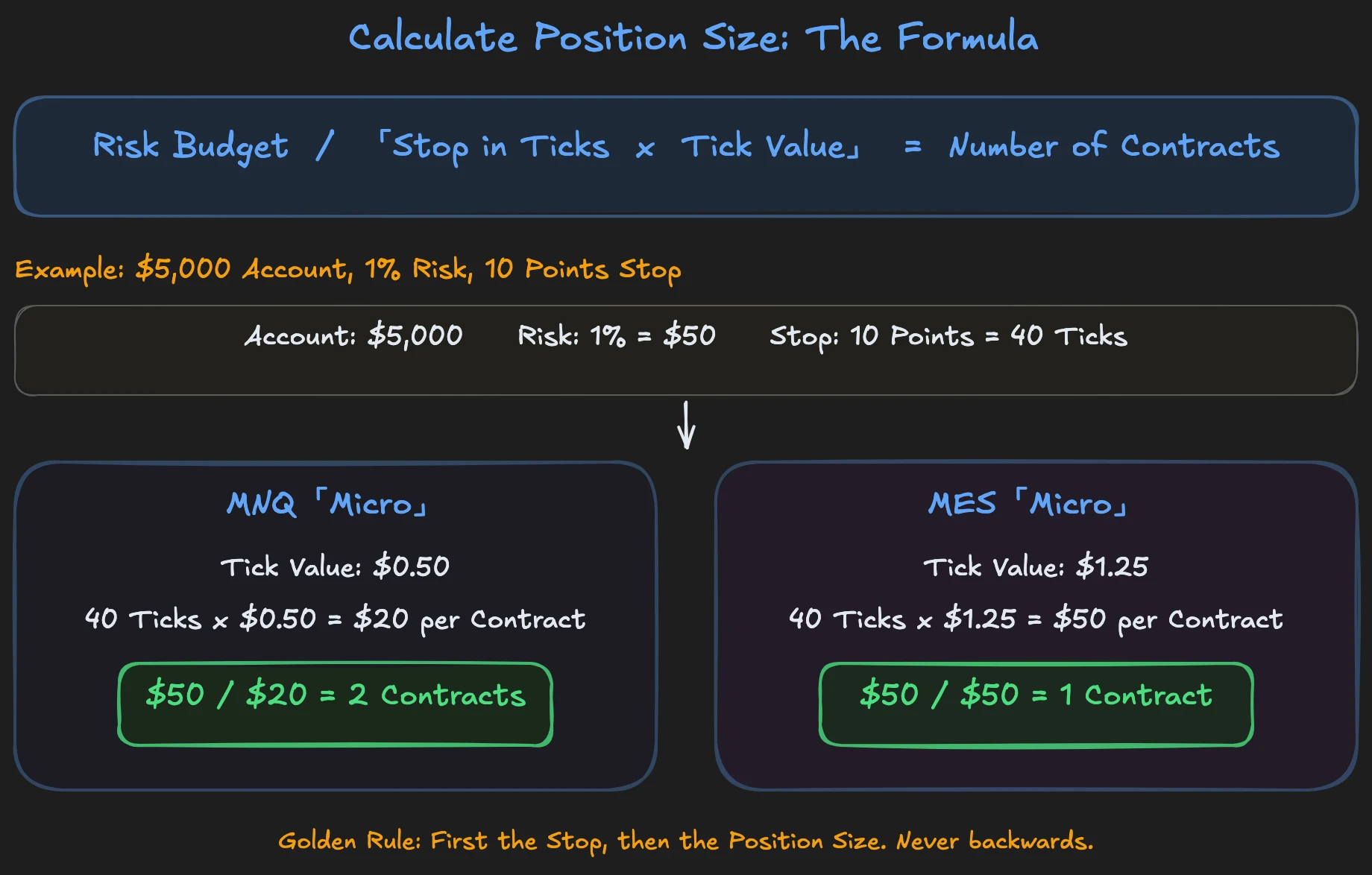
Step 3: Calculate number of contracts. The formula is simple:
Risk budget / (Stop in ticks x tick value) = Number of contracts
A concrete example: Your account has $5,000. You risk 1% per trade, so $50. Your stop is 10 points (40 ticks) from entry.
- MNQ: 40 ticks x $0.50 = $20 risk per contract. $50 / $20 = 2.5, rounded down to 2 MNQ contracts.
- MES: The same 10 points here are 40 ticks x $1.25 = $50 per contract. $50 / $50 = 1 MES contract.
Same trade, same risk budget, but different number of contracts depending on the instrument. With MNQ, you have finer gradations.
The golden rule: first the stop, then position size. Never the other way around. Never choose position size and then set the stop so far that it "fits." More on risk management in trading can be found in our separate guide.
Micro Futures as a Training Ground
Micro Futures are not just for beginners. They are the professional training ground for any trader who wants to test new strategies or markets without unnecessarily risking capital.
The decisive advantage: since Micros trade on the same exchange and track the same underlying, you can use the same analysis tools. Footprint Charts, Volume Profile and Big Trades are also applicable with Micros. However, note that the order flow data from Micros reflects their own order book — liquidity and market depth are lower than with E-minis. You learn with real market data, not a simulation.
The path typically looks like this: you start with one MNQ contract. You trade your setup, collect data, build consistency. If the results are right, you increase to 2 contracts. Then 3. Eventually you switch to NQ. The process is the same; only the size changes.
And scaling also works within a single trade. You start with one MNQ contract. If the trade is running and you can move your stop to break-even, you add a second contract. Your risk remains at zero on the first contract, and the second has its own, limited risk. This is how you build position size without risk, a principle that experienced traders with larger accounts also use.
FAQ: Micro Futures
Are Micro Futures suitable for beginners?
Yes, they were designed exactly for that. An MNQ tick costs $0.50. This gives you the opportunity to learn real trading, with real exchange data, real emotions and real risk, without a normal losing day destroying your account. Micro Futures are the ideal bridge from simulator to real trading.
Which Micro Future should I trade first?
MNQ or MES. If you want more movement per session, take MNQ. The Nasdaq-100 is more volatile and offers more opportunities for active day traders. If you prefer to start with less volatility, MES is the quieter alternative. At traMADA, we focus on NQ and MNQ because the volatility of the Nasdaq-100 opens more trading opportunities per day.
Can I do order flow trading with Micro Futures?
Yes, but with limitations. Micro Futures trade on the same exchange as E-minis and track the same underlying. Order flow trading with Micros is possible, however they have their own order book with less volume and lower market depth. Many order flow traders therefore use E-mini order book data as reference and trade Micros only as the execution instrument.
In our mentoring program, you'll learn these concepts in more than 900 video lessons with real chart examples. The Trader Framework course dedicates 8 lessons to money management alone, from position sizing calculation to strategic scaling.