
 By Marco Bösing
One-Way vs Two-Way Markets: Why Market Type Determines Your Strategy
Every trading session begins with a question that most traders never ask: is this a one-way market or a two-way market? The answer shapes everything, from position sizing to trade management. Getting it wrong means applying the wrong playbook to the wrong environment, and that alone can turn a profitable setup into a loss.
Risk Disclaimer: Trading futures and other financial instruments involves significant risk of loss. Past results are not indicative of future performance. Only trade with capital you can afford to lose.
In my experience, the single biggest improvement newer traders can make is learning to classify the market type within the first 30 minutes of the session. Once you know whether you are in a rotational environment or a directional one, every subsequent decision becomes clearer. This concept connects directly to the broader framework of auction market theory, where price discovery is driven by the continuous interaction of buyers and sellers.
What Separates Two-Way and One-Way Markets
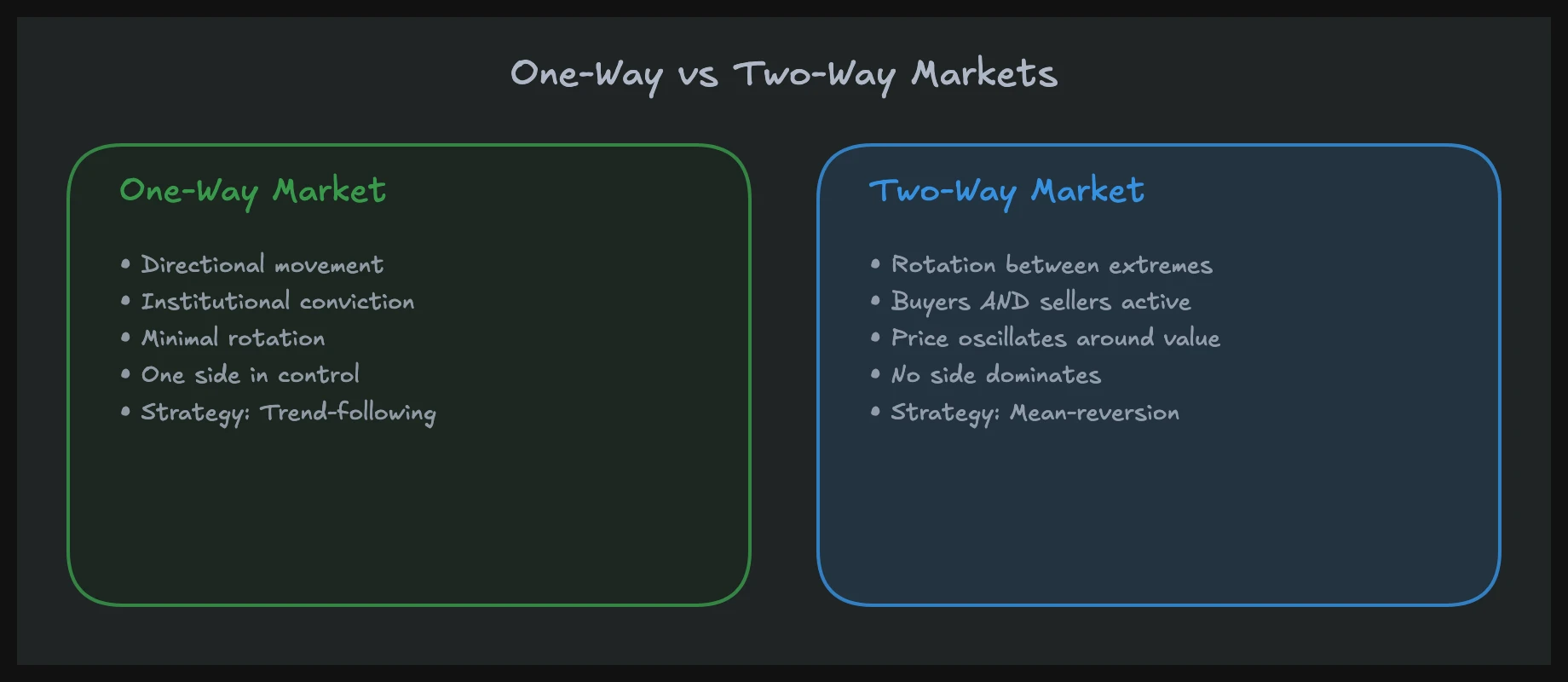
The distinction between two-way and one-way markets is not about whether price moves up or down. It is about participation. In a two-way market, both buyers and sellers are active and competitive. In a one-way market, one side has stepped away or been overwhelmed. The character of each environment is fundamentally different, and the strategies that work in one will fail in the other.
Two-Way Market: Rotation and Equilibrium
A two-way market is a rotational environment. Price moves in one direction, finds responsive participants, and rotates back. Buyers push price up into value, sellers respond at the upper edge, and the market rotates lower. Then buyers step in again near the lower edge. This back-and-forth creates a balanced, range-bound structure.
In the Nasdaq 100 futures (NQ), a typical two-way session might see price rotating within a 50 to 80 point range for most of the day. Volume concentrates in the middle of the range, and the VWAP stays relatively flat. Neither side is able to sustain directional movement because the opposing side remains engaged.
Two-way markets account for the majority of trading sessions. In my observation, roughly 60 to 70 percent of NQ sessions exhibit two-way characteristics for at least the first half of the day. Understanding this baseline is important because it means your default assumption should be rotation until the market proves otherwise.
The key to trading a two-way market is fading extremes. You sell at the upper boundary where sellers have historically responded and buy at the lower boundary where buyers step in. Patience matters more than conviction. The goal is not to catch a trend but to capture the rotation.
One-Way Market: One Side Dominates
A one-way market looks completely different. Price moves in a single direction with conviction. Pullbacks are shallow, brief, and immediately absorbed. One side of the market has either stepped away or is being overwhelmed by aggressive participation from the other side.
In NQ, a one-way session might see price drop 200 or 300 points from the open with almost no meaningful retracement. The aggressive sellers are hitting bids continuously, and buyers who attempt to step in get run over. Volume expands on the move, and there is no rotation back to equilibrium.
One-way markets are rarer but produce the largest moves. A single trend day in NQ can cover more ground than three or four rotational sessions combined. The challenge is that traders who default to fading extremes, the correct approach for two-way markets, will get crushed. Every attempt to buy the dip in a genuine one-way down market becomes a losing trade.
How to Identify Market Type Early
The sooner you can classify the market type, the sooner you can apply the right strategy. I rely on two primary tools in the first 30 minutes of the session: VWAP behavior and delta distribution.
VWAP Behavior in the First 30 Minutes
VWAP (Volume Weighted Average Price) is one of the most reliable indicators for identifying market phases early in the session. In a two-way market, price crosses VWAP frequently. It trades above for a few minutes, dips below, returns above. The VWAP itself stays relatively flat, and price orbits around it.
In a one-way market, price separates from VWAP early and stays on one side. If you see price open, move 30 points above VWAP within 15 minutes, and never return, that separation is a strong signal that buyers are in control. The VWAP begins to slope upward, and the distance between price and VWAP continues to grow.
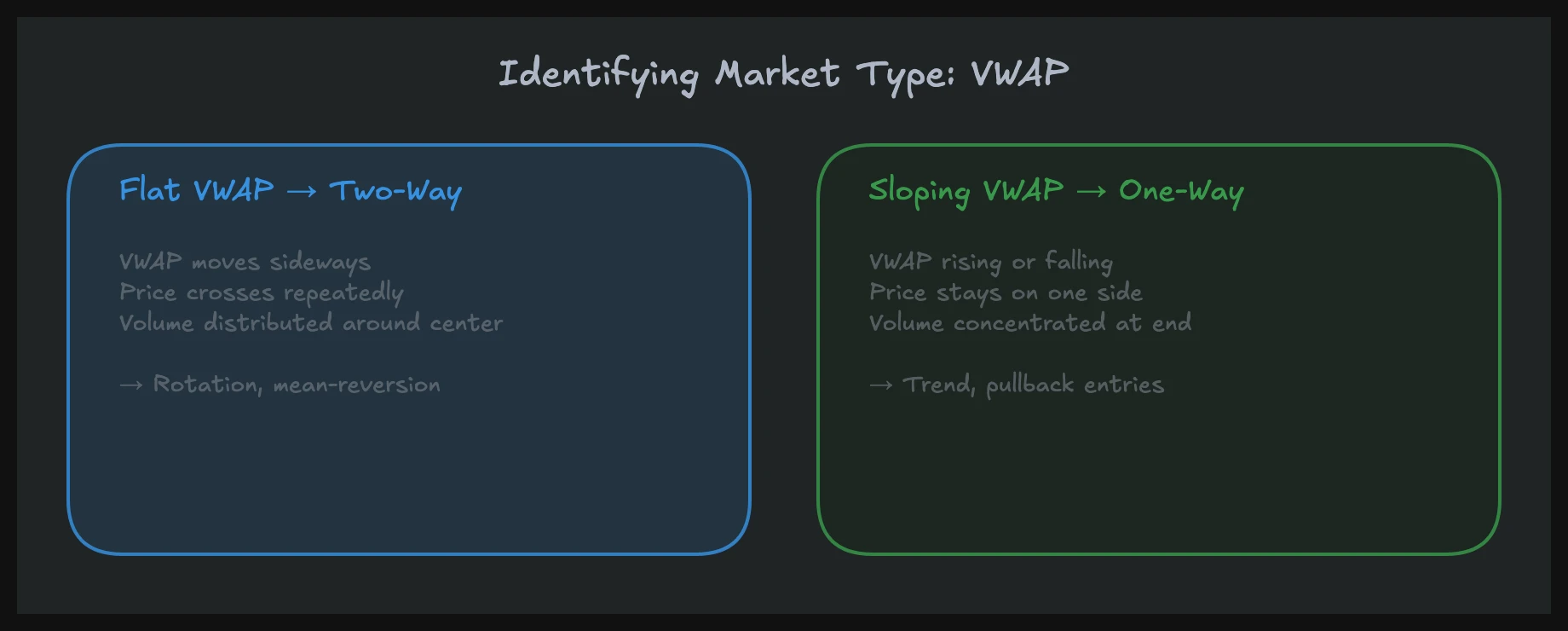
I pay close attention to the first VWAP test after the initial move. If price pulls back toward VWAP and bounces sharply, that confirms one-way behavior. Responsive buyers are defending the average price, and sellers are unable to push through. If price crosses VWAP and begins rotating on the other side, that suggests a two-way environment.
Delta Distribution and Failed Rotations
Order flow data provides a second layer of confirmation. In a two-way market, delta (the difference between market buy orders and market sell orders) oscillates. You see positive delta on up moves and negative delta on down moves, reflecting genuine two-sided participation.
In a one-way market, delta is persistently skewed. On a one-way up day, you will see strong positive delta on advances and mild negative delta on pullbacks. The sellers attempting to push price lower are using limit orders and small size, while buyers are aggressively lifting offers. The imbalance is visible in the cumulative delta, which trends consistently in one direction.
Failed rotations are another tell. In a two-way market, rotations complete. Price moves to one extreme, rotates to the other, and the cycle repeats. In a one-way market, rotations fail. Price pulls back 10 or 15 points, and before it can complete the rotation, aggressive participants push it back in the dominant direction. These failed rotations are among the best entry signals for joining a one-way move.
The Transition: From Two-Way to One-Way
The most profitable trading opportunity in market structure is catching the transition from a two-way market to a one-way market. This is the moment when a balanced, rotational session breaks down, and one side takes control.
Transitions often happen around specific catalysts: economic data releases, a break of the previous session's high or low, or an absorption event where one side builds a large position and then pushes aggressively. In NQ futures trading, these transitions frequently occur between 10:00 and 11:00 AM Eastern, after the opening rotation has played out.
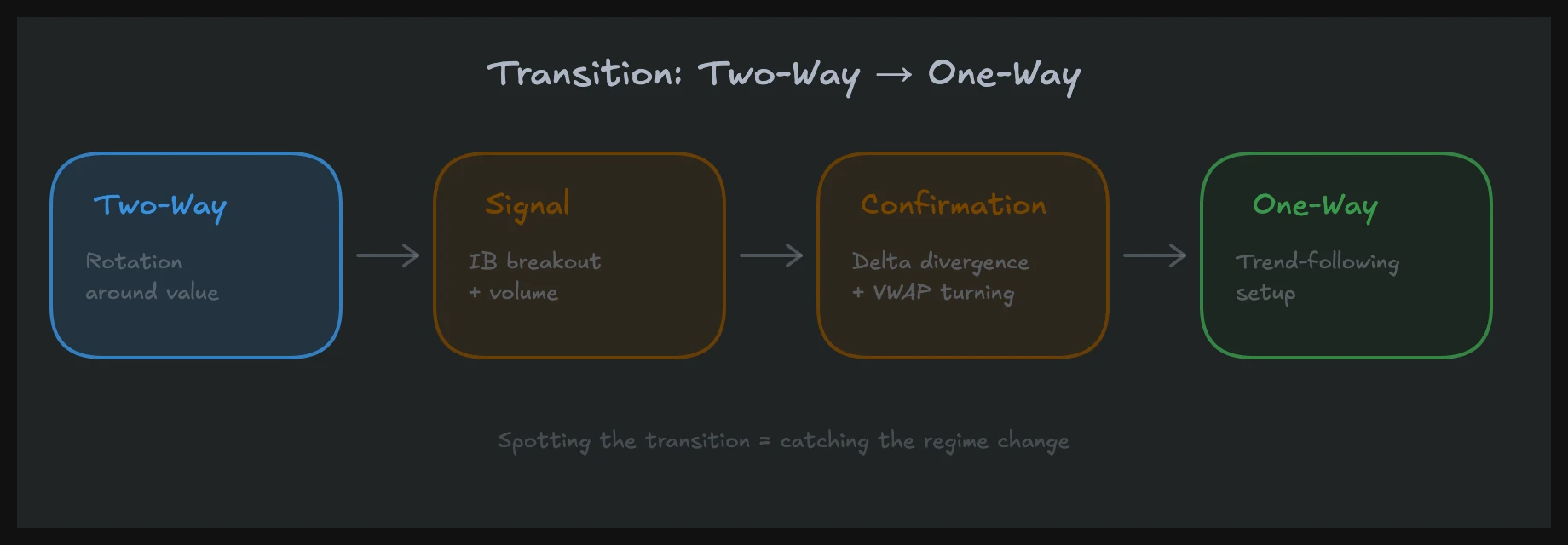
What I look for is a sequence. First, the market is rotating normally, building value in a defined range. Second, price approaches a boundary of that range and, instead of rotating back, accelerates through it on expanding volume. Third, the first pullback after the breakout is shallow, covering less than 30 to 40 percent of the breakout move, and is quickly absorbed.
When all three conditions are met, the transition is likely underway. The old two-way framework no longer applies. Fading is dangerous. The correct approach shifts to trend-following: joining pullbacks in the direction of the dominant move and holding positions longer than you would in a rotational environment.
Not every breakout leads to a genuine transition. False breakouts, where price pushes through a boundary and then rotates back into the range, are common. The difference is in follow-through. A real transition shows sustained volume expansion, persistent delta skew, and shallow pullbacks. A false breakout shows volume fading quickly and delta reversing.
FAQ: One-Way and Two-Way Markets
What is a one-way market?
A one-way market is a trading session where one side, either buyers or sellers, dominates the price action. Price moves directionally with shallow pullbacks and little meaningful rotation. These sessions produce the largest intraday moves and require trend-following strategies rather than mean-reversion approaches. One-way markets are less common than two-way sessions but account for a disproportionate share of daily range.
How do I trade a two-way market?
In a two-way market, the primary strategy is fading extremes. You identify the upper and lower boundaries of the rotation and trade toward the opposite boundary. Position sizing should be moderate because the expected move is limited to the range width. The key is patience: wait for price to reach an extreme where the opposing side has historically responded, then enter with a stop beyond the boundary. Avoid chasing breakouts in a two-way environment, as most boundary tests will result in rotation back into the range.
How can I tell if a market transition is real or a false breakout?
The most reliable signals are volume behavior and pullback depth. A genuine transition from two-way to one-way shows expanding volume through the breakout level, persistent delta in the breakout direction, and a first pullback that retraces less than 40 percent of the initial move. A false breakout typically shows volume fading immediately after the break, delta reversing, and price returning to the range within minutes. Watching how the market responds to its first pullback after the break is the single most useful confirmation technique.
In our mentoring program, you'll learn these concepts in over 1,500 video lessons with real chart examples.