
 By Marco Bösing
Prop Trading Taxes: How Funded Account Profits Are Taxed
Prop trading taxes affect all traders who trade with the capital of a prop firm. The 25% withholding tax doesn't apply because you're not using your own capital. Instead, progressive income tax applies, possibly trade tax, and the legal situation isn't conclusively clarified. This article explains how you correctly pay taxes as a prop trader in Germany, what you can deduct, and where the tax pitfalls lie.
Tax Disclaimer: This article is for general information purposes only and does not replace individual tax advice. Tax regulations can change and depend on personal circumstances. Always consult a qualified tax advisor before making tax decisions.
Why Prop Trading Isn't Capital Income
The most common mistake with prop trading taxes: treating the income like normal proprietary trading and paying 25% withholding tax. That's wrong, and the consequences can be expensive.
Capital income under § 20 EStG covers income from lending your own capital, such as dividends, interest, or disposal gains from your own securities.
In prop trading, that's not the case. You trade with a prop firm's capital and receive a profit share for your performance. You're not an investor letting your money work. You're providing a service: profitable trading. The payout is your compensation for that.
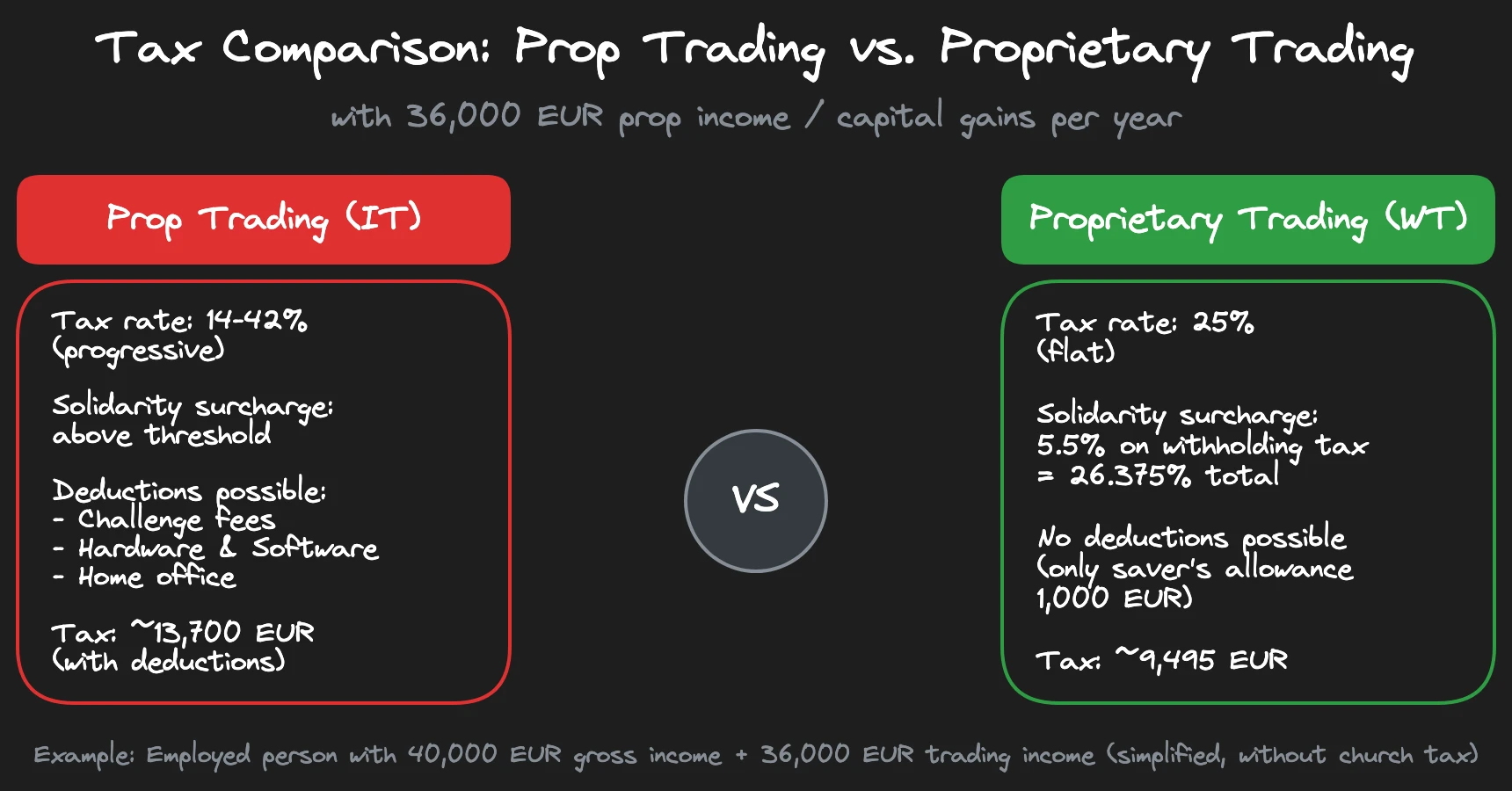
This sounds like a small difference, but has massive tax consequences. Withholding tax is flat: 25% plus 5.5% solidarity surcharge on it, giving 26.375% total burden (without church tax).
Prop trading income, on the other hand, is subject to the progressive income tax rate of 14% to 42% (top tax rate) or 45% (wealth tax from 277,826 euros taxable income).
With high income, you pay significantly more.
Those who nevertheless declare their prop trading income as capital income risk retroactive taxation at the correct income tax rate, interest on back payments under § 233a AO, and in the worst case, tax criminal proceedings under § 370 AO.
You can find a complete overview of all tax types in trading in our article on trading taxes in Germany.
Other Income or Business: The Two Options
If prop trading isn't capital income, then what? Here it gets complicated. There are two possible classifications, and neither is conclusively clarified.
Option 1: Other Income under § 22 No. 3 EStG
§ 22 No. 3 EStG is the catch-all provision for income from services that don't fall under any other income category.
The argument: You're not a business operator in the classic sense, but receive a profit share from an occasional or part-time activity.
The consequences with this classification:
- Progressive income tax (14% to 42%) plus solidarity surcharge
- No business license needed
- No trade tax
- No IHK obligation
- Income-related expenses are deductible (challenge fees, hardware, software)
For many prop traders, this is the more favorable option because trade tax is eliminated and administrative effort remains low.
Option 2: Commercial Income under § 15 EStG
The tax office can also classify prop trading as a commercial activity if certain criteria are met: Independence, sustainability (you trade regularly), profit-making intention (obviously given), and participation in general economic traffic.
The consequences with this classification:
- Progressive income tax (14% to 42%) plus solidarity surcharge
- Business license required
- Trade tax (partially creditable against income tax)
- Mandatory IHK membership
- In return: full deduction of business expenses
Trade tax initially sounds like a disadvantage, but is credited against income tax with four times the trade tax assessment amount according to § 35 EStG. At a rate of up to 400%, this results in no additional burden from trade tax.
In most municipalities, this results in only a moderate additional burden. However, IHK contributions and administrative effort for the business license are added.
Why the Classification Is Unclear
There's no BFH case law and no administrative instruction that specifically deals with the model of online prop firms. The concept (pass challenge, get funded account, collect profit share) has only existed in this form for a few years. Tax offices decide differently. Some accept § 22, others insist on § 15.
"I recommend every prop trader to clarify the classification proactively with the tax office before surprises happen. A binding ruling under § 89 AO through a tax advisor gives you planning certainty."
— Marco Bösing, founder of traMADA
What You Can Deduct as a Prop Trader
Regardless of whether your income is classified as other income or as business: You can deduct occupation-related expenses. Under § 22 as income-related expenses, under § 15 as business expenses. The deductible items are similar in both cases:
- Challenge fees: Even failed challenges are deductible. The fee is directly connected with generating income.
- Hardware: Trading computer, monitors, peripherals. For acquisition costs up to 800 euros net, immediate depreciation as a low-value asset (GWG) is possible, above that it's depreciated over the useful life.
- Software: Trading platform, data feeds, order flow tools, charting software.
- Internet and telephone: Proportionally, to the extent used for business.
- Home office: If the requirements are met (enclosed room, used almost exclusively for business, office-typical equipment). If the home office forms the center of your activity, the actual costs are fully deductible.
- Further education and professional literature: Courses, books, seminars with direct relation to trading.
The big advantage over proprietary trading: As a private investor with capital income, you can practically deduct nothing with withholding tax, only the saver's allowance of 1,000 euros (2,000 euros for joint assessment). No PC, no software, no home office.
As a prop trader, everything occupation-related is deductible. This can significantly reduce the effective tax burden.
Practical Example: Tax Calculation as a Prop Trader
Let's take a simplified scenario: You're employed and have a taxable income of 40,000 euros from your employment. On the side, you earn 3,000 euros monthly as a prop trader (36,000 euros per year).
Your total taxable income is around 76,000 euros. From a taxable income of 69,879 euros (2026), the top tax rate of 42% applies.
Calculation without deductions (simplified):
- 36,000 euros prop income at the marginal tax rate of approximately 42%
- Income tax on prop income: approximately 15,120 euros
- Solidarity surcharge: possibly eliminated by the exemption threshold (2026: 20,350 euros assessed income tax)
- Effective burden: approximately 15,120 euros (42% on prop income)
Calculation with deductions:
- 3,000 euros challenge fees (three challenges at 1,000 euros)
- 2,000 euros hardware and software
- Taxable prop income: 31,000 euros
- Tax: approximately 13,020 euros
- Effective burden: approximately 36.2% on the original 36,000 euros
For comparison: If you earned the same 36,000 euros as a private investor with your own capital, withholding tax would be 9,495 euros (26.375% including solidarity). That's over 3,500 euros less.
The bitter realization: Prop trading is tax-wise more expensive the more you earn elsewhere. Those who already have a high salary pay the top tax rate on prop income. With low or no other income, the progressive rate can even be more favorable than withholding tax. This is part of the overall calculation you should consider when deciding between prop trading and your own capital.
The GmbH Question for Prop Traders
Can a GmbH operate prop trading? Yes, but with restrictions. The GmbH signs a contract with the prop firm, payouts go to the company, and profit is taxed in the GmbH at around 30% (approximately 15% corporate tax plus approximately 15% trade tax at an average rate).
The retention advantage also applies here: Profits that remain in the GmbH and are reinvested grow without additional tax burden. On withdrawal via salary or distribution, tax applies again (25% capital gains tax on distribution).
But the complexity is considerable. You need at least 25,000 euros share capital (of which at least 12,500 euros to be paid in on formation), a tax advisor, ongoing bookkeeping, and must clarify whether the prop firm even works with a GmbH as a contract partner.
My assessment: The GmbH isn't a first solution for prop traders. It only makes sense with very high, stable prop income and if you simultaneously want to build capital in the company. For most prop traders, individual taxation (whether § 22 or § 15) is the more pragmatic path. Details on formation and the honest calculation can be found in our article on starting a trading company in Germany.
FAQ: Prop Trading Taxes
Do I Have to Register a Business as a Prop Trader?
That depends on the classification by your tax office. With other income under § 22 No. 3 EStG, you don't need a business license. With commercial income under § 15 EStG, you do. Since there's no unified line, you should clarify the question proactively before the tax office decides for you. A tax advisor can request a binding ruling under § 89 Abs. 2 AO from the tax office.
Can I Deduct Failed Challenge Fees?
Yes. Challenge fees are directly related with generating income and are deductible as income-related expenses (under § 22) or business expenses (under § 15). This also applies to challenges you didn't pass. Keep all receipts and payment records carefully. An overview of the various prop firms and their challenge costs can be found in our prop trading firms comparison.
Do I Pay Trade Tax as a Prop Trader?
Only if the tax office classifies your activity as commercial (§ 15 EStG). With other income (§ 22 No. 3 EStG), no trade tax applies. If trade tax does apply, it's credited against income tax with four times the assessment amount under § 35 EStG, which completely neutralizes trade tax at rates up to 400%. The actual additional burden is therefore moderate in most cases. Good risk management of your finances helps you keep tax burden in view.
Our Tax & Finance module with 4 lessons explains the differences between private individuals and GmbH structures in detail, from correct classification to deductibility to the GmbH question. At tra-mada.de/en, you'll find the module alongside more than 900 video lessons from institutional traders.