
 By Marco Bösing
Starting a Trading Company in Germany: When Does a GmbH Make Sense?
Starting a trading GmbH sounds like the ultimate tax trick. YouTube videos promise massive savings, tax advisors advertise optimization models, and in every trading community the GmbH is discussed as the solution for everything. The reality: For the majority of traders, a GmbH is more expensive, not cheaper. But for those who understand retention and cost deduction, it can bring a significant long-term advantage. You can find a complete overview of all tax options for traders in our article on trading taxes in Germany. Here we'll discuss the honest calculation for a GmbH.
Tax Disclaimer: This article is for general information purposes only and does not replace individual tax advice. Tax regulations can change and depend on personal circumstances. Always consult a qualified tax advisor before making tax decisions.
Private vs GmbH: The Tax Comparison
As a private trader, you pay withholding tax: 25% plus solidarity surcharge (5.5% on the tax), altogether about 26.375%.
Flat, simple, done. The downside: As a private individual, you can't deduct income-related expenses beyond the saver's allowance (1,000 euros): no PC, no data feeds, no office.
Tax is due on the entire profit, no ifs or buts.
A GmbH pays corporate tax (15%) plus solidarity surcharge on it (0.825%) plus trade tax (approximately 14% at an average rate of 400%), so together around 30%.
At first glance, that's already more than private withholding tax. And it gets worse: If you want to withdraw money from the GmbH, you pay on top. Via salary, your personal income tax rate applies (top tax rate 42%, from 277,826 euros taxable income even 45%).
Via a profit distribution, another 25% capital gains tax plus solidarity surcharge is added, so approximately 26.375%.
| Private | GmbH (Distribution) | |
|---|---|---|
| Tax rate on profits | 26.375% (withholding tax + soli) | ~30% (KSt + GewSt) |
| Additional tax on withdrawal | none | 26.375% on distribution |
| Income-related expenses deductible | no (only 1,000 EUR allowance) | yes, in full |
| Effective total burden (on withdrawal) | ~26.4% | ~48.5% |
"If you're only thinking trading and want to get the money out, you can generally say it's better to stay private."
— Marco Bösing, founder of traMADA
Why do traders set up a GmbH at all? Because under certain conditions, the calculation turns completely around.
When a Trading GmbH Makes Sense
There are three scenarios where the GmbH wins. And all three have nothing to do with the tax rate itself.
Retention: Leaving Profits in the Company
Retention means: You leave the profits in the GmbH. The approximately 30% tax (corporate tax + trade tax) is due on the trading profit, but after that the capital remains in the GmbH and can be reinvested without capital gains tax or solidarity surcharge accruing again with every reallocation. The tax burden on distributions only arises when you actually withdraw the money.
Over long periods, the compound interest effect unfolds here with full force. Imagine you reinvest your trading profits in the GmbH, for example in stocks or ETFs. Over 20 or 30 years, this capital grows considerably stronger than privately, where 26.375% is deducted from realized profits every year. The GmbH pays approximately 30% once on the trading profit and lets the rest work. That's not a marginal difference, over decades it's a massive wealth advantage.
I'll say it clearly: The GmbH is a long-term vehicle. Those who leave their trading profits in the company and reinvest build wealth in a way that's simply not possible privately.
Cost Deduction: What You Can't Deduct as a Private Individual
As a private trader, you can practically deduct no costs from your trading profits.
In a GmbH, it looks completely different. Deductible are among others:
- PC, monitors, and hardware
- Data feeds and software subscriptions
- Electricity, internet, and telephone (proportionally)
- Office or home office
- Company car
- Further education and training
- Business meals
Those who have 2,000 to 3,000 euros in deductible costs per month reduce their tax base considerably. With 10,000 euros profit and 2,500 euros costs, you only pay tax on 7,500 euros in the GmbH, that's 2,250 euros instead of 3,000 euros. In combination with retention, the GmbH suddenly becomes cheaper than private taxation.
Products and Legal Certainty
A GmbH is considered a professional market participant. This opens access to products that aren't available to EU retail investors, for example US ETFs like the SPY, which are blocked for private individuals in Europe due to the PRIIPs regulation (EU Regulation No. 1286/2014).
Added to this is an aspect that many underestimate: Legal certainty. In 2021, the legislator introduced a loss offset limitation for derivatives with the Annual Tax Act 2020 (§ 20 Abs. 6 Satz 5 EStG) that only affected private traders. GmbHs weren't affected by this. The BFH declared this limitation unconstitutional in 2024, and it was abolished with the Annual Tax Act 2024, but the example shows: Tax changes hit private individuals faster and harder than corporations.
The GmbH also offers liability separation. Your private assets are separated from business risk. According to § 13 Abs. 2 GmbHG, only the company's assets are liable for the company's obligations, not your private assets.
The Honest Calculation: An Example
Let's take 10,000 euros monthly trading profit and calculate through four scenarios.
| Scenario | Taxes | Net | Assessment |
|---|---|---|---|
| Private | 26.375% on 10,000 EUR | approx. 7,362 EUR | Simple, immediately available |
| GmbH, pay everything out | 30% KSt/GewSt + 26.375% on distribution | approx. 5,154 EUR | Significantly worse than private |
| GmbH with costs (2,500 EUR) | 30% on 7,500 EUR + optimized salary | approx. 7,250 EUR | Close to private scenario |
| GmbH with retention | 30% once, then reinvested tax-free | 7,000 EUR in the GmbH | Optimal long-term |
Scenario 1, Private: 26.375% withholding tax on 10,000 euros. Net: approximately 7,362 euros. Simple, clear, immediately available.
Scenario 2, GmbH, pay everything out: Approximately 30% corporate and trade tax on 10,000 euros = approximately 3,000 euros taxes. 7,000 euros remain in the GmbH. On distribution, another approximately 26.375% capital gains tax on the 7,000 euros = approximately 1,846 euros. Net: approximately 5,154 euros. Significantly worse than private.
Scenario 3, GmbH with costs: 2,500 euros deductible costs. Tax base: 7,500 euros. Taxes: approximately 2,250 euros. 5,250 euros remain plus 2,500 euros already used costs. With clever salary optimization, the result approaches the private scenario.
Scenario 4, GmbH with retention: 7,000 euros after taxes remain in the GmbH and are reinvested. No further tax on distributions as long as nothing is withdrawn. Over years and decades, this capital grows with the full compound interest effect.
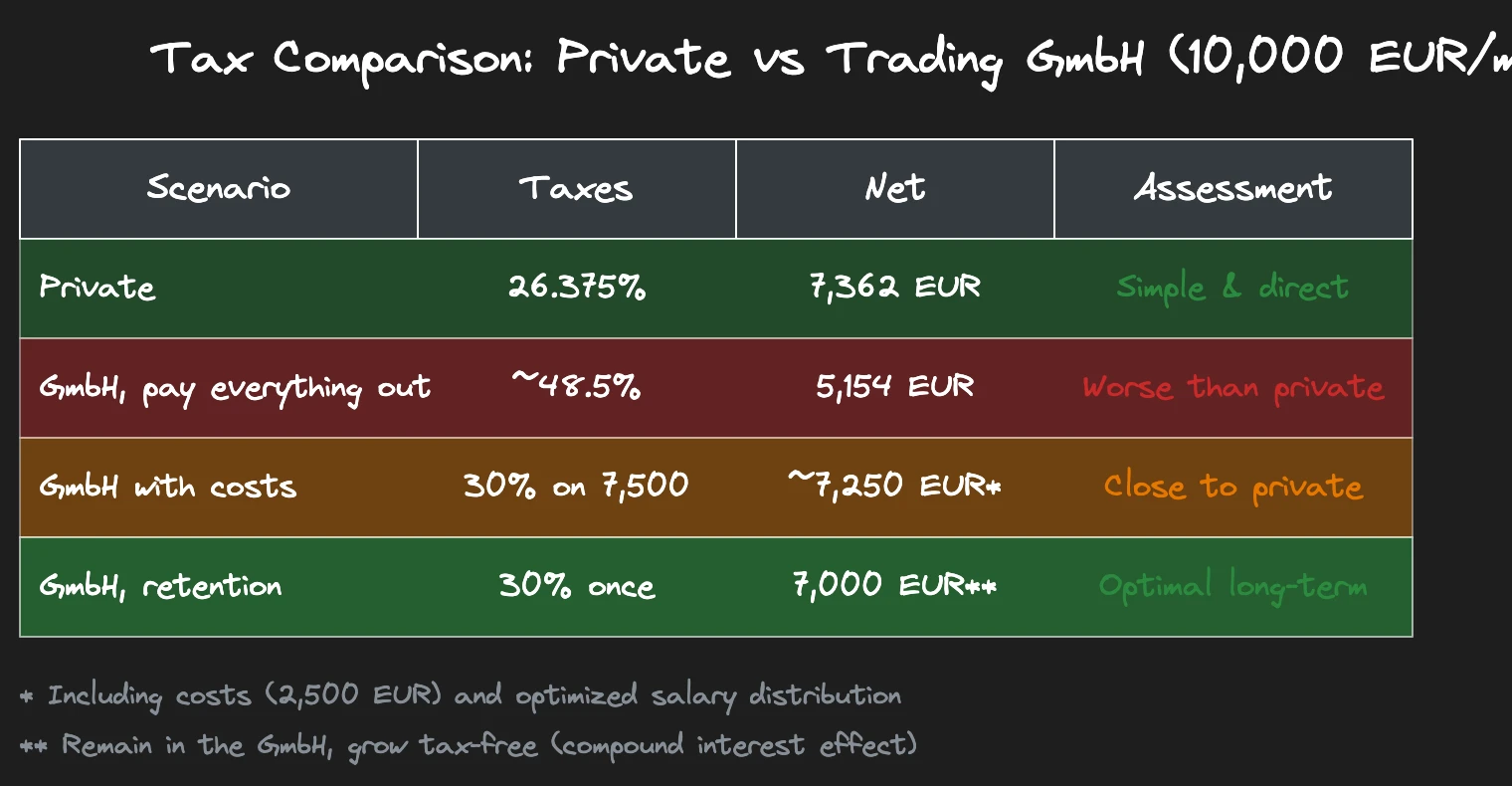
The core message is clear: A trading GmbH only makes sense if you don't withdraw everything. Those who need their entire income do better privately.
What You Need for Formation
Setting up a GmbH isn't a weekend project. You need:
- Share capital: 25,000 euros (§ 5 Abs. 1 GmbHG), of which at least half (12,500 euros) must be paid in upon registration with the commercial register (§ 7 Abs. 2 GmbHG)
- Tax advisor with trading experience: Not optional. The tax pitfalls are too complex for do-it-yourself
- Corporate purpose: Must be cleanly defined. "Proprietary trading in financial instruments" can be questioned by the tax office
- Bookkeeping: Double-entry bookkeeping (§ 238 HGB) and annual financial statements are mandatory
- IHK membership: Mandatory membership as a GmbH according to § 2 IHKG
- Ongoing costs: Tax advisor, bookkeeping, IHK, expect 200 to 500 euros per month
"Under no circumstances on your own."
— Marco Bösing, founder of traMADA
Without a tax advisor who knows trading, you risk expensive mistakes during formation and ongoing operations.
Minimum: 10,000 euros monthly profit to justify the ongoing costs. Better is 20,000 to 30,000 euros. Below that, the GmbH's fixed costs eat up the tax advantage.
The Most Common Mistakes with a Trading GmbH
Setting up a GmbH before being profitable. The GmbH is the long-term goal, not the starting point. Those who aren't yet trading consistently profitably burn money for bookkeeping and tax advisor without value. Start private, build your trading, and switch only when profits are stable and high enough.
Paying everything out instead of retaining. The biggest advantage of the GmbH, retention, only works if you leave profits in the company. Those who withdraw every euro effectively pay more taxes than privately.
Setting up without a tax advisor. The combination of corporate tax, trade tax, salary optimization, and distribution strategy is complex. A mistake during formation or in ongoing bookkeeping can be expensive.
Underestimating ongoing costs. Tax advisor, bookkeeping, IHK contributions, possibly a business account, these costs run regardless of whether you're profitable in a month or not.
FAQ: Starting a Trading GmbH
From What Profit Does a Trading GmbH Make Sense?
As an absolute minimum, 10,000 euros monthly profit applies, better is 20,000 to 30,000 euros. Important is that profits are consistent, because a single good month doesn't justify a GmbH. Fixed costs run every month, regardless of the result. A comprehensive overview of all tax options for traders is in our article on trading taxes in Germany.
Can I Use a GmbH as a Prop Trader?
That's a special case. Prop trading income is taxed differently than profits from proprietary trading. The GmbH structure can work here, but brings additional questions. More on this in our article on prop trading taxes.
Do I Need a Tax Advisor for the Trading GmbH?
Yes, no discussion. The combination of corporate tax, trade tax, loss offset, distribution strategies, and retention is too complex to implement correctly without professional help. Make sure to find a tax advisor who has experience with trading and futures, because not every tax advisor knows the peculiarities of financial instruments.
Our Tax & Finance module at traMADA covers the trading GmbH in four dedicated lessons, from decision-making to tax calculation to concrete implementation. At tra-mada.de/en, you'll find the module alongside more than 900 video lessons from institutional traders.