
 By Marco Bösing
Spotting Big Trades: When Large Players Enter the Market
Big Trades are unusually large orders that show where institutional market participants are actively intervening in the market. While normal retail orders get lost in the noise, these trades leave visible traces in the Order Flow. If you can read them, you see what's really happening behind price movement.
Risk Warning: Trading futures and other financial instruments carries significant risk of loss. Past performance is not indicative of future results. Only trade with capital you can afford to lose.
What Big Trades Are and Why They Matter
Big Trades are aggressive market orders that exceed a defined size filter. Instead of looking at every single order, you filter out the noise and only see the trades where someone is building or closing a position with real capital. At their core, Big Trades are nothing more than the aggressive side of order flow with a size filter.
In the chart, they are displayed as colored marks: green prints show Ask Trades (aggressive buyers, i.e., Market Buys), red prints show Bid Trades (aggressive sellers, i.e., Market Sells). The size of the mark reflects the volume: the larger the marker, the larger the order behind it.
Why is this relevant? Your own two or four contracts don't move the market at all. But when someone is active at a certain level with a multiple of that, it has meaning. At professional desks, people work with order flow. Big Trades are the tool to make this institutional activity visible.
One important detail: Big Trades show aggregated data. The size filter doesn't necessarily refer to a single order, but to the total volume at a price within a short time window. A cluster of several dozen contracts may come from a single order or from multiple quickly successive orders.
The Two States: Confirmation and Trap
A Big Trade alone doesn't tell you where the market is going. What matters is what happens after. There are exactly two possible states, and both provide actionable information.
Confirmation: When Big Trades Move the Market
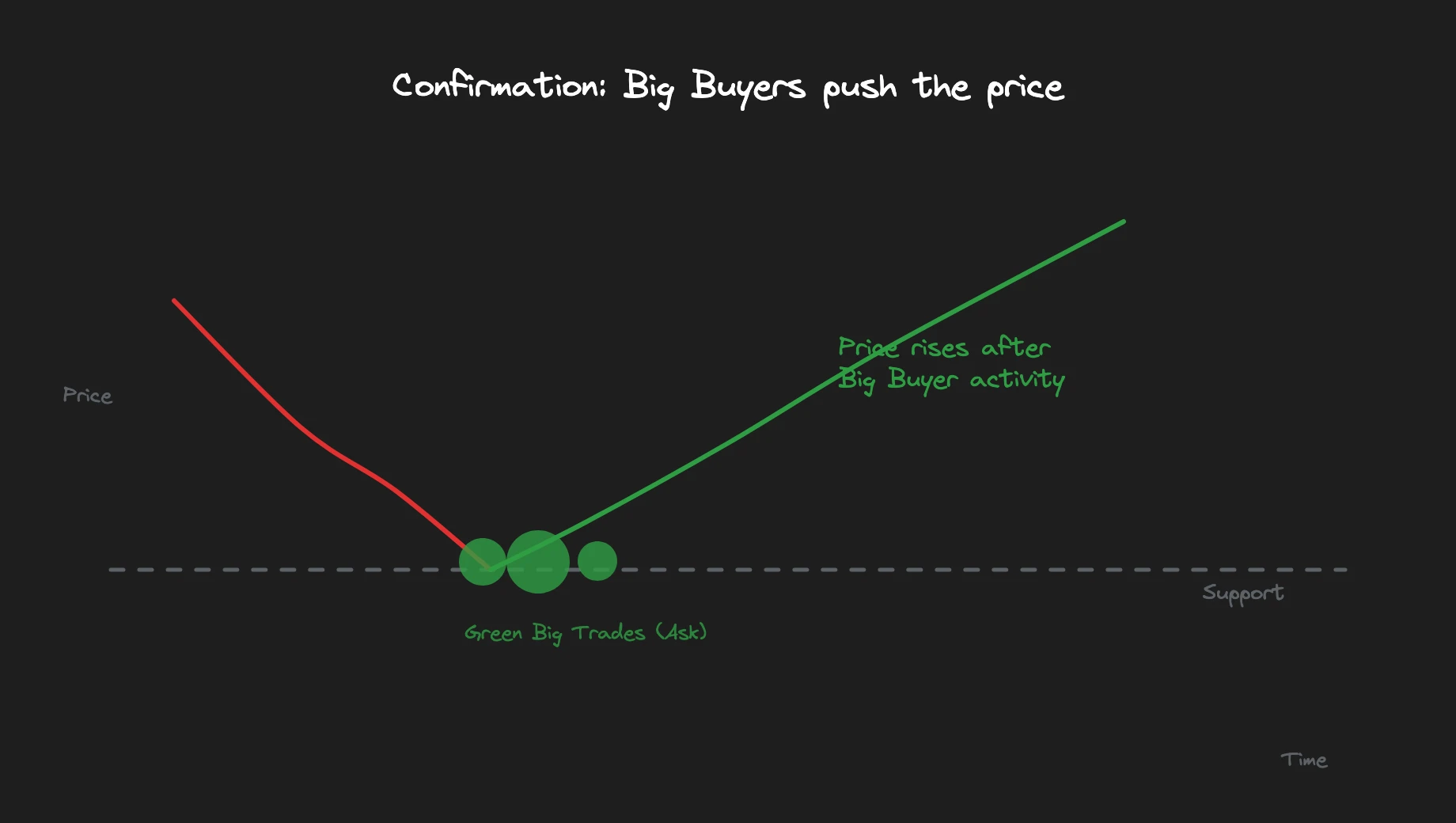
The first state is confirmation. A large buyer appears and price rises. Or a large seller appears and price falls. The aggressive side manages to push price in their direction.
In practice, it looks like this: several green Big Trades appear at a support level. Price reacts immediately, turns upward and defends the level. That's confirmation. Institutional buyers are active and successful.
With confirmed Big Trades, you can trade in their direction. Your stop-loss belongs just behind the Big Trade because if those contracts are no longer being defended, your thesis is invalid. The large market participants are behind you, they should defend the level. If they don't, you're out.
Trap: When Big Trades Fail
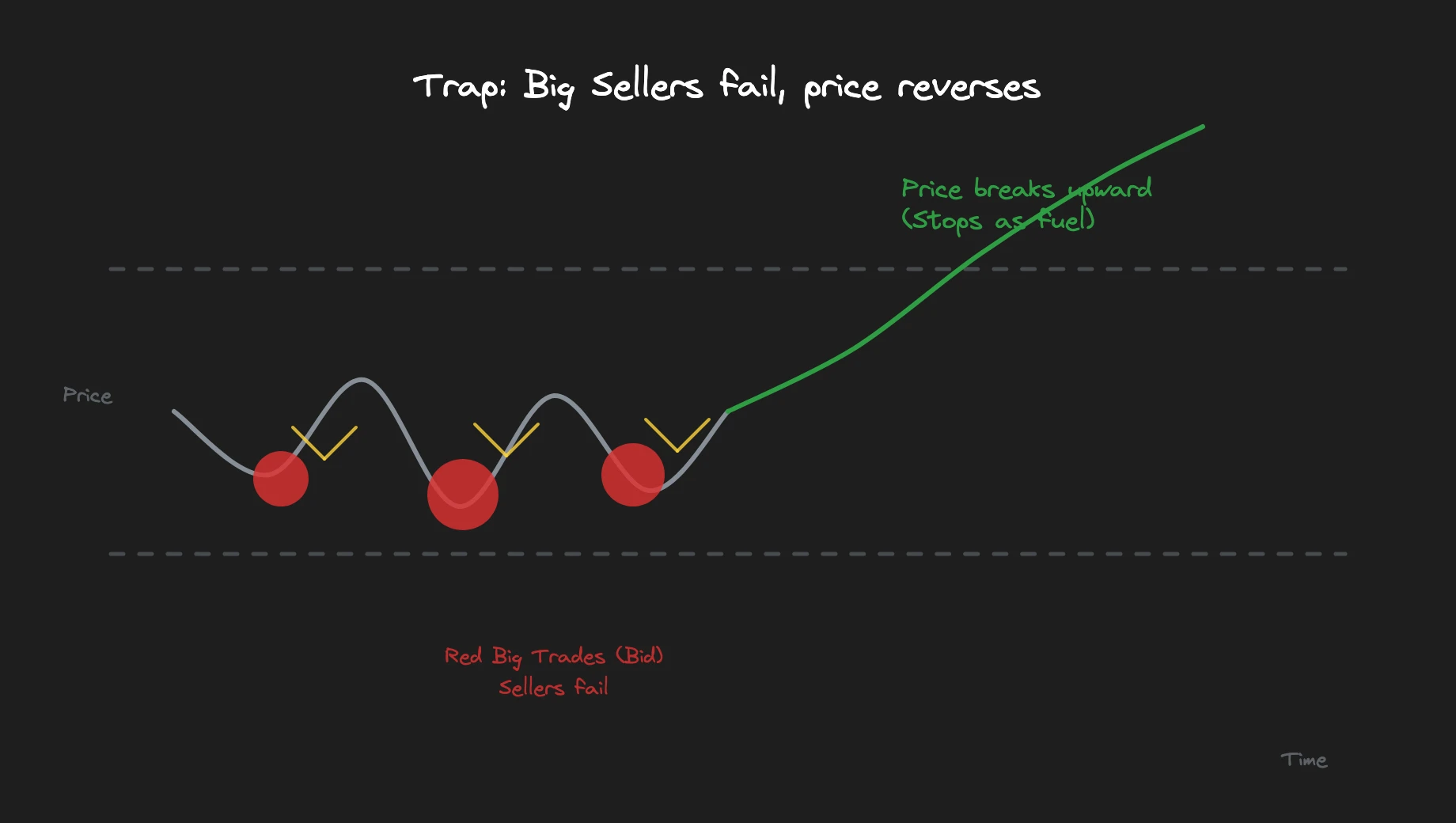
The second state is the Trap, and it is actually the more profitable one. A large seller appears but price doesn't fall. Or a large buyer appears but price doesn't rise. The aggressive side fails. This is called Failed Orderflow.
Why is this so valuable? When massive sell orders can't push price down, the question becomes: what could possibly make price fall then? The answer: probably nothing. Someone is absorbing these sell orders with passive limit orders on the opposite side. The sellers aren't getting through.
But it gets better. The trapped traders now sit on a losing position. Eventually their stop-losses get triggered. And a stop-loss of a short is a Market Buy, which means additional buying pressure. The stops of trapped sellers become fuel for your long position. This principle is also the foundation of Stop Runs.
That's why Trap situations are often better than confirmations: the confirmed Big Trades don't bring additional pressure. But the ones that fail create even more momentum in the opposite direction through their stops. Failed Orderflow is more informative than successful order flow.
Reading Big Trades Correctly: What Matters
Seeing Big Trades is one thing. Interpreting them in the correct context is another. Without a clear framework, Big Trades lead to constantly changing direction and ultimately just collecting losses.
Big Trades Are Confirmation, Not Signal
This is the most important principle. You first need a thesis for where the market could go. Then you use Big Trades to confirm or reject this thesis. Like with Footprint Charts: order flow confirms, it doesn't dictate direction.
If you blindly follow every Big Trade, you'll go long on every green print and short on every red. The result is constant direction changes and a miserable hit rate. Waiting for confirmation and understanding the context, that's the recipe for success.
Context and Location Determine Relevance
A Big Trade in the middle of a trendless movement says little. A Big Trade at a key level, a notable zone in the Volume Profile or at VWAP tells you a story. Location provides the context, Big Trades provide the confirmation. Anyone who deals with risk management knows: without clear context, there is no good setup.
Imagine the market is falling to a known support level. There, large red prints appear (sellers wanting to push price lower). But price reverses and runs upward. That's a Trap at a relevant level: two pieces of information that fit together and make a clear statement.
The "Too Big To Fail" Strategy
From this principle of failed Big Trades, a strategy was developed: Too Big To Fail. The idea: you identify a sideways phase (range), observe how large market participants repeatedly try to break out of this range and fail. Their stops become the catalyst for the counter-movement.
The strategy is deliberately beginner-friendly and combines range recognition with Big Trade analysis and cumulative delta. It is part of our live trading module and one of the first steps our members take to implement real order flow trades.
FAQ: Big Trades in Order Flow
From what size is a trade a Big Trade?
That depends on the product and market conditions. In quiet phases, a lower threshold suffices; on volatile days, the filter needs to be set higher because there is generally more volume in the market. There is no fixed value that always works. Often you can estimate before market open whether it will be a quiet or extreme day, and the filter is adjusted accordingly. The exact calibration is part of our mentoring program.
Can I see Big Trades with any software?
No. You need order flow-capable software with access to real-time exchange data. The most common platforms for this are ATAS and Bookmap, both used in our curriculum. Standard charting tools like TradingView or MetaTrader cannot display this level of detail because they lack direct access to exchange data or only show aggregated volume data. A detailed comparison of platforms can be found in our Order Flow Software Comparison.
How do I distinguish a Trap from delayed confirmation?
The key is price reaction. A Big Trade that doesn't move price is immediately visible: price stalls or moves in the opposite direction. Delayed confirmation shows itself by price hesitating but then moving in the direction of the Big Trade. The boundary between the two isn't always sharp. That's why you never work with just a single Big Trade but look for clusters and patterns that create a clear picture.
In our mentoring program, you'll learn these concepts in more than 900 video lessons with real chart examples. The NQ Masterclass dedicates 5 lessons to Big Trades alone, and our "Too Big To Fail" strategy is the perfect introduction to live trading.