
 By Marco Bösing
Tape Reading: How to Read Time & Sales and Level 2 Data
Tape reading is the skill of interpreting raw market data in real time by watching executed trades on the Time & Sales window and resting orders on the Level 2 display. It is the oldest form of order flow analysis, dating back to Jesse Livermore reading ticker tape in bucket shops, and it remains one of the most powerful ways to understand who is doing what at any given price.
Risk Disclaimer: Trading futures and other financial instruments involves significant risk of loss. Past results are not indicative of future performance. Only trade with capital you can afford to lose.
What Time & Sales and Level 2 Actually Show You
Before diving into interpretation, it helps to understand what each data stream represents.
Time & Sales (T&S) is a record of every executed trade. Each line shows the time, price, size, and whether the trade was executed at the bid or at the ask. When a trade prints at the ask, it means a buyer lifted the offer with a market order, which is an aggressive buy. When a trade prints at the bid, a seller hit the bid with a market order, which is an aggressive sell. T&S does not show you intentions or resting orders. It shows you completed transactions, the actual commitment of capital.
Level 2 / DOM (Depth of Market) shows the resting limit orders on both sides of the market. You see how many contracts are sitting at each price level above and below the current market. These are passive orders placed by traders who are willing to wait for their price rather than pay the spread.
Together, these two streams give you something no indicator can replicate: a real-time view of supply and demand as it unfolds. T&S tells you what already happened. Level 2 tells you what might happen next. The combination is where real edge lives.
In our NQ Masterclass, we dedicate an entire module to DOM reading for liquidity analysis, because understanding these raw data streams is foundational to everything else in order flow trading.
Reading Time & Sales: Large Prints, Speed, and Clusters
When I first started tape reading, I made the mistake of trying to read every single print. That is impossible on something like NQ, where thousands of contracts trade per minute during active sessions. The key is knowing what to filter for.
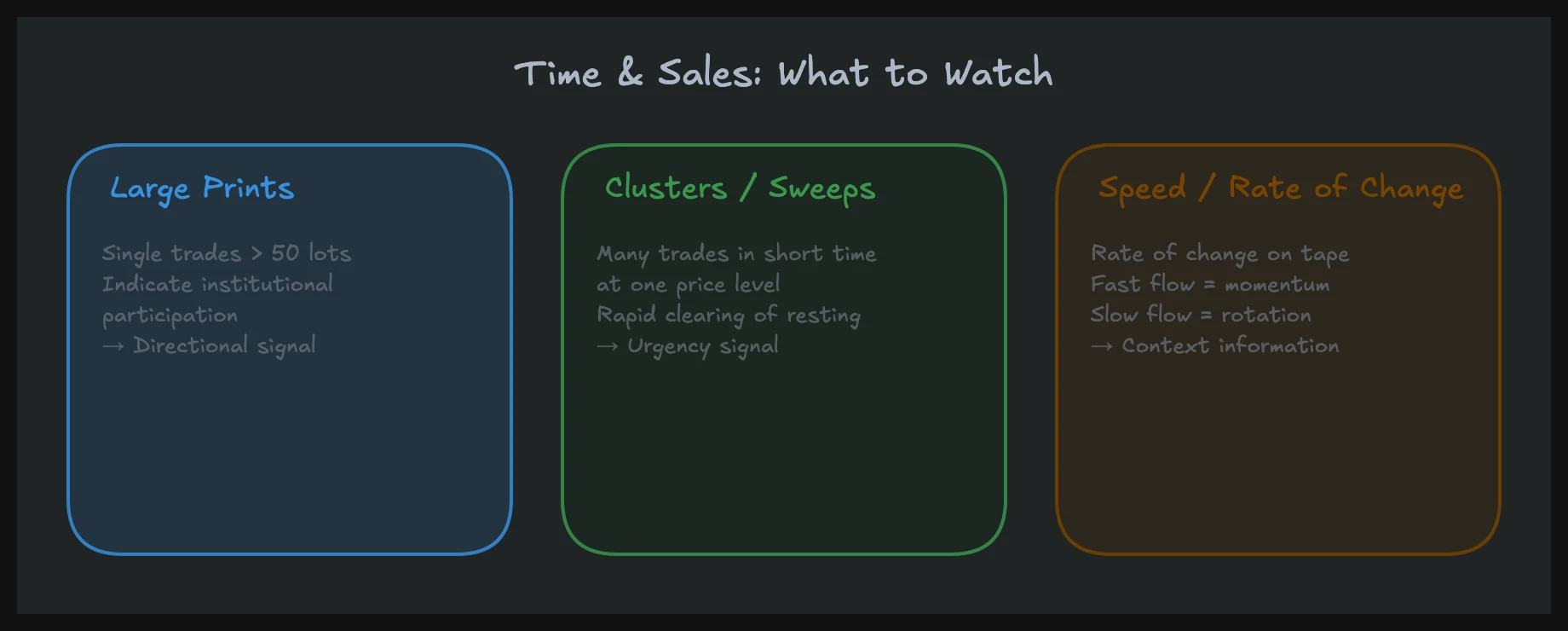
Large prints are the most obvious signal. On ES, a single print of 200+ contracts stands out. On NQ, 50+ contracts at a single price is noteworthy. These large prints often represent institutional execution. When you see a cluster of large prints all hitting the bid at the same price, that is aggressive selling pressure from a participant with real size.
Speed and acceleration matter just as much as size. A sudden burst of rapid prints on the ask side, even if each individual print is only 5-10 contracts, tells you buyers are getting urgent. They are willing to pay up, and they are doing it fast. This acceleration often precedes a move. Conversely, when the tape slows down at a key level, it can signal exhaustion.
Clusters at price reveal where the real battle is happening. If you see 2,000 contracts trade at a single price over 30 seconds, half at the bid and half at the ask, that price is contested. Buyers and sellers are fighting for control. The resolution of that fight, which side runs out of ammunition first, often determines the next move.
One pattern I watch for in NQ is what I call the "absorption and break" sequence. Price approaches a level with heavy selling on the tape (prints at bid), but the market does not drop. Large limit buy orders are absorbing the selling. Then the tape suddenly flips: you see a rapid sequence of large prints at the ask, and price rips higher. The sellers exhausted themselves against a wall of passive buyers, and now the aggressive buyers take over.
For a deeper look at how to quantify the buy vs. sell aggression you observe on the tape, see our guide on delta and CVD analysis, which aggregates the same data into visual form.
Reading Level 2: Depth, Imbalance, and Disappearing Orders
Level 2 data requires a different kind of attention. You are not watching transactions. You are watching intentions, and intentions can be deceiving.
Depth imbalance is the simplest Level 2 signal. If you see 5,000 contracts resting on the bid side within five ticks of the market and only 1,200 on the offer side, there is a visible imbalance. All else being equal, less resistance exists above. But this is where it gets tricky: those 5,000 contracts on the bid can vanish in an instant. They might be algorithmic orders that pull when price gets close.
Appearing and disappearing orders are a critical tell. I pay close attention to large orders that show up at a specific price and then vanish before they get hit. This is often a spoofing pattern, though not all disappearing liquidity is spoofing. Sometimes traders legitimately cancel orders as conditions change. The key question is: did the order disappear because someone canceled it, or because it got filled? Check the T&S to confirm.
Stacked liquidity is when you see unusually large resting orders at multiple consecutive price levels. For example, 2,000+ contracts at each of three consecutive offer prices in ES. This creates a wall that aggressive buyers must chew through. If they do chew through it and price breaks the wall, it is often a powerful signal because whoever was defending those levels has been defeated.
For a broader perspective on how these resting orders create and define market structure, our order book analysis guide covers the strategic framework.
Iceberg Orders and Hidden Institutional Size
Iceberg orders are one of the most valuable things you can spot on the tape. An iceberg order is a large order that only displays a small portion of its total size. When that displayed portion gets filled, it automatically refills with another clip.
Here is how you spot them in practice. You are watching NQ, and you see 10 contracts resting at the offer at 18,450. Those 10 contracts get lifted by a buyer. But instead of the price ticking up to 18,451, another 10 contracts instantly appear at 18,450. And another. And another. You check the T&S and see that 300 contracts have now traded at that price, all against what appeared to be a tiny 10-lot. That is an iceberg. Someone has real size to sell and does not want the market to know.
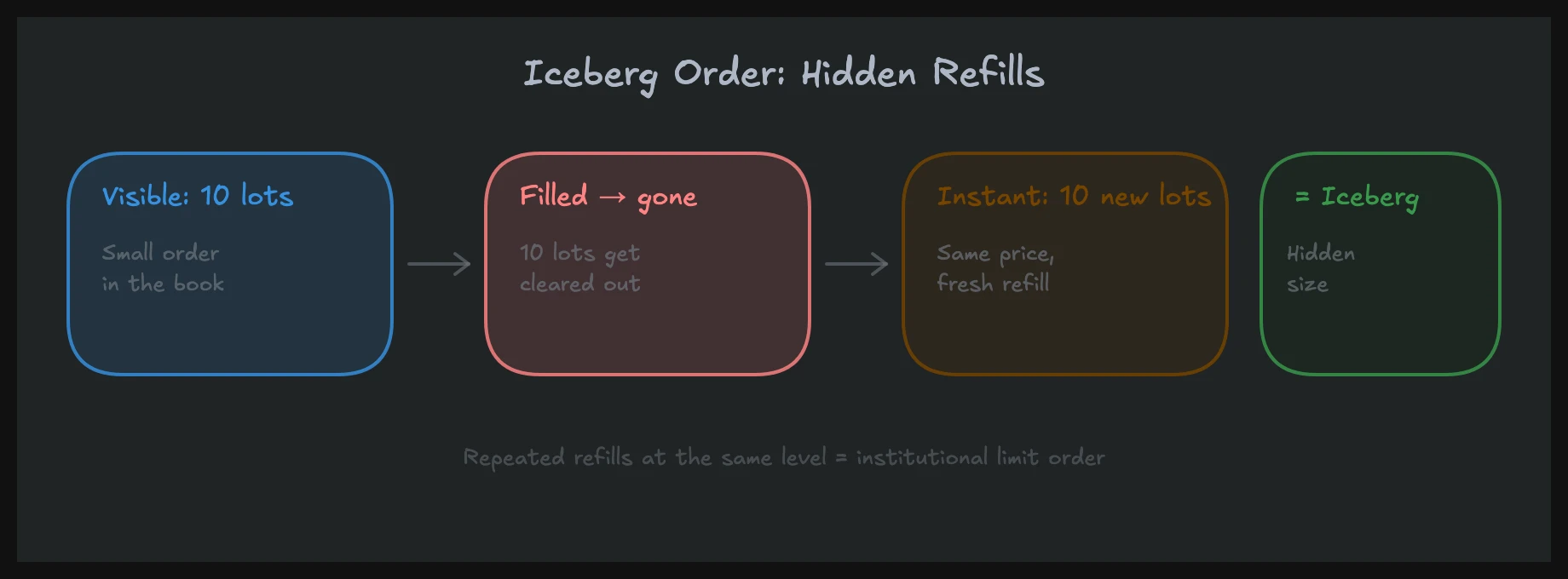
Icebergs tell you something critical: a large participant is committed to a price. They have placed significant size there and are hiding it. When you see an iceberg absorbing aggressive flow and holding, that price level becomes important. If the iceberg eventually gets exhausted and price breaks through, the move is often explosive because all the traders who were leaning on that hidden support or resistance are now wrong.
In our curriculum, we cover icebergs as one of four core elements of tape reading, alongside limit orders, market orders, and rate of change. Each element reinforces the others.
Rate of Change: Speed as a Sentiment Indicator
The rate at which liquidity gets consumed is itself a powerful signal. I think of it as the market's heartbeat.
When resting orders on the offer side are getting consumed rapidly, with each level clearing in seconds rather than minutes, the market is telling you that buyers are urgent and supply is thin. This acceleration in consumption speed often precedes the steepest part of a move.
Conversely, when price is grinding higher but each tick takes longer and longer to clear, and the prints get smaller, that deceleration signals fading momentum. The buyers are losing conviction even as price continues upward. This divergence between price direction and tape speed is one of the most reliable exhaustion signals I have found.
Tools like Bookmap, Jigsaw, and the ATAS DOM are specifically designed to visualize these dynamics. They color-code the tape, show historical depth changes, and highlight large prints. They do not replace the skill of reading raw flow, but they make the pattern recognition significantly faster.
If you are just getting started with order flow concepts, I would recommend mastering footprint charts and volume profile before tackling live tape reading. The tape is the rawest, most unfiltered data stream available, and it is easy to see noise instead of signal without a solid foundation. For traders working on NQ futures, the speed and volatility of that contract make tape reading both more challenging and more rewarding.
Frequently Asked Questions
Is tape reading still relevant with algorithmic trading?
Yes. Algorithms are market participants, and they leave footprints on the tape just like human traders do. In fact, algorithmic patterns like iceberg refills, rapid cancellations, and sweep sequences are often more consistent and readable than human order flow. The data stream has gotten faster, but the underlying principles of reading aggression, absorption, and exhaustion remain the same.
What is the best tool for tape reading?
The most popular dedicated tools are Bookmap for visual depth history, Jigsaw for reconstructed tape with iceberg detection, and ATAS for combined DOM and footprint analysis. Each has strengths depending on your style. The important thing is choosing a tool that lets you filter by size and highlights large prints automatically, because trying to read the raw unfiltered tape on an active contract like NQ or ES is impractical.
How long does it take to learn tape reading?
Tape reading is widely considered the hardest order flow skill to develop. Most traders I have worked with need three to six months of daily screen time before they can reliably extract signal from the tape in real time. I recommend starting with slower instruments or replaying recorded sessions at reduced speed. Build the pattern recognition gradually rather than trying to read live NQ on day one.
In our mentoring program, you'll learn these concepts in over 1,500 video lessons with real chart examples.