
 By Marco Bösing
How to Keep a Trading Journal: The #1 Habit of Profitable Traders
Most traders know they should keep a trading journal. Almost no one does it consistently. They believe it means writing down entry and exit prices. That's a trade log, not a journal. A real trading journal captures not WHAT you traded, but WHY. It makes the self-awareness we described in our article on trading psychology tangible and measurable.
Risk Warning: Trading futures and other financial instruments carries substantial risk of loss. Past performance is not indicative of future results. Only deploy capital you can afford to lose.
Why a trade log isn't a trading journal
A trade log captures: date, instrument, direction, entry, exit, P&L. That's bookkeeping. Useful, but not sufficient. It tells you what happened. Not why.
A trading journal adds three dimensions: the thought before the trade, the emotion during the trade, and the lesson afterward. These three dimensions make the difference between a trader who repeats the same mistakes for years and one who systematically improves.
The decisive question after every trade isn't "Did I make money?" but "Did I follow my process?" A trade that loses money but followed the rules is a good trade. A trade that makes money but violates your rules is a bad trade. Without a journal you can't make this distinction because your memory prioritizes result over process. You remember the profit, not the broken rule.
In my time on institutional desks, post-session reviews were a fixed part of the daily routine. No trader left the trading room without documenting their trades. Not optional, not voluntary, part of the job. The chain of thought, emotion, and behavior described in trading psychology can only be traced in a journal.
The 7 fields every trading journal needs
A good journal isn't complicated. It has seven fields. No more, no less. Each field serves a concrete purpose.
1. Date and instrument. Sounds obvious, but it's the foundation for pattern recognition. Over weeks and months this field shows you which days of the week you're profitable, which markets (e.g. NQ vs. ES) you get the best results in, and which sessions you should avoid.
2. Setup type. Which setup from your playbook did you trade? If you can't name it, the trade shouldn't have existed. This field forces honesty: was it a defined setup or a gut-feeling trade?
3. Entry and exit. The concrete price levels for later analysis of your execution quality. Did you enter at the planned level or did you chase? Did you close at target or too early?
4. R-multiple. Not the dollar amount, but the multiple of your risk. A profit of $300 says little. A profit of 3R says everything. R-multiples make your performance comparable across different instruments and account sizes. If you want to deepen the logic behind this, you'll find it in our article on risk management in trading.
5. Emotional state (1-10). Before AND during the trade. Over weeks a pattern emerges: "I lose money when my emotional state is above 7." Or: "My best trades happen at a level of 3-4." This correlation is worth gold, and without a journal it's invisible.
6. Screenshot. One annotated chart per trade. Without a screenshot you rewrite the story in your head. You remember a clean entry even though the chart shows you were 5 points late. The screenshot is your most honest witness.
7. One lesson. One sentence. What did this trade teach you? "My entry was too early because I didn't wait for confirmation." "Position size was correct, stop held." This one sentence forces you to extract something from every trade, even the boring ones.
The review process: daily, weekly, monthly
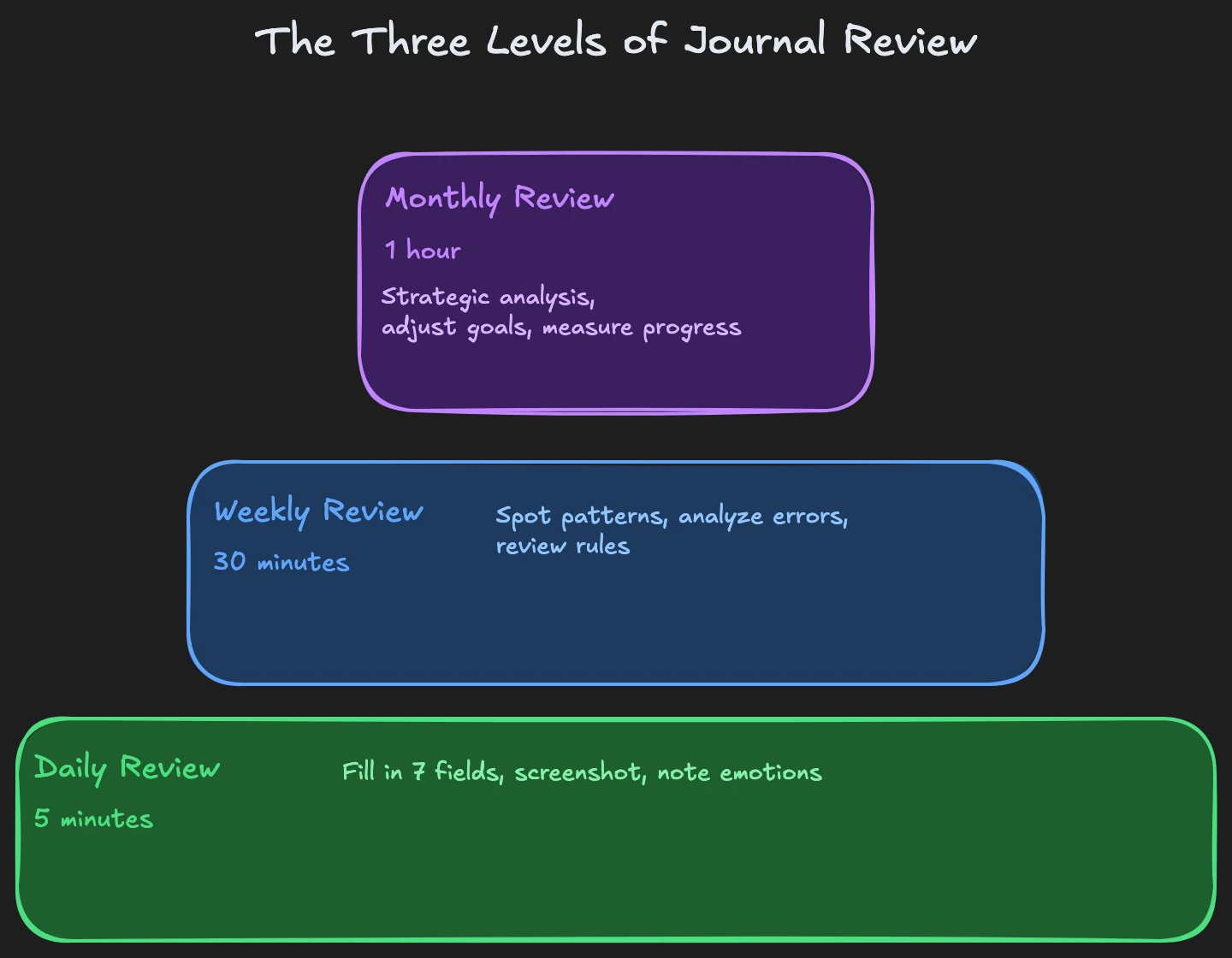
A journal without review is a notebook collecting dust. The value isn't created in writing, but in reading back. Three levels make the difference.
Daily review (5 minutes). Right after the session. Fill in the 7 fields for every trade. Rate your session discipline on a scale of 1 to 10. One sentence: "What went well, what didn't?" In our article on building trading discipline we describe why this daily review is the point where habits solidify. Five minutes. No excuses.
Weekly review (30 minutes). Sunday evening. Go through your trades of the week and answer three questions: Which setups had positive expectation? Which market conditions fit my style? Where did emotions take over? Here you recognize patterns that remain invisible in the daily review. Maybe you trade poorly on Mondays because you don't disconnect on the weekend. Maybe your afternoon trades are systematically worse than your morning trades.
Monthly review (1 hour). This is the strategic level. Win rate by setup type. Average R per winner vs. loser. Correlation between emotional state and result. Here you discover patterns that would be invisible without data: that your setup A has an expectation of 2.3R, while setup B is at -0.4R. Without this analysis you keep trading both. With this analysis you drop setup B and double down on setup A.
"Trading is like a business. Without bookkeeping every business eventually goes bankrupt. Your journal is your bookkeeping."
— Marco Bösing, founder of traMADA
Software and templates
The best journal is the one you actually use. Tool choice is secondary. Consistency is everything.
Excel / Google Sheets / Notion. Free, customizable, no lock-in. Most traders start here, and many stay. A simple table with the 7 fields is completely sufficient. Notion offers the advantage of embedding screenshots directly.
Tradeways. Our partner Tradeways is built exactly around the workflow described above. Trades come in automatically from ATAS, MT5, Rithmic, and Sierra Chart, so you only fill in the fields that actually require thought: setup, emotional state, lesson. The structured review sessions and performance dashboards cover the daily, weekly, and monthly level without you having to build a single formula.
Edgewonk. Specialized in statistical analysis. Tracks expectation, R-multiples, emotional correlations, and setup performance automatically. If you want to make your monthly review data-driven, you save significant time here.
TraderVue. Strength lies in automatic broker import (over 80 brokers directly supported) and the community function. You can share trades with others and get feedback. Less deep in statistics than Edgewonk, but the lowest barrier to entry.
The decisive insight: a simple spreadsheet you use every day beats professional software you open once a month. The perfect tool doesn't exist. The perfect habit does.
FAQ: Trading Journal
How long should a journal entry take?
Maximum 5 minutes per trade. The 7 fields keep the entry focused and quick. If you write 20 minutes per trade, you'll stop after a week. Consistency beats perfection. A short, honest entry every day is more valuable than a detailed essay once a month.
What do I do with the journal during a losing streak?
That's exactly what it's for. The question isn't whether you're losing, but whether you're following your process. If yes, the losses are statistical noise. If no, the journal shows you exactly where you're deviating. Overtrading often shows up in the journal first: too many trades, too high emotional values, no named setups.
Do I need a journal in paper trading too?
Especially then. The habit has to be automatic before you trade live. Paper trading without a journal only trains the technical side. Paper trading with a journal trains the entire process, including the self-reflection that makes the difference in live trading.
Our 30-day "Building a Trader" program trains exactly these mental skills systematically. At tra-mada.de/en you'll find the program together with more than 900 video lessons.