
 By Marco Bösing
How to Stop Overtrading: 7 Signs You're Trading Too Much
Overtrading destroys more accounts than bad strategies. Most traders don't lose because their analysis is wrong, but because they trade too often. A study by Barber and Odean shows: the most active 20% of retail investors achieved an annual return of only 11.4%, while buy-and-hold investors came to 18.5%. Anyone who has understood trading psychology knows: overtrading isn't a discipline problem. It's a behavior that arises from certain thought patterns. And thought patterns can be changed.
Risk Warning: Trading futures and other financial instruments carries substantial risk of loss. Past performance is not indicative of future results. Only deploy capital you can afford to lose.
What overtrading really is
Overtrading doesn't simply mean "too many trades." It means: trades without edge. Every trade that isn't based on a clearly defined setup has a negative expected value. You pay commissions, you pay the spread, and you get nothing in return except variance. That's not trading. That's expensive dice rolling.
The institutional reality is sobering: many profitable prop traders make only a few trades per day. Some make not a single trade on some days. Not because they're lazy, but because they understood that every trade without setup burdens the account. If you trade everything, how is it supposed to work?
Higher frequency leads to more emotional decisions. More emotional decisions lead to worse quality. Quality in trading comes through selection, not through activity. Scalping is the riskiest style for overtrading because the high frequency multiplies emotional errors instead of diluting them. Anyone who has to make a decision every 30 seconds has no time to question their own thought patterns.
7 warning signs of overtrading
1. You trade without a setup
"I have a feeling" isn't a setup. If the trade isn't in your rule set, it doesn't exist. No chart pattern, no order flow signal, no volume profile, then there's no trade. The fact that the market is moving isn't a reason to open a position.
2. You trade to make back losses
The thought "I have to get this back" is the most dangerous sentence in trading. It sounds rational, but it's purely emotional. This thought triggers a chain: thought, then emotion (frustration, pressure), then behavior (revenge trade), then result (another loss). Losses are information, not catastrophes. The market doesn't know you're in the red. It owes you nothing. Anyone who internalizes this breaks the revenge trade cycle at the root.
3. You trade in low-quality times
Between sessions, during lunch break, in the last 30 minutes before market close, just to "be in the market." Not every hour is tradeable. The best setups emerge in specific time windows with high liquidity and clear market structure. Whoever trades outside these windows acts without statistical basis and still pays full commissions.
4. You increase position size after losses
That's the opposite of what works. Losses should lead to smaller positions, not larger ones. Whoever doubles after a loss isn't trading strategically, they're gambling. The urge to "get it back with one big trade" is a clear signal that emotions have taken the wheel.
5. You constantly check your P&L
If you check your P&L during the session, you're not trading setups anymore, you're trading emotions. A green day makes you reckless. A red day makes you desperate. In our article on trading discipline we describe why the P&L tracker is one of the three biggest enemies of your discipline. Hide it during the session.
6. You can't stop even though you've reached your daily goal
"The market is running so well today." That's the thought. The reality: the best session is the one you end when you're in the green. Whoever keeps trading after reaching the daily goal typically gives back a large part of the profits. You won. Take it with you.
7. You trade too many instruments at once
NQ, ES, gold, and EUR/USD all open at the same time. You can't read the order flow on four instruments simultaneously. Each instrument has its own character, its own liquidity structure, its own key levels. Whoever jumps back and forth between four markets doesn't really understand any of them. Every additional instrument dilutes your focus and increases the probability of impulsive decisions. The most successful traders we know trade one instrument. Maximum two.
Why professional traders trade less
On institutional desks there are position limits, daily loss limits, and fixed trading hours. These aren't suggestions. These are rules that are enforced. Not because the traders there are incompetent, but because even the best traders act irrationally under stress when nothing stops them.
The principle behind it is radically simple: one setup, one instrument, one timeframe. The most successful traders concentrate on the essential and eliminate everything else. I once lost over 30 trades in a row and was still profitable. Why? Because the few winners were 4-6R large. That only works with extreme selectivity. Whoever takes every supposed trade will never build the patience to hold the big moves.
More decisions mean more decision fatigue. More decision fatigue means more mistakes. Trading less isn't a sign of passivity. It's a sign of professionalism. The best traders are bored most of the time, and that's exactly the point.
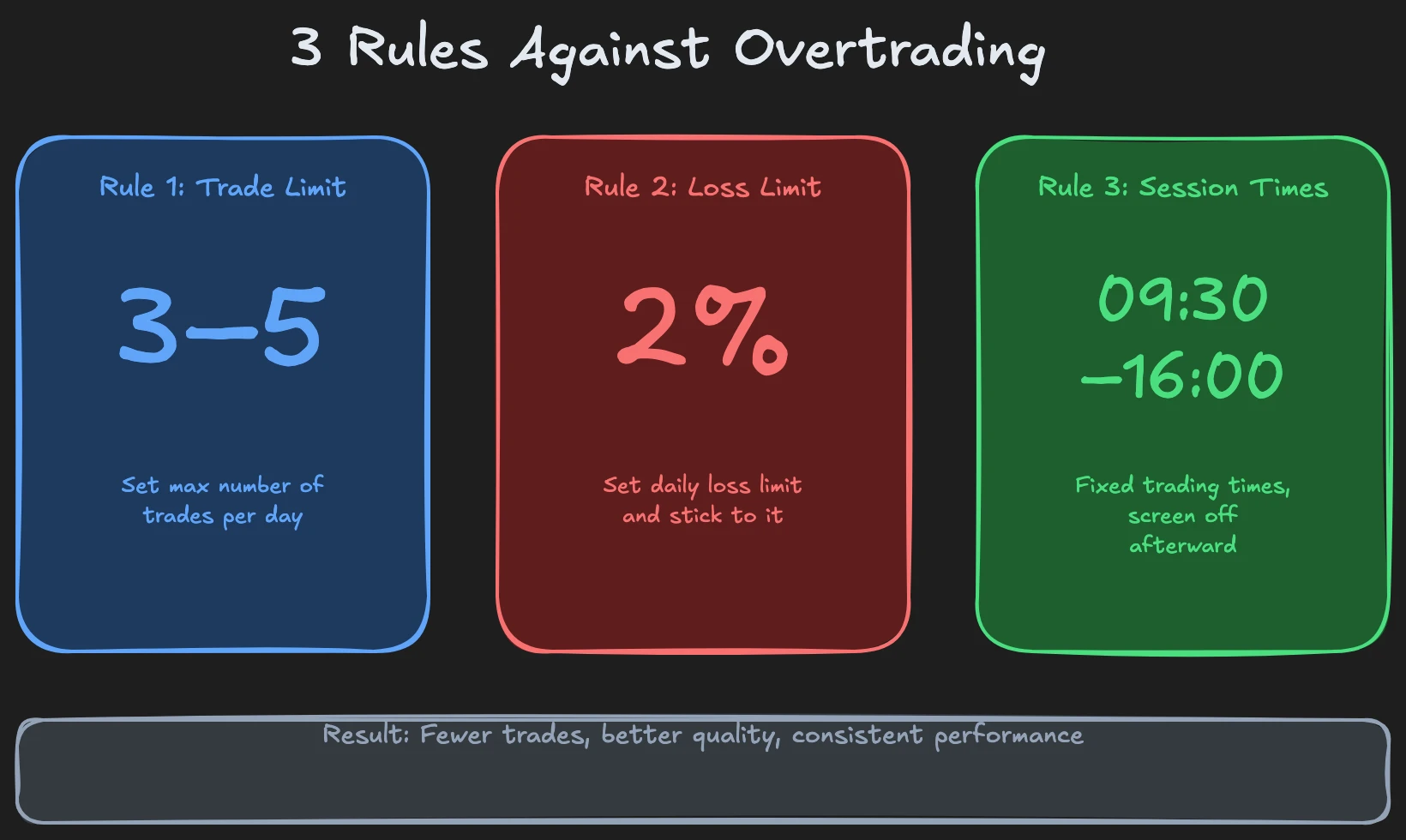
3 rules against overtrading
Insight alone doesn't stop overtrading. Knowing you're trading too much isn't enough, just like knowing smoking is unhealthy doesn't make someone quit. You need rules that kick in automatically before your emotions take control.
1. Daily trade limit: maximum 3 trades. When the limit is reached, you close the platform. No exceptions. No "but this setup is perfect." Three trades are enough to be profitable. If none of the three trades worked, the fourth won't save it either. This one rule alone eliminates the majority of overtrading.
2. Daily loss limit: maximum 2% of the account. After two consecutive losing trades the session is over. Not because the strategy stopped working, but because your mental state has changed. After two losses you're not the same trader as at the beginning of the session. In our article on risk management in trading you'll find the formula for correct position sizes that operationalize this limit.
3. Fixed session times: define start and end. If your session ends at 4:00 PM, you close the platform at 4:00 PM. Not at 4:15 because "the market is running so well right now." Building trading discipline describes the 4-week framework to anchor this habit step by step.
FAQ: Overtrading
How many trades per day are normal?
Many profitable day traders make 1-3 trades per day. Quality over quantity. If you regularly make more than 5 trades, ask yourself for each one: did this trade have a valid setup? If the honest answer is "No" for more than two trades, you have your answer.
Is scalping always overtrading?
No. But scalping requires the highest discipline of all trading styles because the high frequency multiplies emotional decisions. A scalper who makes 20 trades a day makes 20 decisions about whether to follow their rule set or their feeling. That's 20 opportunities to make a mistake. Most retail traders massively underestimate the emotional requirements of scalping.
What do I do when I notice my overtrading urge?
Close the platform. Immediately. Stand up, walk away. Then write down the thought that triggered the impulse. "I have to get this back." "This opportunity will never come again." "Just one more." Writing it down makes the automatic thought conscious, and that's the first step to breaking the pattern. A trading journal helps make these patterns visible over weeks.
Our 30-day "Building a Trader" program trains exactly these mental skills systematically. At tra-mada.de/en you'll find the program together with more than 900 video lessons.