
 By Marco Bösing
Trading Psychology: Why Mindset Matters More Than Any Strategy
Trading psychology is not the ability to suppress emotions. It is the ability to change the thoughts that produce these emotions. Fear in trading is not a character flaw. It is the direct result of a thought pattern. Change the pattern, and you change the result.
Risk Warning: Trading futures and other financial instruments carries substantial risk of loss. Past performance is not indicative of future results. Only deploy capital you can afford to lose.
What most traders understand by psychology (and why that's not enough)
Ask a trader what trading psychology means, and you almost always get the same answer: control emotions. Manage fear. Keep greed in check. Recognize FOMO. That sounds logical. The problem: it doesn't work. Or more precisely, it works until it matters.
The entire industry treats emotions like a disease you can cure with the right technique. Breathing exercises before a trade. Journaling after a trade. Meditation in the morning. All of that has its place. But it falls short because it addresses the symptom, not the cause.
Emotions are symptoms, not causes
Imagine you have an open trade in NQ. The market moves against you, your stop is 8 points away. You feel a tightness in your chest. Your finger hovers over the mouse. You want to close the trade even though your setup is intact. That's not irrational fear. That's a completely rational reaction to a thought you're not aware of.
The thought is not "I'm losing $200." The thought is "If this trade fails, that proves I'm not a good trader." This thought is the actual trigger. The fear is only its consequence. As long as you try to manage the fear without changing the thought behind it, you're fighting shadows.
What the trading industry sells you
The trading industry sells you coping mechanisms. "Take three deep breaths before entering the trade." "Write your emotions in a journal." "Set a daily loss limit and stop when you reach it." All of these are useful tools, no question. But they address the behavior, not the cause of the behavior.
It's like telling a smoker to replace cigarettes with gum. It helps short-term. But if the underlying stress that leads to reaching for a cigarette isn't addressed, the craving finds a new way.
In trading it's the same. You learn not to move your stop prematurely. Good. But if the thought "This loss makes me a loser" remains unchanged, the fear will find another way: you won't enter the next trade at all. Or you'll reduce your position so much that even a winning trade becomes meaningless. The symptom shifts. The cause remains.
The thought before the feeling
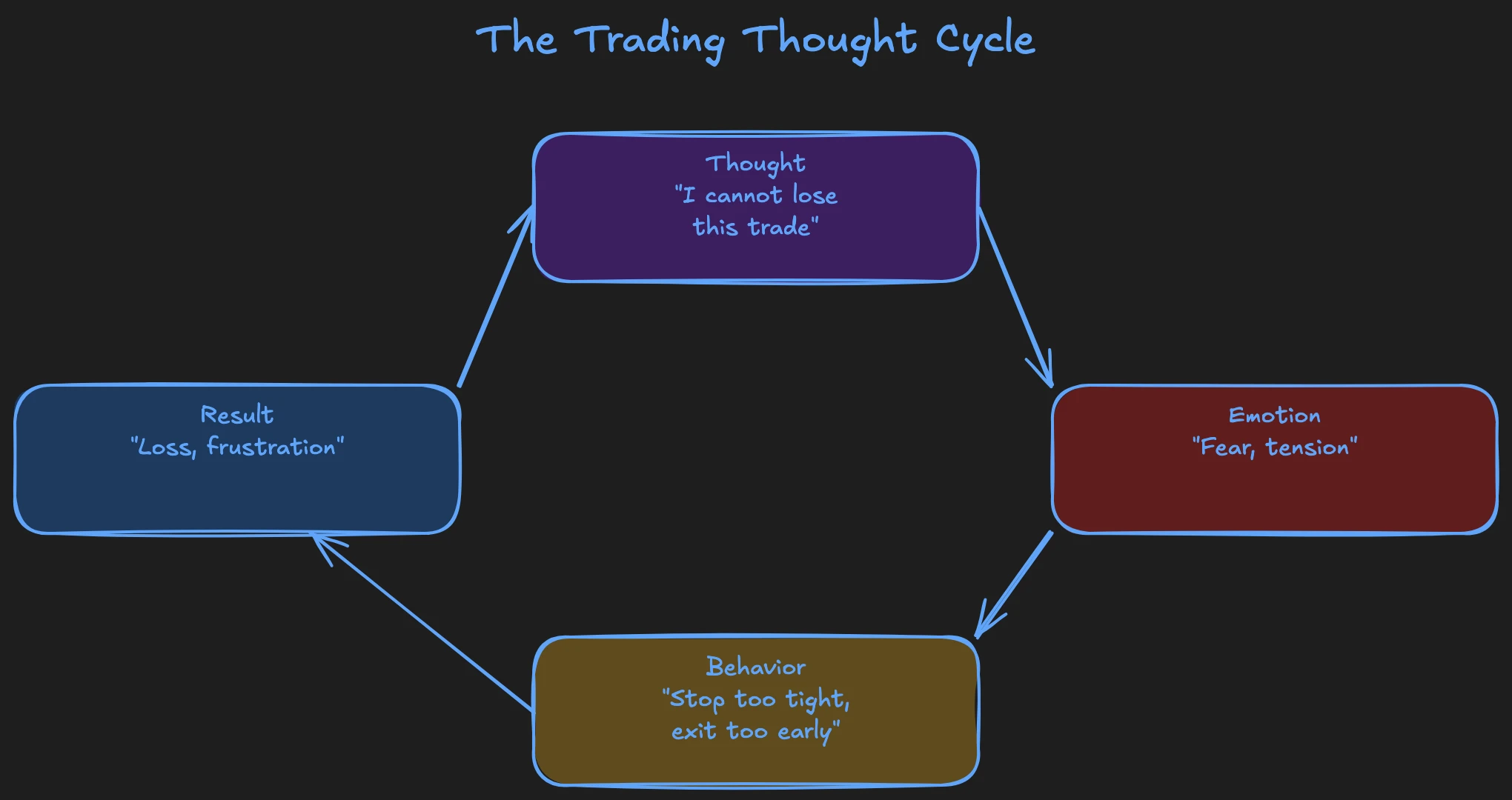
Every action in trading follows a chain: thought, then emotion, then behavior, then result. Most traders try to intervene at the level of behavior. "Stick to your plan." "Don't overtrade." "Set your stop and forget it." These are behavioral rules. They work exactly as long as your willpower holds.
Imagine a garden. Every thought you plant is a seed. A seed of trust produces a different plant than a seed of doubt. Most traders unconsciously plant doubt, fear, and self-judgment and then wonder about the harvest. You can't change the harvest by cutting the fruit. You have to plant different seeds.
That sounds abstract, but it's radically practical. If after a losing trade you think "Wrong again, I'm just not good enough," you've just planted a seed. This seed becomes fear before the next trade. This fear becomes hesitation. Hesitation becomes a missed setup. The missed setup becomes frustration. Frustration becomes a revenge trade. The revenge trade becomes another loss. And the cycle starts over.
The law of cause and effect in trading
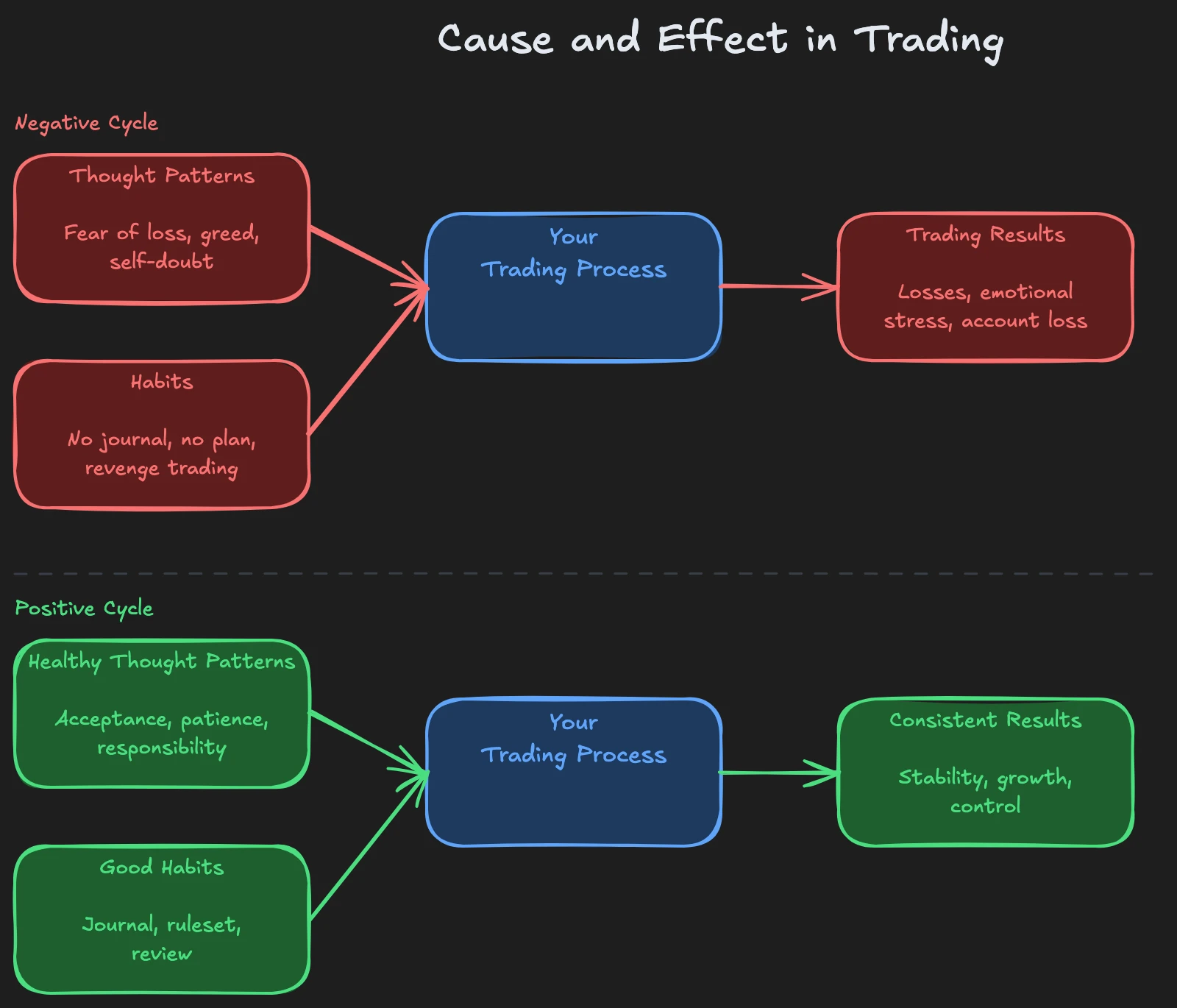
There's a principle that's ruthlessly honest in trading: your results are the output of your inputs. Not sometimes. Always. Your account balance is no accident. It's the exact result of your thoughts, decisions, and habits over the last weeks and months.
That's uncomfortable. It means you can't blame the market, the broker, the algorithm, or the news. It means you're responsible. And that's exactly the good news.
Why "the market got me" ends your trading career
Every trader who became successful stopped blaming the market for their losses at some point. That's not a motivational speech. That's an observation from my years on institutional desks and working with hundreds of traders.
"The market stopped me out." "The news destroyed my trade." "The spike was manipulation." All these sentences have one thing in common: they remove you from the causal chain. If the market is at fault, you can't change anything. If you can't change anything, there's no reason to get better. If there's no reason to get better, you'll repeat the same mistakes. That's not a mindset problem. That's a logic problem.
We are at fault for everything. That sounds harsh, but only this thought gives you the power to change something. If you entered the trade, you made the decision. The news was on the calendar beforehand. The stop was your choice. The position size was your choice. Everything that happens in your trading goes through your decisions. Whoever accepts that can improve. Whoever rejects it repeats.
If you want to understand the technical side of this principle, how institutional market participants move liquidity and why "manipulation" is usually normal market behavior, you'll find the basics in our guide to order flow trading.
What the seeds in your trading head are
Back to the garden. What you tell yourself after every trade is the input. Not what the market did. Not what your P&L shows. But the thought you formulate in response.
After a losing trade there are two options. Trader A thinks: "The trade didn't work. My setup was correct, the market developed differently. What can I learn from the execution?" Trader B thinks: "Again. I'm just not made for this."
Trader A just planted a seed of learning. Trader B planted a seed of resignation. In a single moment the difference is invisible. Over 200 trades it becomes the difference between a profitable and a failed trader.
A single rotten thought can contaminate a whole series of healthy thoughts. Like a rotten banana in a fruit bowl infects the other fruits , a single thought like "I'll never make it" can affect your entire trading week. Negativity spreads: from the individual trade to the session, from the session to the week, from the week to your self-image as a trader.
The difference between successful and unsuccessful traders
If you analyze a hundred traders who all have the same knowledge, took the same courses, use the same software, and trade the same market, you find a surprisingly consistent difference between the profitable and the unprofitable. It's not the strategy. It's not the capital. It's not talent. It's execution.
Knowledge vs. execution: the real gap
"The biggest problem for traders who aren't successful is execution. Almost all of them have the knowledge."
— Marco Bösing, founder of traMADA
That's not an exaggeration. Most traders who fail can explain exactly what they should have done. They know their mistakes. They know they were overleveraged. They know they moved the stop. They know they traded out of revenge. The knowledge was there. The execution wasn't.
Why? Because knowledge and behavior are separated by emotions. And emotions are driven by thoughts. You know you shouldn't move the stop. But the thought "If I get stopped out here, the whole week was for nothing" produces an emotion stronger than your knowledge.
The solution isn't more knowledge. The solution is to change the thought. "If I get stopped out here, I managed my risk correctly" produces a completely different emotion. And a completely different action.
How you systematically close this gap between knowledge and execution is the central topic of our article on building trading discipline.
How successful traders process mistakes
The difference shows up most clearly after losses. Successful traders reflect: What was the plan? Did I follow the plan? If yes, the loss was part of the system. If no, what took me off the plan? They extract information from the mistake and build it into their process.
Unsuccessful traders fixate on the negative: the amount they lost. The feeling of defeat. The fear it will happen again tomorrow. They don't process the mistake, they store it as emotional baggage. Every new mistake adds to the existing baggage until the baggage becomes so heavy that trading becomes impossible.
The difference isn't intelligence or talent. It's a thought pattern. And thought patterns are changeable. A trading journal is one of the most effective tools for this because it externalizes and structures the processing. If you're not yet sure whether the effort pays off for where you are right now, the honest answer is in Is a Trading Journal Really Necessary?.
The thought pattern behind drawdown
A drawdown is a number. 5%, 10%, 20%. The number itself is neutral. What isn't neutral is your interpretation of that number.
Trader A sees a 10% drawdown and thinks: "My system has an expected maximum drawdown phase of 15%. I'm within parameters. Moving on." Trader B sees the same 10% drawdown and thinks: "One more week like this and I'm done. I need to get more aggressive to make it back."
Trader A will survive the drawdown. Trader B will deepen it. Not because the market behaves differently, but because the thought produces different behavior. Trader B will increase positions, widen stops, force setups. Every one of these decisions is the logical consequence of the underlying thought. Change the thought, and the decision changes with it.
Discipline is not willpower, it's a habit
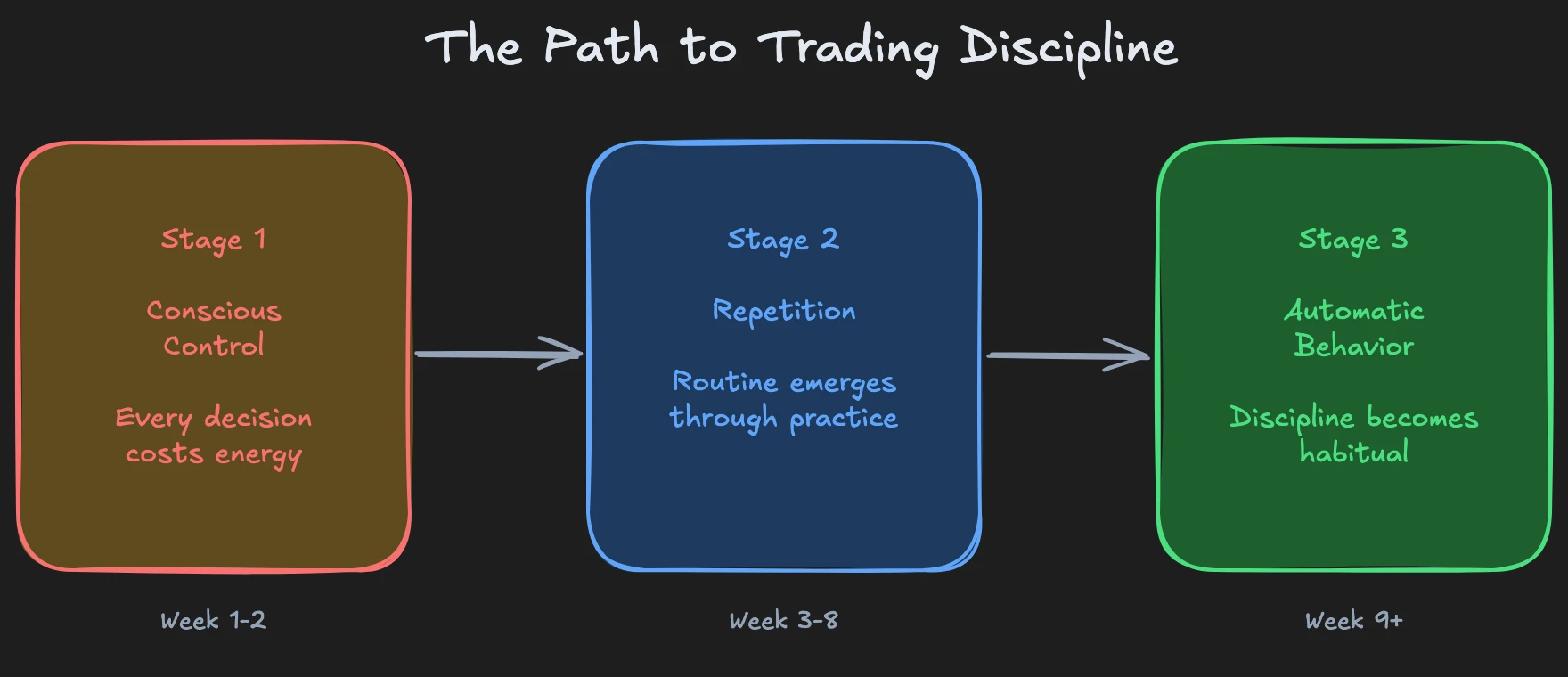
When traders talk about discipline, they almost always mean willpower. The ability to force yourself to do the right thing even when everything inside you screams for the wrong thing. The problem: willpower is a limited resource. And in trading it gets depleted faster than in almost any other activity.
Why willpower is a limited resource
Every decision you consciously make consumes mental energy. Should I enter this trade? Should I move the stop? Should I take profits or let them run? Is this FOMO or a real signal? Every one of these questions costs you something.
A trader who consciously forces every trade against their impulses is mentally exhausted after two hours. Decision fatigue sets in. And that's exactly when the most expensive mistakes happen: late morning, when willpower is depleted, but the market is still moving.
The trader who has internalized the same rules as an automated habit uses almost no mental energy for the same decisions. They don't think about whether to move the stop. They don't move it. Not because they force themselves, but because it doesn't occur to them as an option. Like brushing your teeth. You don't think about whether to brush your teeth in the morning. You just do it.
How to build habits in trading
Habits emerge through three elements: start small, remove friction, and track the process, not the result.
Start small means: don't resolve to follow every rule perfectly starting tomorrow. Take one rule. For example: "In the next 10 trades I won't move my stop a single time." Not 100 trades. Not the rest of your career. Ten trades. That's doable.
Remove friction means: identify the distractions that pull you out of your process. Your phone next to the keyboard. The WhatsApp group active during your session. The second monitor with Twitter. Distraction kills your performance. Find your three biggest distractions and eliminate them. Not reduce. Eliminate.
Track process means: evaluate your sessions not by P&L, but by process adherence. Did you follow your rules? Did you only trade setups that were in your plan? Did you maintain your position size? If yes, the session was a success, regardless of the result. Anyone who consistently implements this will find that overtrading almost disappears on its own.
Making trading routine
The goal isn't iron will. The goal is for trading to feel like a routine. Wake up in the morning, make coffee, go through pre-market analysis, mark levels, wait for setups, follow rules, end session, do review. Not because you force yourself, but because it's your normal routine.
Institutional desks build this routine through external structure. Position limits prevent overleveraging. Daily loss limits enforce stopping. Mandatory reviews after every session ensure reflection. This external structure doesn't exist because institutional traders are undisciplined. It exists because even the best traders act irrationally under stress when no structure holds them.
As a retail trader you don't have this external structure. You have to build it yourself. In our 30-day "Building a Trader" program, we systematically build exactly this state: from conscious control through targeted repetition to automatic habit.
Setbacks, responsibility, and the institutional mindset
Every trader experiences setbacks. The difference isn't whether you experience setbacks, but how you interpret them. Interpretation determines whether the setback makes you better or breaks you.
Setbacks as training data
In sports this is obvious. A boxer who gets hit in sparring analyzes why his guard was open. He doesn't fixate on the pain of the hit. He uses the hit as information to improve his guard.
In trading the logic is identical, but execution is harder. Why? Because a losing trade is linked to a real dollar amount. The pain isn't just emotional, it's financially measurable. That makes it harder to see the loss for what it is: a training data point.
Setbacks are obstacles where you grow. Not because losses are pleasant. But because every setback contains the information you need to not repeat it. A trade that stopped you out shows you where your risk management can be improved. A session where you overtraded shows you which trigger threw you out of your process. A drawdown shows you whether your system is stable or whether you're lying to yourself.
Taking full responsibility
This is the most uncomfortable section of this article. But it's the most important.
You can't blame the broker. You can't blame the algorithm. You can't blame the news. Everything that happens in your trading is the result of your decisions. You entered the trade. You chose the position size. You set the stop or didn't set it. You decided to be in the market before a news release.
We are at fault for everything. That sounds destructive, but it's the opposite. Only when you accept that you are the cause can you also be the solution. As long as someone else is at fault, you're powerless. Once you take full responsibility, you're capable of action.
On an institutional desk the post-loss review is never a discussion about the market. The question is never "What did the market do?" The question is always "What did we do?" Because only our own decisions are within our control.
How to translate this responsibility into a concrete system that protects your capital is described in our article on risk management in trading.
Protecting your capital as psychological strategy
Most traders view risk management as a mathematical problem. 1% per trade. Risk-reward 1:2. These are useful numbers. But the real value of conservative risk management is psychological.
If you risk 0.2% of your capital per trade, no single trade can emotionally destroy you. You can have five losing trades in a row and have lost 1%. That's irrelevant. Your head stays clear. You continue making rational decisions. You continue trading according to plan.
Compare that to a trader who risks 5% per trade. Two losses and they've lost 10%. Now the thought begins: "I need to make this back." This thought changes their entire trading. They increase positions, take worse setups, move stops. The original mistake wasn't the strategy. The mistake was that the position size left no room for healthy psychology.
"Protect your money first" isn't a platitude. It's psychological insurance. Whoever protects their capital simultaneously protects their ability to think clearly.
Sustainable growth: How to systematically train your mind
Trading psychology isn't a book you read once and then you're cured. It's a daily practice. Technically I made peace with the market long ago. My mindset? I work on it constantly and steadily. That's not a sign of weakness. It's the hallmark of a professional trader.
The 30-day structure as a beginning, not a goal
30 days is enough to produce the first fundamental shifts in your thinking. You won't be perfect after 30 days. But you'll have developed an awareness of your own patterns that didn't exist before. You'll notice when a destructive thought appears. And for the first time you'll have a choice whether to follow it or not.
The real effect unfolds in the months after. Mental habits work like financial investments: the compound effect takes time. Day 1 is invisible. Day 30 shows first changes. Day 90 shows new patterns. After 6 months you won't recognize yourself.
Plan the next 90 days after your first 30. What do you want to be able to do as a trader in 90 days that you can't do today? Not in terms of strategy. In terms of your thinking, your behavior, your habits. Write it down. Be specific.
What you can concretely do today
You don't need a program or a coach to take the first step today. Three things you can implement immediately:
1. Write down your most common thought during a losing trade. Not after the trade. During the trade. What goes through your head when the price moves against you? Be honest. Write down the exact thought, not a sanitized version. This thought is the starting point for everything that follows.
2. After your next session, note one thing you controlled and one thing you didn't control. The market moves how it moves. You don't control that. Whether you moved your stop, you control. This distinction between controllable and uncontrollable is the foundation of professional trading.
3. Identify one distraction and remove it. Not three. One. Your phone during the session? Put it in another room. Social media on the trading monitor? Uninstall the browser tab. A single removed distraction has more effect than ten good intentions.
Technical knowledge without psychology is useless
You can master order flow trading. You can read footprint charts in your sleep. You can have the perfect framework. If your head doesn't follow, all of that is worthless.
This is the uncomfortable truth that stands at the beginning of every trading career: the technical side is the easy part. It's learnable, reproducible, systematizable. The mental side is the real work. And it never stops.
Every trader who tells you they've "mastered" psychology is lying to themselves. Markets change. Your life changes. New situations create new challenges. The professional trader isn't the one who has no psychological challenges. They're the one who has a process for dealing with them.
FAQ: Trading Psychology
Why is trading psychology so important?
Because knowledge alone doesn't produce results. The vast majority of all trading mistakes aren't knowledge mistakes, they're execution mistakes. Traders know what they should do. They still don't do it because their thoughts produce emotions stronger than their knowledge. Trading psychology addresses exactly this gap between knowledge and action.
Can trading psychology really be trained?
Yes. Trading psychology isn't an innate trait, it's a collection of thought patterns and habits. Thought patterns are changeable, habits are trainable. The process requires awareness (recognizing what you think), repetition (consistently practicing new thoughts), and structure (a system that holds you when motivation fades). It's not a secret, it's work.
What's the difference between fear and FOMO?
Both are emotions, but they arise from different thoughts. Fear is based on the thought "This loss proves I'm not good enough." FOMO (Fear of Missing Out) is based on the thought "This opportunity will never come again, and everyone else is making money right now." Fear leads to passivity and missed trades. FOMO leads to impulsive entries without a setup. Both require different interventions: fear needs a re-evaluation of losses, FOMO needs the realization that the market provides new opportunities every day.
How long does it take to build the right trading mindset?
Plan on 30 days for the first noticeable shifts in your awareness. You'll start to notice your destructive thoughts in real time. After 3-6 months of consistent work, new thought patterns and habits become automatic. The decisive factor isn't intensity, it's consistency. 10 minutes of daily reflection over 90 days beats a one-time weekend seminar by far.
Our 30-day "Building a Trader" program trains exactly these mental skills systematically: from awareness of your own thought patterns to automation of the right habits. At tra-mada.de/en you'll find the program together with more than 900 video lessons from institutional traders.