
 By Marco Bösing
Building Trading Discipline: Why Willpower Isn't Enough
Trading discipline has nothing to do with willpower. Willpower is a limited resource that fails exactly when you need it most: after three losing trades, at the end of a long session, in the moment where the market moves against you. Real discipline emerges through systems, habits, and structure. In this article I'll show you how to build it without relying on motivation.
Risk Warning: Trading futures and other financial instruments carries substantial risk of loss. Past performance is not indicative of future results. Only deploy capital you can afford to lose.
Why willpower fails in trading
In our article on trading psychology we described how emotions arise from thought patterns and why knowledge alone doesn't produce results. Discipline is the next step: How do you execute what you know?
Most traders try to force themselves through their rules with pure willpower. That works at 8 in the morning when you're fresh and focused. It doesn't work anymore at 11, when you've already made 40 conscious decisions: analyzed setup, weighed entry, set stop, calculated position size, let profits run or take them, evaluate next setup. Every single one of these decisions consumes mental energy.
That's called decision fatigue. Your brain has a limited budget for conscious decisions. Every decision you force reduces this budget. The trade that kills you isn't trade number 1. It's trade number 5, when your mental reserves are depleted and you make "just one more quick trade."
No prop desk in the world relies on the willpower of individual traders. Institutional trading floors have position limits, daily loss limits, mandatory reviews, trading time windows. Not because their traders are weak. But because even the best traders act irrationally under stress when no structure holds them.
If you have to force yourself to follow your rules on every trade, you don't have a discipline problem. You have a system problem.
The habit loop in trading
Discipline doesn't work through force. It works through automation. And automation emerges through habits. Every habit follows the same three steps: cue, routine, reward.
Cue: The market gives you a signal. Your setup appears on the screen. That's the trigger that sets off a chain of action.
Routine: You execute your checklist. Entry level, stop-loss, take-profit, position size. Everything is defined beforehand. You don't decide in the moment. You execute what you decided earlier.
Reward: And here most traders make the critical mistake. The reward isn't the profit. The reward is: "I followed my process." Whoever links their reward to P&L trains their brain on results they don't control. Whoever links their reward to the process trains their brain on behavior they do control.
The same works in the other direction. Destructive habits follow the same three steps: cue is a loss. Routine is the revenge trade. Reward is the short-term relief of "getting it back." This loop is just as automatic as a good habit loop. You won't get rid of it by suppressing it. You get rid of it by replacing it: same cue (loss), different routine (end session, do review), different reward (clarity about the mistake).
Your trading rules as autopilot
A pilot goes through a checklist before every takeoff. Whether it's their first flight or their ten-thousandth. They don't rely on their feeling whether everything is in order. They systematically check every point. Trading should work the same way.
Pre-market checklist: Economic calendar checked. Key levels from the volume profile marked. Bias for the day defined. Maximum position size set. If any of these points is missing, you don't start. Period.
In-trade rules: The stop is set before the trade is opened. No moving. No "I'll give it a bit more room." Take-profit is defined beforehand. Position size is calculated, not estimated. Whoever defines their position size and stop-loss as fixed rules doesn't have to think anymore in the moment of decision.
Post-session review: Three questions are enough. Did I only trade my setups? Did I maintain my stops? Is there something I'll do differently tomorrow? Five minutes. Every day. That's the point where habits solidify.
The rule set isn't a prison. It's a liberation. The more decisions your rules make for you, the less willpower you need. And the more mental energy remains for the few moments where it really matters.
The 3 biggest enemies of your discipline
Trading discipline rarely fails due to lack of motivation. It fails due to distractions that pull you out of your process before you even notice.
1. Your smartphone. Not on silent. In another room. Every notification you read during a session interrupts your focus. Studies show that every interruption costs an average of over 20 minutes to get back to the same state of concentration. In a 2-hour session you can't afford that.
2. Social media and trading chats. Someone in the group just made $2,000. Your thought: "Why am I sitting here waiting for my setup?" And you're out of your process. FOMO doesn't arise in the market. FOMO arises in trading chats. Close them during the session.
3. The P&L tracker. If you look at your P&L during the session, you're not trading your setup anymore. You're trading your emotions. A green day makes you reckless. A red day makes you desperate. Both are poison for your discipline. Hide your P&L during the session. Evaluate at the end of the day.
On institutional desks smartphones are restricted, chats are only allowed for trade-relevant content, and P&L is discussed at the end of the day, not during the session. These rules don't exist out of mistrust. They exist because they work.
The 4-week framework for trading discipline
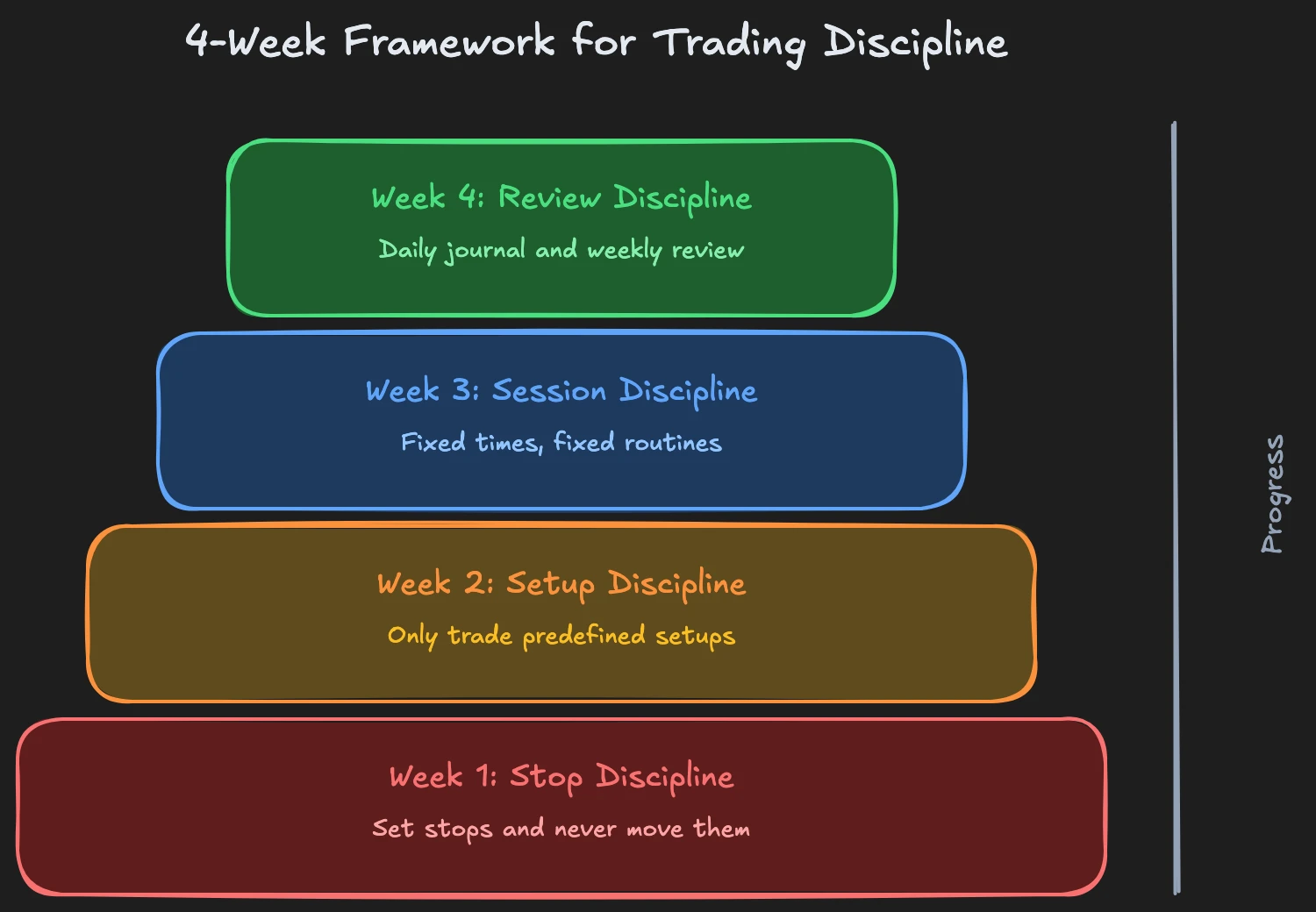
Don't try to change everything at once. One habit per week. Four weeks. After that you have a foundation to build on.
Week 1: Stop discipline. A single rule: don't move your stop-loss. Not once. No matter what the market does. At the end of each day you note: Did I move my stop? Yes or no. No explanations, no excuses. Just the truth. One week. This is the foundation because every other aspect of discipline builds on this one ability.
Week 2: Setup discipline. Only predefined setups. No "that looks good." No gut feeling. If the setup isn't in your rule set, there's no trade. Here too: daily tracking. How many trades did you make? How many were in your plan? The difference is your improvement potential.
Week 3: Session discipline. Define a fixed start time and a fixed end time. If your session ends at 4:00 PM, you close the platform at 4:00 PM. Not at 4:15 because "the market is running so well right now." Overtrading almost disappears on its own when you follow this one rule.
Week 4: Review discipline. Five minutes written review after every session. What went well? What didn't? What will I do differently tomorrow? That sounds simple because it is simple. But it's the difference between a trader who repeats the same mistakes for years and one who steadily improves. A trading journal makes this process systematic and traceable.
Four habits. Four weeks. Not all at once. Week 1 only stop discipline, nothing else. Then in week 2 setup discipline is added, while stop discipline continues. This way each week builds on the previous one. The compound effect takes time, but it's real.
FAQ: Trading Discipline
How long does it take to build trading discipline?
Four weeks for the basics: maintain stops, only trade setups, respect session times, daily review. According to a study by Phillippa Lally (University College London, 2009), it takes an average of 66 days for a new behavior to become automatic, with a range of 18 to 254 days. What matters isn't the duration, but consistency. A little every day beats a massive effort once a month.
What helps against revenge trading?
Recognize the trigger thought: "I have to get this back." This thought is the signal, not the loss itself. Concrete rule: after two consecutive losing trades you end the session. No discussion, no exceptions. If you follow this one rule, revenge trading becomes practically impossible.
Do I need a trading coach for discipline?
No. The 4-week framework in this article is implementable without external help. What a coach or group provides is accountability: someone you report to. That accelerates the process, but isn't mandatory. Your daily tracking sheet can serve the same function if you're honest with yourself.
Our 30-day "Building a Trader" program trains exactly these mental skills systematically. At tra-mada.de/en you'll find the program together with more than 900 video lessons from institutional traders.