
 By Marco Bösing
NFP Trading: How to Trade Non-Farm Payrolls Correctly
First Friday of the month, 2:30 PM CET. Non-Farm Payrolls. NQ moves 100+ points in seconds, spreads widen, stops are hit. NFP days are the most volatile regular dates on the calendar and simultaneously the days when most retail traders lose money. Not because the data is unpredictable, but because they approach handling the event incorrectly. I saw this hundreds of times in my institutional time: the difference between making money and burning money on NFP days lies not in the forecast, but in the process.
Risk Warning: Trading futures and other financial instruments carries significant risk of loss. Past performance is not indicative of future results. Only trade with capital you can afford to lose.
What Non-Farm Payrolls Are and Why They Move the Market
Non-Farm Payrolls (NFP) is the monthly report on the change in employment outside agriculture in the USA. It is published by the Bureau of Labor Statistics (BLS), every first Friday of the month at 2:30 PM CET (8:30 AM Eastern Time). It is the most important single data point in the US economic calendar.
Three numbers matter at the release: the headline number of new jobs created, the Unemployment Rate, and the Average Hourly Earnings. The hourly wages are particularly relevant because they directly point to wage inflation and thus to Fed monetary policy.
The chain of effect is clear: Employment → Consumer Spending → Economic Growth → Fed Policy. Strong numbers mean a hawkish Fed, higher interest rates and pressure on NQ. Weak numbers mean a dovish Fed, lower rates and tailwind for tech stocks. Who knows the basics of futures trading knows how directly interest rate expectations impact index futures. The complete framework for how macro data flows through bonds to your trade can be found in the guide Macroeconomics for Traders. And how to prepare your entire trading day with the economic calendar is explained in the article How to Use an Economic Calendar.
The critical point: not the number itself moves the market, but the deviation from consensus. 200,000 new jobs with expectations of 200,000 is a non-event. The same 200,000 with expectations of 150,000 is a hawkish shock. The market prices expectations, not facts.
Before the Release: Preparation Is Everything
Preparation for NFP does not start at 2:29 PM. It starts the evening before. Professional traders go into the day with a plan, not with hope.
Know the consensus. Where is market expectation? What would be positive, what negative? Bloomberg, Reuters and Investing.com publish consensus forecasts. You don't just need the headline expectation, but also the whisper number, the unofficial expectation that is often closer to the actual market reaction.
Check positioning. Holding positions through NFP is not trading; that is gambling. Go flat or adjust your stops so that a 100-point spike doesn't knock you out AND your risk stays within limits. Most traders are better off being completely flat before the release.
Reduce position size. Who wants to trade after NFP starts with half or smaller size. Spreads widen, slippage increases, fills become unreliable. Your normal risk management doesn't work as usual under these conditions. Adjust it.
Check the calendar. NFP rarely comes in isolation. Unemployment Rate and Average Hourly Earnings are released simultaneously. Sometimes NFP Friday collides with other events or month-end. Know the context.
One point that is often underestimated: many institutional traders are flat before the release. In my time as an institutional trader, that was standard. We didn't hold positions before NFP. We didn't make our money betting on the number; we made it from the reaction afterward. That should make you think.
Three Approaches for NFP Days
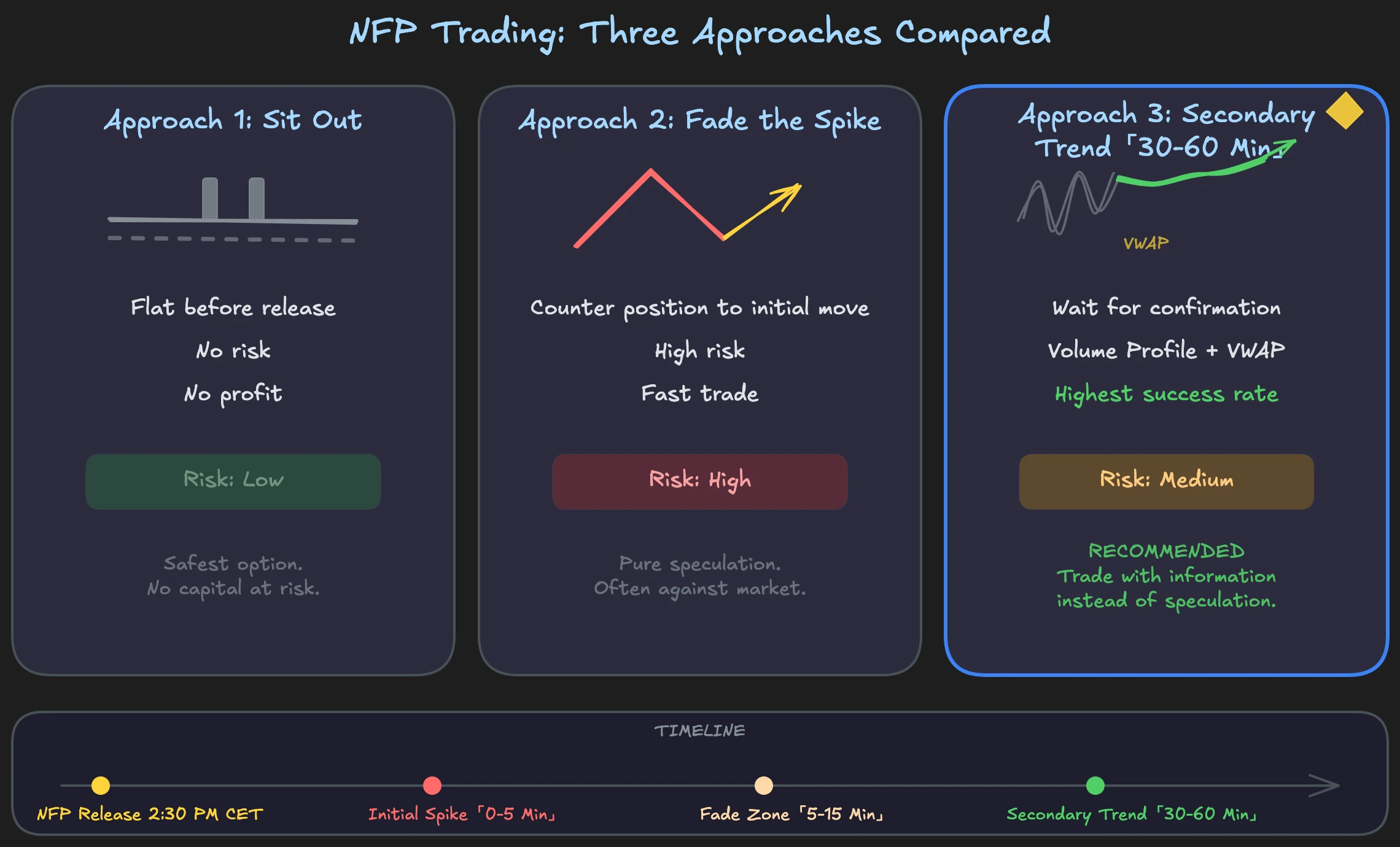
There is not one correct way to trade NFP days. There are three fundamentally different approaches, and each fits a different experience level and risk tolerance.
Approach 1: Complete Sit-Out
The safest option. No trade, no risk. Who doesn't have a clear edge at macro events (and few do) stays out. That is not missed money. That is preserved capital.
Sitting out doesn't mean ignoring the day. You observe, take screenshots, analyze the reaction afterward. You build experience without risking capital. For most traders, especially beginners, that is the best choice. And that without restriction.
Approach 2: Fading the Initial Spike
Only for experienced traders. The first reaction to NFP almost always exaggerates. NQ shoots up 100 points and drops 80. Or it dives 120 points and recovers 90. This pattern is known, and that is exactly why it is not easy to trade.
The setup: wait 5-15 minutes after the release. Check for exhaustion in the order flow. If the aggressive side is weakening and no new large orders are coming in the direction of the spike in the Footprint Chart, a fade is possible. Tight stop, small target, half size.
The risk: if the move is real and doesn't reverse, your stop is quickly reached. No fade without clear exhaustion in the order flow. Never blindly go against the spike.
The first reaction is emotion. The second is information. Who understands that understands the core of fading.
Approach 3: Trading the Secondary Trend
Wait 30-60 minutes after the release. The dust settles, spreads normalize, emotional trades are through. Now the market shows where it really wants to go. Not the knee-jerk reaction, but the weighed direction.
Volume Profile and VWAP after 30 minutes show whether the market accepts the new range or pushes back into the old one. If a new Value Area builds above the pre-NFP level, the move is probably sustainable. If price stays in the old range, the spike was a flash in the pan.
This approach has the highest success rate of the three because you trade with information instead of speculation. You have seen how the market has digested the data. You have seen where real volume was traded. You have seen whether there is follow-through or not.
NFP spikes are frequently classic Stop Runs. They clear liquidity before the real move comes. Who waits 30 minutes sees the real move, not the liquidity grab.
The Most Common Mistakes on NFP Days
Taking a directional bet before the release. You don't know what is coming. Nobody knows. A position before NFP is not analysis; it is a coin flip with leveraged exposure.
Full position size in the first minute. Slippage and spread eat up every theoretical edge. Who goes full size into the first reaction pays more for the entry than the trade can ever yield.
Setting stops too tight. NQ can run 30 points in one direction and then 60 in the other. Normal stops don't work on NFP days. Your stop must reflect the volatility of the event, not your standard setup.
Trading the number instead of the reaction. Good numbers don't automatically mean long. The market interprets. Sometimes good numbers are bad because they mean a hawkish Fed. Sometimes bad numbers are good because they bring rate cuts closer. Trade the reaction, not your opinion about the number.
Revenge trading after the first loser. NFP days have a structure: spike, reversal, then trend. Who loses on the spike and immediately trades back often catches the reversal in the wrong direction. A loser on an NFP day is not a reason to trade more. It is a reason to turn off the screen.
FAQ: NFP Trading
Should beginners trade NFP days?
No. Sit them out, observe the market, take screenshots. Learn from observation before risking capital. If you absolutely want to be involved, use Micro Futures with minimal size. But don't expect profit. Consider it as a paid lesson.
Which index reacts more strongly to NFP: ES or NQ?
NQ reacts more volatile. The tech concentration and higher interest rate sensitivity of growth stocks in the Nasdaq 100 cause stronger swings in employment-related data that shift Fed expectations. ES reacts broader and more even. Both have elevated volatility, but NQ is the sharper instrument.
How long does the elevated volatility after NFP last?
Typically 30-60 minutes of elevated spreads and volatility. After that, market structure normalizes and you can work with normal setups. On particularly surprising days (deviations of 100,000+ jobs from consensus), the effect can last the entire trading day. The daily range on NFP Fridays is significantly larger than on normal days, spreads widen to three to five times.
In our Macroeconomics course with 20 video lessons, you will learn how bonds, interest rates and economic data connect. The course shows you how to integrate NFP, CPI and FOMC into your trading workflow, not as gambling but as contextual information. At tra-mada.de/en, you will find the program.