
 By Marco Bösing
GDP Nowcast in Trading: How to Use Real-Time GDP Estimates
Official GDP comes out once per quarter. Far too slow for traders to react. The Atlanta Fed GDP Nowcast solves this problem. It updates the GDP estimate six to seven times per month as new economic data gets released. The result is the closest possible approximation to a live GDP. Not a trading signal, but a powerful context filter that shows you which macroeconomic regime the market is currently in. How macro data flows through the transmission chain to affect your trade is explained in the guide Macroeconomics for Traders.
Risk Disclaimer: Trading futures and other leveraged products involves substantial risk and can result in the loss of your entire invested capital. The content in this article does not constitute investment advice. Only trade with capital you can afford to lose.
What the GDP Nowcast Is and How It Works
The official US Gross Domestic Product (GDP) is published by the Bureau of Economic Analysis (BEA), once per quarter, with weeks of delay. The first estimate (Advance Estimate) appears around 30 days after quarter end, followed by two revisions (Second and Third Estimate). For traders, this rhythm is practically useless. By the time the number is released, the market has long since priced it in.
The Atlanta Fed GDP Nowcast works fundamentally differently. It is a statistical model that replicates the BEA methodology and processes every relevant economic release in real time. From this it derives a running GDP estimate composed of 13 subcomponents. When new ISM data comes out, it flows in immediately. When retail sales are published, the estimate updates within hours. The same applies to housing starts, durable goods orders, personal income, and dozens of other indicators.
The key difference from consensus forecasts: GDPNow is purely model driven, without human judgment, without rounding, without narrative framing. Consensus forecasts are surveys among economists. GDPNow is an algorithm that processes data.
An important point to understand: At the beginning of a quarter, estimates are volatile because few data points are available. With each subsequent release, the model stabilizes. Toward the end of the quarter, estimates typically converge close to actual GDP.
Why the GDP Nowcast Moves Markets
GDP growth means corporate profits. Corporate profits drive equity valuations. This causal chain is why significant shifts in GDP Nowcast can change market sentiment within days.
When GDPNow swings sharply negative (like in spring 2025, when the estimate fell to -2.8% on March 28), market sentiment flips to risk-off. NQ sells into support zones, bonds rise, defensive sectors outperform. Conversely, when GDPNow trends upward, breakouts in NQ hold better, risk-on dominates.
In my experience, this regime shift is exactly where most retail traders fail. They see price decline, search for a chart pattern as an explanation, find none, and trade against it anyway. Those who follow the GDPNow trajectory understand why the market suddenly reacts differently than in previous weeks.
The difference from events like the NFP Report is fundamental. NFP moves the market in minutes: a spike, a fade, a secondary trend. The GDP Nowcast does not move a single day. It shifts the backdrop over days and weeks. It changes how the market interprets every subsequent data release. When which data comes out is shown in the Economic Calendar.
GDPNow and bond yields move in tandem. Strong GDP growth drives yields up because the market prices in a tighter Fed. Rising yields in turn create pressure on growth-sensitive indices like the Nasdaq.
How to Use GDP Nowcast in Your Workflow
Weekly Check
Every Sunday or Monday: Where does GDPNow stand? Is the estimate trending up, down, or sideways? This categorization gives you the macroeconomic context for the coming trading week. You do not need to track every update. A weekly glance is enough.
After Major Data Releases
Did the new ISM number or current retail sales figure significantly shift the nowcast? A movement of 0.5 percentage points in a single update is noteworthy. A shift of 0.1 percentage points is noise and irrelevant for your trading.
Regime Filter
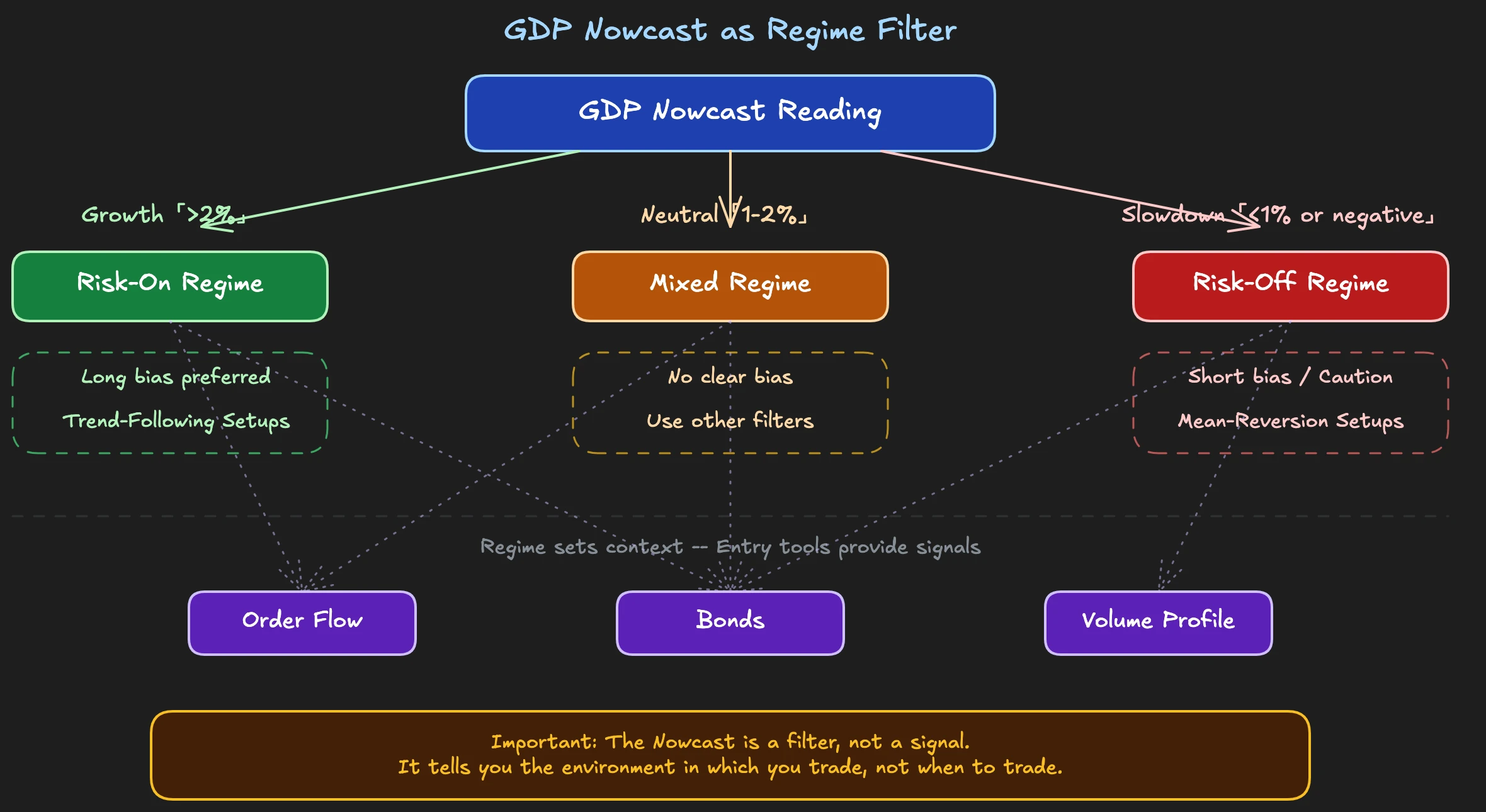
The real strength of GDP Nowcast lies in regime classification:
- GDPNow clearly positive (above 2.5%): Risk-on environment. Pullbacks in NQ are more likely to be bought, trend days are more frequent, momentum strategies work better.
- GDPNow near zero or negative: Risk-off environment. Rallies run into resistance, the market trades more in ranges or trends downward.
- GDPNow in rapid transition (sharp movements in both directions): Highest uncertainty, widest ranges, most difficult trading environment. Here patience is more important than activity.
Combination with Other Tools
The GDP Nowcast sets the macroeconomic context. Bond yields confirm this context, or contradict it. Order flow provides the entry. Volume Profile shows you the relevant price levels.
Crucial: Do not trade directly based on GDP Nowcast. It is a filter, not a signal. It does not tell you when to buy or sell. It tells you which environment you are trading in, and which type of setups are more likely to work in that environment.
"Most traders look at individual macro numbers and try to trade directly from them. That does not work. What works: understanding what the sum of the data says about the current growth environment, and aligning your trading accordingly."
— Marco Bösing, Founder of traMADA
Common Mistakes When Using GDP Nowcast
Overinterpreting individual updates. One update is not a trend. The model is volatile at the beginning of the quarter because few data points are available. Wait for three to four updates before considering a direction confirmed.
Using GDPNow as an intraday signal. The nowcast is a weekly to multi-week context tool. It does not tell you what NQ will do today at 3:45 PM. Those who trade on individual updates misunderstand the instrument.
Reading GDP Nowcast without interest rate context. Strong GDP growth sounds bullish, but if yields are simultaneously rising because the market prices in a more restrictive Fed, the net reaction can be negative. Always read the nowcast together with the bond market.
Comparing old estimates with current ones. GDPNow for Q1 2026 is not comparable to GDPNow for Q3 2025. Each quarter the model starts from zero. Only the trajectory within a quarter is meaningful.
FAQ: GDP Nowcast
Where can I find the GDP Nowcast?
Directly on the Atlanta Fed website at atlantafed.org/cqer/research/gdpnow. Free, no registration required. The data is also available via FRED (Federal Reserve Economic Data). Additionally, it is worth looking at the New York Fed Staff Nowcast, which uses a different model (dynamic factor model instead of bridge-equation approach) and is updated weekly on Fridays. Both together give a more complete picture.
How often should I check the GDP Nowcast?
Once per week for the current status. Additionally after particularly market-relevant data releases (ISM, retail sales, NFP) to see if the estimate has shifted significantly. Daily checking is unnecessary and leads to overinterpretation.
Is there a GDP Nowcast for other countries?
The ECB, Bundesbank, and other central banks publish similar real-time estimates. However, the Atlanta Fed GDPNow is the most watched globally because US GDP significantly influences worldwide risk sentiment. For futures traders trading US indices, the US nowcast is the relevant reference.
In our Macroeconomics course with 20 video lessons you learn how bonds, interest rates, and economic data are connected. The GDP Nowcast is a fixed component of weekly macro analysis, and in the course we show you how to connect GDPNow with interest rates, COT data, and order flow into a complete trading workflow. Context instead of guessing.