
 By Marco Bösing
Trump Tariffs 2026: Market Impact and What Traders Need to Know
When the White House announced an emergency 15% tariff on a broad basket of imports in February 2026, index futures sold off within seconds. Trump tariffs 2026 became the dominant driver for equity, bond, and currency markets almost overnight. If you trade NQ or ES, you need to understand how tariff policy transmits through the economy and what that means for price action on your charts.
Risk Disclaimer: Trading futures and other financial instruments involves significant risk of loss. Past results are not indicative of future performance. Only trade with capital you can afford to lose.
What Happened: The February 2026 Emergency Tariff
On February 12, 2026, the administration invoked emergency trade authority to impose a 15% across-the-board tariff on imports from the EU, Japan, South Korea, and Taiwan. The stated goal was to address a widening trade deficit and protect domestic manufacturing. Markets had priced in some tariff risk, but the scope and speed caught most participants off guard.
Within the first 30 minutes of the announcement, NQ futures dropped over 350 points. ES followed with a 120-point sell-off. Treasury yields initially spiked as traders priced in higher inflation expectations, then reversed as flight-to-safety flows dominated later in the session. The VIX jumped from 18 to 27 in a single day.
This was not an isolated event. Trade war trading has been a recurring theme since 2018, but the 2026 round introduced a new wrinkle: the tariffs directly targeted semiconductor and advanced electronics supply chains. For NQ, which is loaded with companies that depend on global tech manufacturing, the impact was immediate and outsized.
The Transmission Chain: Tariffs to Your Trading Screen
Understanding how tariffs move markets requires following a clear chain of events. In our macroeconomics course, I teach this exact transmission mechanism because it shows up in real trading situations again and again.
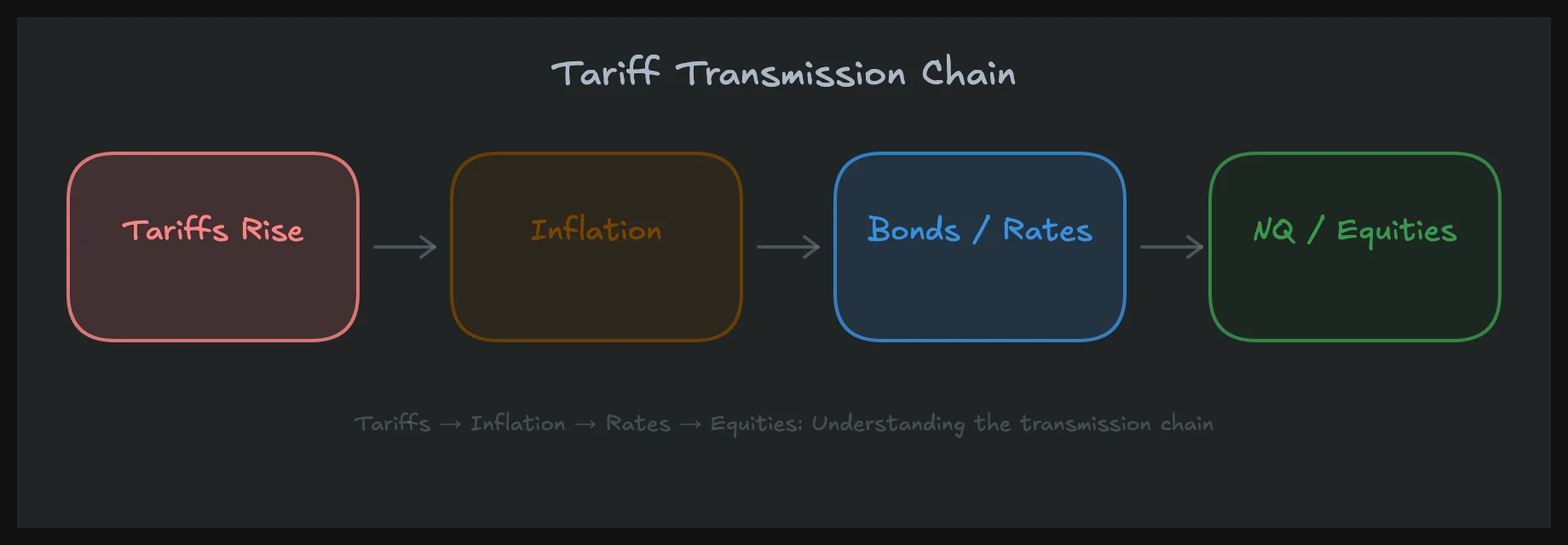
Step 1: Import costs rise. A 15% tariff is a 15% tax on imported goods. Companies that rely on foreign components, whether it is chips from Taiwan or automotive parts from Germany, face higher input costs immediately.
Step 2: Inflation expectations adjust. Higher input costs feed into consumer prices. Bond markets react fast. The 10-year yield moved 18 basis points higher in the two sessions following the announcement as traders repriced the inflation outlook.
Step 3: The Fed's hands get tied. If inflation runs hotter because of tariffs, the Federal Reserve has less room to cut rates. This matters because rate expectations directly influence equity valuations. The GDP Nowcast dropped sharply in the weeks after the tariff announcement, reflecting the uncertainty tariffs inject into economic activity.
Step 4: Forward P/E compresses. When discount rates rise and earnings estimates fall simultaneously, price-to-earnings multiples compress. This is what happened in late February and March 2026. Analysts revised S&P 500 earnings estimates down by roughly 3-4%, while the risk-free rate moved higher. The result was a double hit to valuations.
Step 5: NQ takes the hardest punch. The Nasdaq 100 is disproportionately exposed to tariff impact markets because its largest constituents, the mega-cap tech companies, run global supply chains. Apple, Nvidia, and AMD source heavily from the targeted countries. When tariffs hit these supply chains, NQ underperforms ES, and that spread becomes a tradable signal.
Trading Tariff Announcements: The Three-Phase Pattern
In my experience, tariff announcements from this administration follow a recognizable pattern that I have seen play out multiple times since 2025. Understanding it gives you an edge over traders who react purely on instinct.
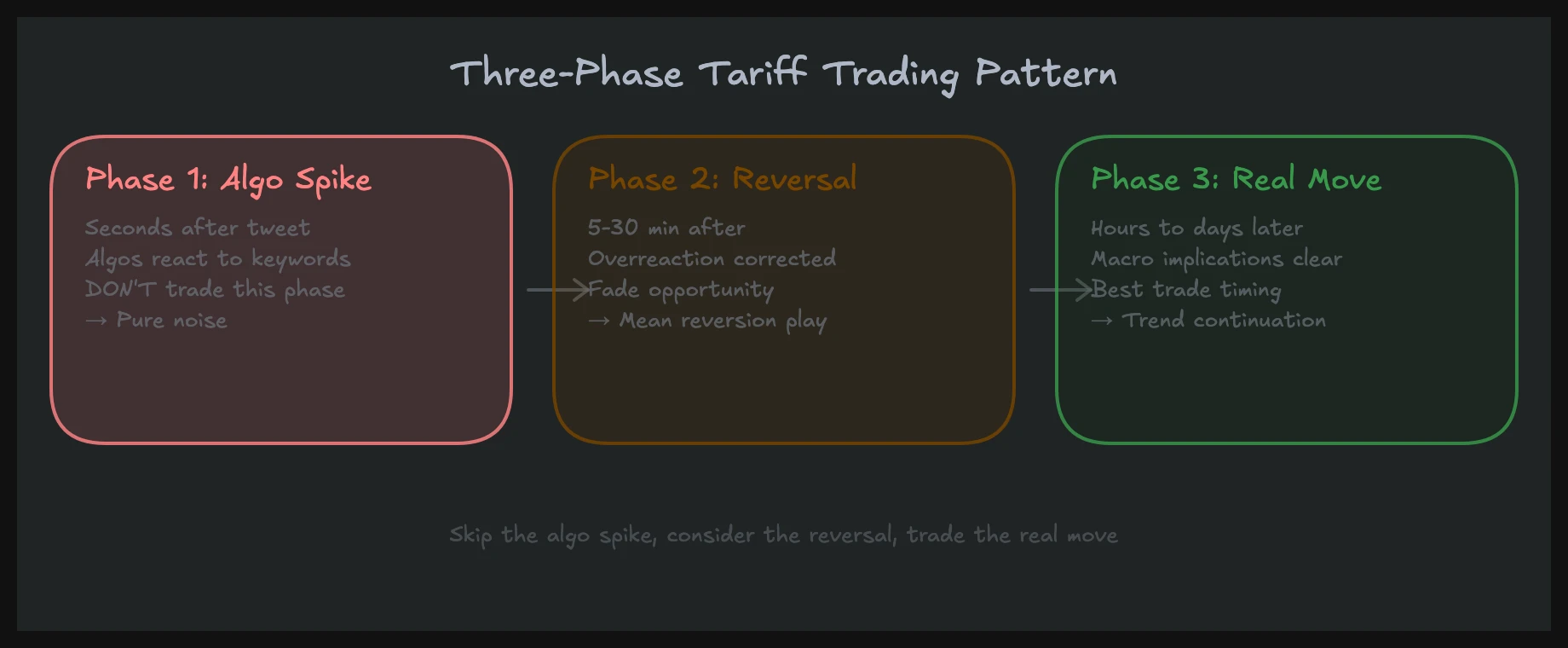
Phase 1: The social media spike. Policy announcements often hit social media before any official press conference. Algorithms scan these posts and fire orders within milliseconds. You will see a violent move, sometimes 50-100 NQ points, in the first 2-3 minutes. This move is almost entirely algorithmic. It often overshoots.
Phase 2: The reversal. Once the initial algo wave passes, human traders step in. Many of them fade the initial move, especially if the headline language is ambiguous. You will frequently see a 40-60% retracement of the initial drop within 15-30 minutes.
Phase 3: The real move. Hours later, once analysts and institutional desks have assessed the actual policy details, the market finds its direction. This is where the genuine repricing happens. In February 2026, NQ rallied almost 200 points off the lows in Phase 2, then sold off another 500 points over the following three sessions as the full scope of the tariffs became clear.
The lesson: do not chase Phase 1. Wait for Phase 2 to show you where liquidity sits, and position for Phase 3 with proper risk management.
Positioning in a Tariff-Driven Market
When tariff policy is the dominant narrative, several market conditions shift in predictable ways. Here is what I watch for in my own trading:
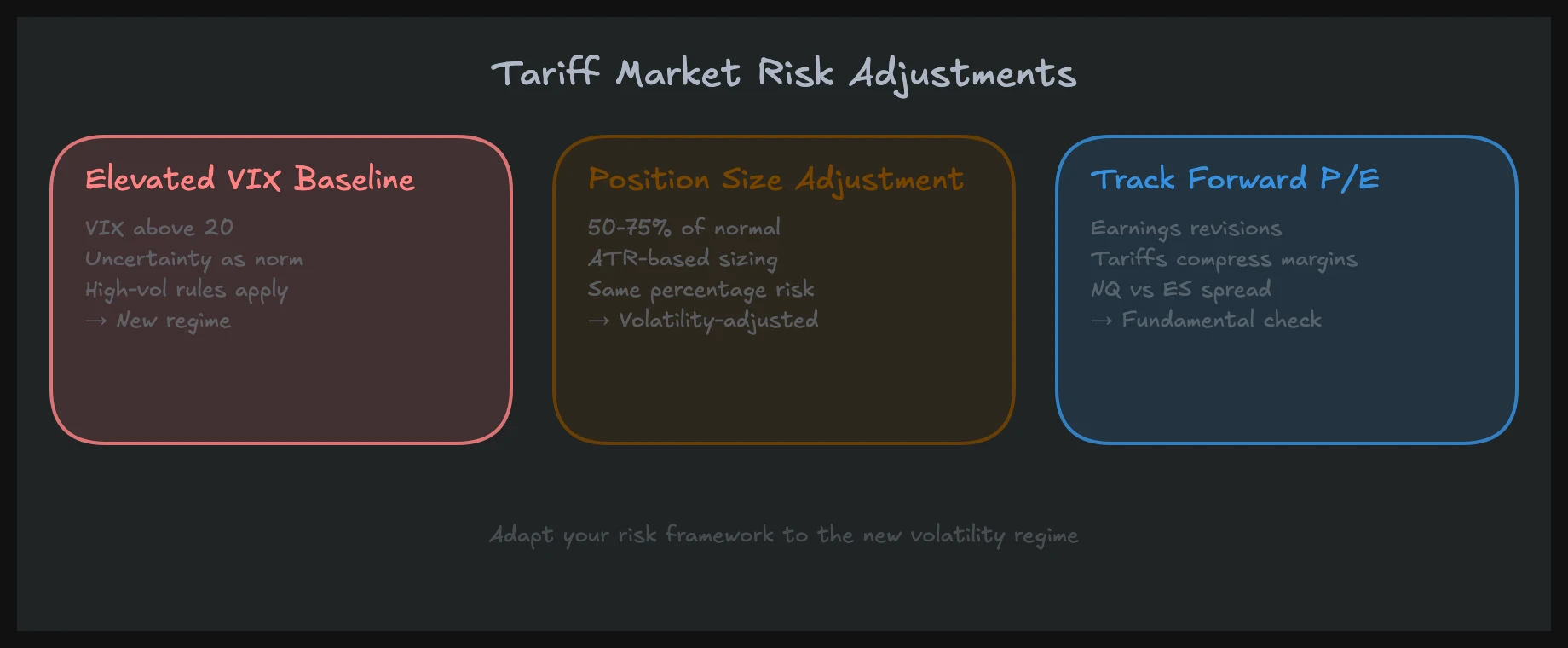
Elevated VIX, wider ranges. The VIX stayed above 22 for six consecutive weeks after the February announcement. Daily ranges on NQ expanded from an average of 250 points to over 400 points. This means you need to widen stops and reduce position size, or you will get stopped out on noise.
NQ underperformance vs ES. When tariffs are the story, NQ consistently underperforms ES. This is not random. It reflects the higher tariff exposure of tech supply chains. I track the NQ/ES ratio daily during tariff cycles. A widening spread confirms that tariff fears are driving the market, not some other factor.
Bond-equity correlation shifts. Normally, bonds and equities move inversely during risk-off events. During tariff shocks, both can sell off simultaneously because tariffs are inflationary (bad for bonds) and growth-negative (bad for equities). This is a black swan-type scenario where traditional hedges fail. If you are long ES and long bonds expecting a hedge, a tariff announcement can hurt both sides of that trade.
Sector rotation is fast and violent. Domestic-focused companies, think utilities, healthcare, and some industrials, outperform during tariff escalation. International revenue companies, especially in tech and consumer discretionary, get hit hardest. If you watch sector ETFs alongside your index trading, you can confirm the tariff narrative in real time.
What Comes Next: Forward-Looking Considerations
As of early 2026, the tariff situation remains fluid. Retaliatory measures from the EU and Japan are in various stages of implementation. The administration has signaled willingness to negotiate but has also escalated rhetoric.
For traders, the key forward-looking variable is whether tariffs become permanent or serve as a negotiating tool. Permanent tariffs mean sustained inflation pressure, a more hawkish Fed, and lower equilibrium P/E multiples. Negotiated reductions would trigger sharp relief rallies, especially in NQ.
I keep a close watch on the news trading strategy framework during these periods. The playbook is straightforward: know the transmission chain, watch the three-phase pattern on announcements, manage risk aggressively, and let the market tell you which scenario it is pricing.
In our macroeconomics course with 20 video lessons, you will learn how tariffs, inflation, and bond yields interact and how macro data improves your trading decisions. At united-daytraders.com, you will find over 1,500 video lessons from institutional traders.
FAQ
How do tariffs affect the stock market?
Tariffs increase import costs for companies that rely on foreign goods and components. This raises inflation expectations, pushes bond yields higher, and compresses equity valuations. The stock market prices in both the direct cost impact on corporate earnings and the indirect effect of a potentially more restrictive Federal Reserve. During the February 2026 tariff announcement, the S&P 500 lost roughly 5% over three trading sessions as analysts revised earnings estimates lower and discount rates moved higher.
Why does the NQ react more strongly to tariffs than the S&P 500?
The Nasdaq 100 is heavily weighted toward technology companies with extensive global supply chains. Companies like Apple, Nvidia, and AMD manufacture or source critical components from countries directly targeted by tariffs. When import costs rise for semiconductors and electronics, these companies face margin compression that hits earnings estimates immediately. The S&P 500, while also affected, has broader sector exposure including domestic-focused sectors like utilities and healthcare that are relatively insulated from tariff impact. During the 2026 tariff cycle, NQ underperformed ES by roughly 3-4% in the first two weeks.