
 By Marco Bösing
USA-Iran Conflict: Market Impact and Trading Strategies
The USA-Iran conflict has escalated into a full military confrontation involving Israel, the United States, and Iran, with strikes and counterstrikes sending shockwaves through global markets. Oil prices are surging, volatility is spiking, and traders face both serious risks and real opportunities across multiple asset classes.
Risk Disclaimer: Trading futures and other financial instruments involves significant risk of loss. Past results are not indicative of future performance. Only trade with capital you can afford to lose.
I have been through geopolitical escalations before (the Ukraine-Russia conflict in 2022 was the last major one), and there is a playbook that works. This article breaks down the oil transmission mechanism, the situational investments that make sense right now, and the exact trading strategies I use when volatility explodes. For the full framework, start with the news trading strategy where I lay out the complete approach.
The Geopolitical Situation
The current escalation between the USA, Israel, and Iran is not a contained skirmish. We are looking at active military operations with strikes flying back and forth. Iran is being hit, and Iran is shooting back.
Why does this matter at a trading desk? The Middle East is one of the world's primary oil-producing regions, and any disruption ripples through global energy supply within hours. Diplomatic alliances are shifting, creating the kind of uncertainty markets hate. And the scale of this conflict touches global economic stability, not just local conditions on the ground.
We saw similar dynamics during the Trump tariff escalation, where a single policy shift cascaded through equities, bonds, and currencies. Military conflict follows the same transmission logic but hits harder and faster because the commodity impact (oil) is immediate.
Oil Transmission: Three Factors
Every time a military conflict breaks out, I look at oil first. Always. And every time, I look at it from the long side. Here is why.
Factor 1: Military demand. The military needs oil. Full stop. Tanks, jets, naval vessels, logistics convoys all run on petroleum. Civilian consumption stays the same, but now there is a massive additional demand layer from military operations.
Factor 2: Production disruption. The conflict zone is where oil comes from. Saudi Aramco (at one point larger than Apple by market cap) has already had refinery infrastructure hit. When oil-producing nations are in the line of fire, supply gets destroyed. Less supply plus greater demand equals higher prices.
Factor 3: The Strait of Hormuz. This chokepoint carries a massive share of global oil shipments. With the strait effectively closed or severely restricted, getting oil from production to market breaks down. Purely from a supply-chain math perspective, this pushes crude prices sharply higher.
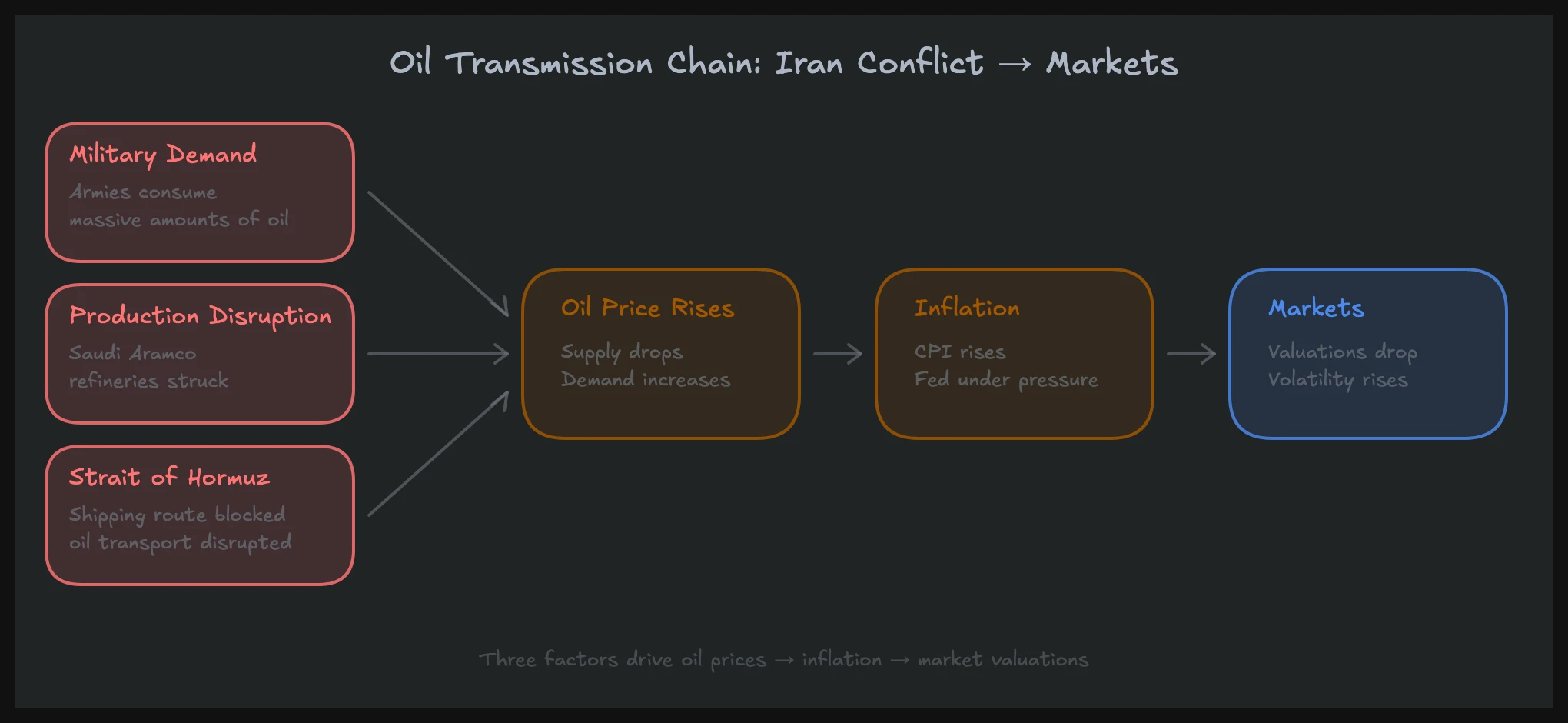
All three factors compound. Rising oil prices feed directly into inflation expectations, and inflation expectations reshape every market you trade, from equities to bonds to currencies. If you want to understand the full chain from commodity prices to Fed policy to your P&L, the macroeconomics for traders guide walks through it step by step.
Situational Investments During Geopolitical Escalation
Oil itself is going to be extremely volatile and erratic, which makes it more of a trading instrument than an investment vehicle right now. But there are categories of investments that benefit from the conditions this conflict creates, and they move more slowly, giving you time to position.
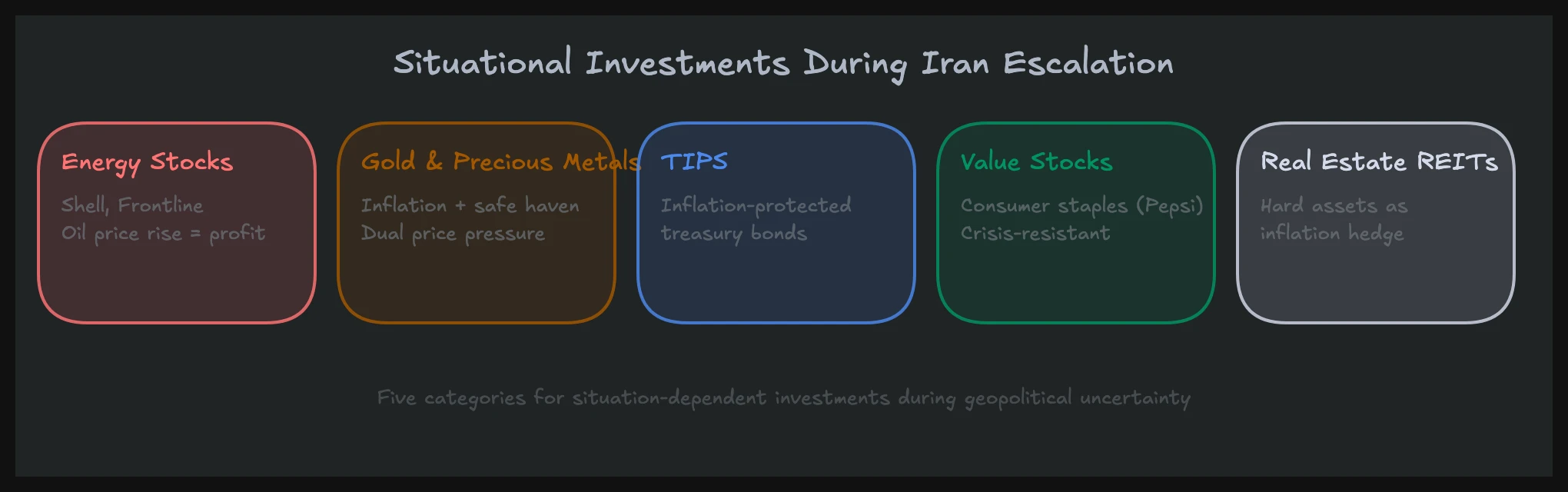
Energy stocks. Companies like Shell that produce oil outside the conflict zone benefit directly. Their commodity is rising in price while operations continue normally. The oil they sell is suddenly worth significantly more, lifting revenue, profit, and share price.
Gold and precious metals. Gold gets a dual driver here. First, if oil pushes inflation higher, gold rises because the dollar loses purchasing power. Second, gold benefits from safe-haven demand as capital flows out of risk assets. These two forces compound, which is why gold tends to outperform during extended geopolitical crises rather than just spiking and fading.
TIPS (Treasury Inflation-Protected Securities). US government bonds with coupon payments tied to inflation. If inflation rises, your payments rise with it. Fair warning: the extra dollars you receive are also worth less because of that same inflation. TIPS are not a wealth builder, but they work for anyone who wants inflation-adjusted income without active management.
Value stocks. Consumer staples companies (think Pepsi, packaged food, fast-food chains) keep selling regardless of what happens in the Middle East. If these stocks get dragged down with the broader market during a sell-off, that is a buying opportunity: stable cash flows at a discount.
REITs (Real Estate Investment Trusts). Hard assets tend to hold value during inflationary periods. REITs give you real estate exposure without buying physical property, a comfortable inflation position for investors who understand real estate better than financial markets.
My personal pick: Frontline. Most people have never heard of Frontline unless they have been watching my content for years. Frontline operates a tanker fleet that ships oil across the world. When oil demand surges and shipping routes get disrupted, tanker companies are exactly what the market needs. I bought a large position when the Ukraine-Russia conflict started, sold most at a profit, and still hold a smaller position. I am evaluating whether to add more. This is not a buy-and-hold stock like Berkshire Hathaway. It is fragile: you need to check the balance sheet, review fleet inventory, and understand their scrapping schedule for older tankers. But in situations like this, Frontline can deliver outsized returns.
Important timing note: These investments are valid if inflation actually materializes. Oil needs to stay elevated for a sustained period, not just spike for two days. If the conflict ends and the Strait of Hormuz reopens, the inflation thesis weakens. Position accordingly.
Trading Strategies in High-Volatility Regimes
When the cash market opens during a geopolitical escalation like this, things will move fast. The VIX is already elevated, which tells us there is stress in the system and heavy, rapid trading. For short-term traders, this creates two distinct strategies.
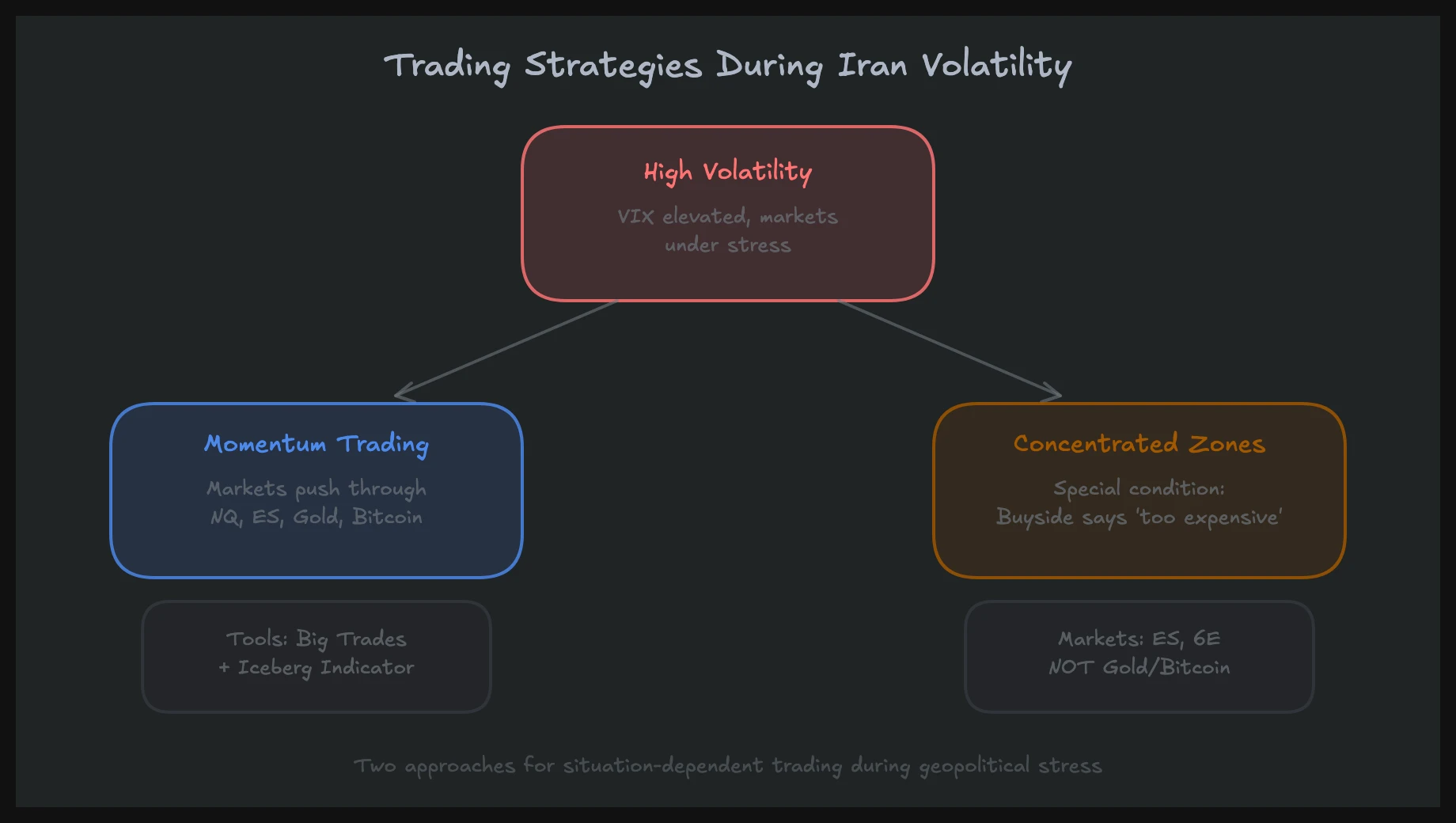
Strategy 1: Momentum Trading
Elevated VIX and volatility means elevated momentum. Markets in high-volatility regimes tend to push through in one direction rather than chop around. You will see sustained moves where price just keeps driving, driving, driving in one direction.
I exploit this by entering at key levels, taking profit, closing, and repeating. The key is a tight stop-loss and the discipline to take profits rather than hoping for more.
The tools I rely on: Big Trades (showing where large participants enter the market) and our proprietary Iceberg indicator (displaying only confirmed iceberg orders where a large player has pushed price in a verified direction). Together they tell me where institutional money is flowing in real time.
Markets for momentum trading: Nasdaq (NQ), S&P 500 (ES), potentially crude oil (CL) if liquidity holds up, and gold.
Strategy 2: Concentrated Zones
This strategy only works when a specific condition is met. When volatility gets extreme, the buyside (institutional speculators) eventually says: "Stop. This is too expensive." The sellside (market makers) provides liquidity and the buyside consumes it. My background is on the buyside as a junior institutional trader, and I have lived this exact situation. When prices get so expensive that the buyside walks away, trading activity compresses into very tight, concentrated zones.
Once market makers realize they cannot extract more profit, a release occurs. Volume floods back in, and price breaks out of these compressed zones violently.
I trade this in ES and 6E (Euro futures), deep liquid markets where institutional dynamics play out cleanly. Do not try this in gold or bitcoin, as those markets are too thin and volatile for it to work. The sequence: (1) extreme volatility, (2) buyside pulls back, (3) market makers hit their profit ceiling, (4) volume concentrates, (5) breakout. You can trade the breakout or anticipate it within the zone.
The Bitcoin Side Effect
Here is something most people are not thinking about: Iran accounts for roughly 4-5% of the global Bitcoin hashrate. With the conflict escalating, that mining capacity is likely dropping offline. The network gets thinner, meaning fewer miners are competing to validate transactions.
This creates a potential long opportunity. A thinner network combined with the current price pullback could set up an attractive entry, especially if we see positive ETF flows when US markets open. Bitcoin trades 24/7, giving us early signals before the equity session starts.
Watch for two things: (1) hashrate data confirming Iranian mining has dropped, and (2) ETF inflows turning positive during US hours. If both happen, Bitcoin could be a strong situational investment alongside the traditional plays I outlined above. For short-term trading, Bitcoin is also viable as a momentum instrument following the same approach I described for NQ and ES.
FAQ
How does the USA-Iran conflict affect oil prices?
The conflict pushes oil prices higher through three simultaneous forces: military operations increase fuel demand, production facilities like Saudi Aramco are being damaged (reducing supply), and the Strait of Hormuz is restricted (blocking a major shipping route). If the conflict persists, sustained high oil prices feed into broader inflation and affect everything from consumer prices to central bank policy.
What should traders watch during a geopolitical escalation?
Four things. The VIX: above 25-30, expect expanded daily ranges and momentum moves. Oil price action, because it is the primary transmission mechanism. Bond yields, because rising inflation expectations shift rate pricing and equity valuations. And ETF flow data (especially Bitcoin and sector ETFs), because institutional positioning shows where smart money expects things to go. For more on how these pieces connect, see our guide on black swan events and trading.
When do geopolitical situational investments stop working?
These plays unwind when conditions reverse. If the Strait of Hormuz reopens or the US secures shipping lanes, oil drops and the inflation thesis weakens. Energy stocks, gold, TIPS, and tanker companies like Frontline would give back gains. Value stocks and REITs hold up better since their appeal is partly independent of the conflict. Do not treat these as set-and-forget positions; geopolitical trades have clear catalysts in both directions.
In our macroeconomics course with 20 video lessons, you'll learn how oil prices, inflation, and bond yields interact and how geopolitical events inform your trading decisions. At tra-mada.de/en, you'll find more than 900 video lessons from institutional traders.