
 By Marco Bösing
Black Swan Events: How to Protect Your Trading Account from the Unexpected
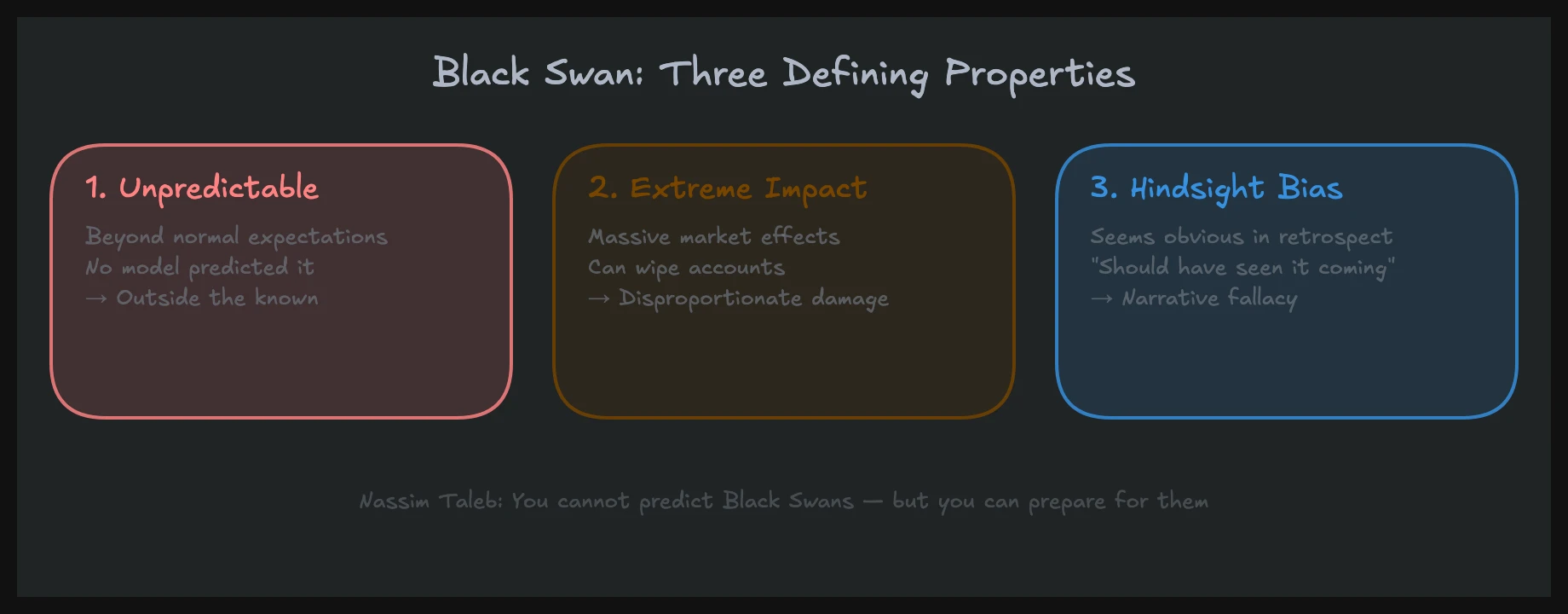
A black swan event is an unpredictable, extreme occurrence that carries massive market impact and, afterward, feels obvious in hindsight. Nassim Nicholas Taleb coined the term, and his core argument still holds: we systematically underestimate tail risk. In black swan trading, survival is the only metric that matters.
Risk Disclaimer: Trading futures and other financial instruments involves significant risk of loss. Past results are not indicative of future performance. Only trade with capital you can afford to lose.
What Makes a Black Swan Different
Not every market sell-off is a black swan event. A bad NFP print that drops NQ 150 points is normal. A pandemic shutting down global economies in a week is a black swan. The Flash Crash of May 6, 2010, when the Dow fell nearly 1,000 points in minutes, was a black swan. COVID-19 in March 2020, when the S&P 500 lost 34% in 23 trading days, was a black swan.
The defining features: the event is outside normal expectations, it carries extreme consequences, and people construct narratives afterward explaining why it was "predictable." It wasn't. That's the whole point.
For traders, the distinction matters because black swans break normal market behavior. Correlations that held for years collapse. Liquidity disappears. Stop orders don't fill at your price. The usual news trading strategy that works for scheduled events like FOMC or NFP is useless here because there's no calendar entry for a pandemic or a flash crash.
This is what our NQ Masterclass calls an "anomaly regime." The market isn't just volatile. It's broken from a structural perspective. The rules change, and if you don't recognize that shift immediately, your account pays the price.
Five Protections You Set Up Before It Happens
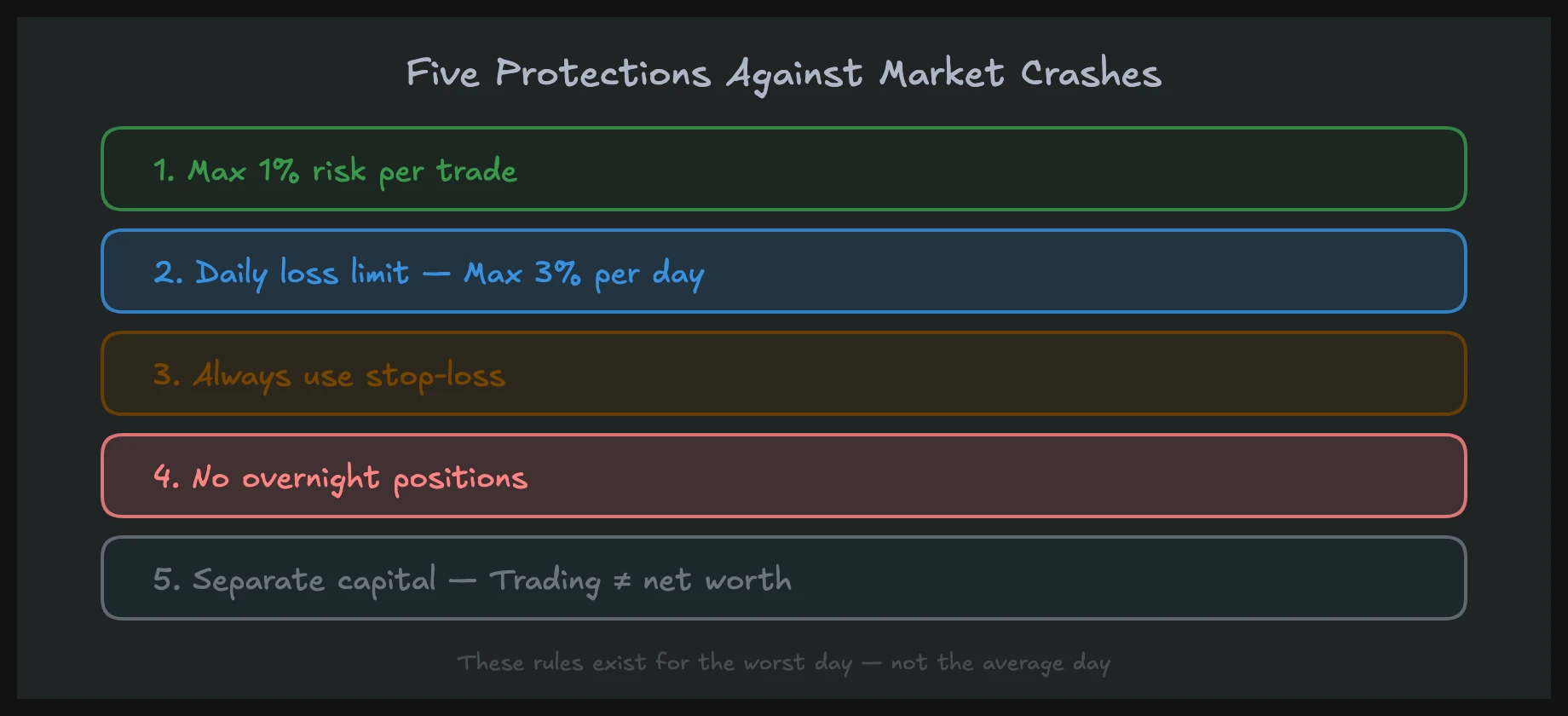
Black swan protection is not something you implement during the event. By then it's too late. These five rules run permanently, every day, whether the market feels safe or not.
-
Risk no more than 2% per trade. This is the single most important rule. At 2% risk, you can survive 10 consecutive losses and still have 80% of your account. At 5% risk, 10 losses in a row leaves you with 60%. In a black swan, correlated losses come fast. The 2% cap keeps you in the game. This is the same principle our Money Management module teaches across 8 lessons: capital protection always comes before growth.
-
Set a daily loss limit of 3 to 5%. When you hit this number, you're done for the day. No exceptions. On a $50,000 account, that's $1,500 to $2,500 maximum. On professional desks, this is enforced by the system itself. Your access gets locked. As a retail trader, you enforce it yourself. Write the number on a sticky note next to your screen. More on daily limits in our risk management guide.
-
Always use stop-losses. Every position, every time. "I'll watch it and exit manually" is a strategy that works until it doesn't. In a flash crash, you won't react fast enough. The bid can gap through five price levels before you click the mouse. A stop-loss won't guarantee your fill price, but it guarantees the order is in the system.
-
Avoid overnight positions unless intentional. Most black swans hit outside regular trading hours or at the open. If you carry overnight positions casually because you "forgot to close" or "it was still looking good," you're exposed to gap risk you didn't plan for. If you hold overnight, do it deliberately, with position size adjusted for the wider risk window.
-
Separate your capital. Don't put your entire trading capital in one account at one broker. Keep 60 to 70% of your total capital in your trading account and the rest in a separate bank account. If something catastrophic happens, broker insolvency, a flash crash that blows past your stops, you still have capital to restart. This is insurance, not optimization.
These five protections cost nothing. They require no special tools, no software, no subscription. They just require discipline, which is exactly what our 'Building a Trader' program trains.
During the Black Swan: The Three-Day Playbook
When a black swan event hits, your response depends entirely on whether you're in a position or flat.
If you're in a position: Do not panic-close everything at the worst possible price. Your stops should already be in place (see Protection #3). Let them do their job. If your stop gets hit, accept the loss. If you're in a winning position because you were on the right side, tighten your stop to lock in profit but don't exit prematurely just because the news looks scary. Fear-driven exits at the bottom of a crash are how traders turn a manageable loss into a catastrophic one.
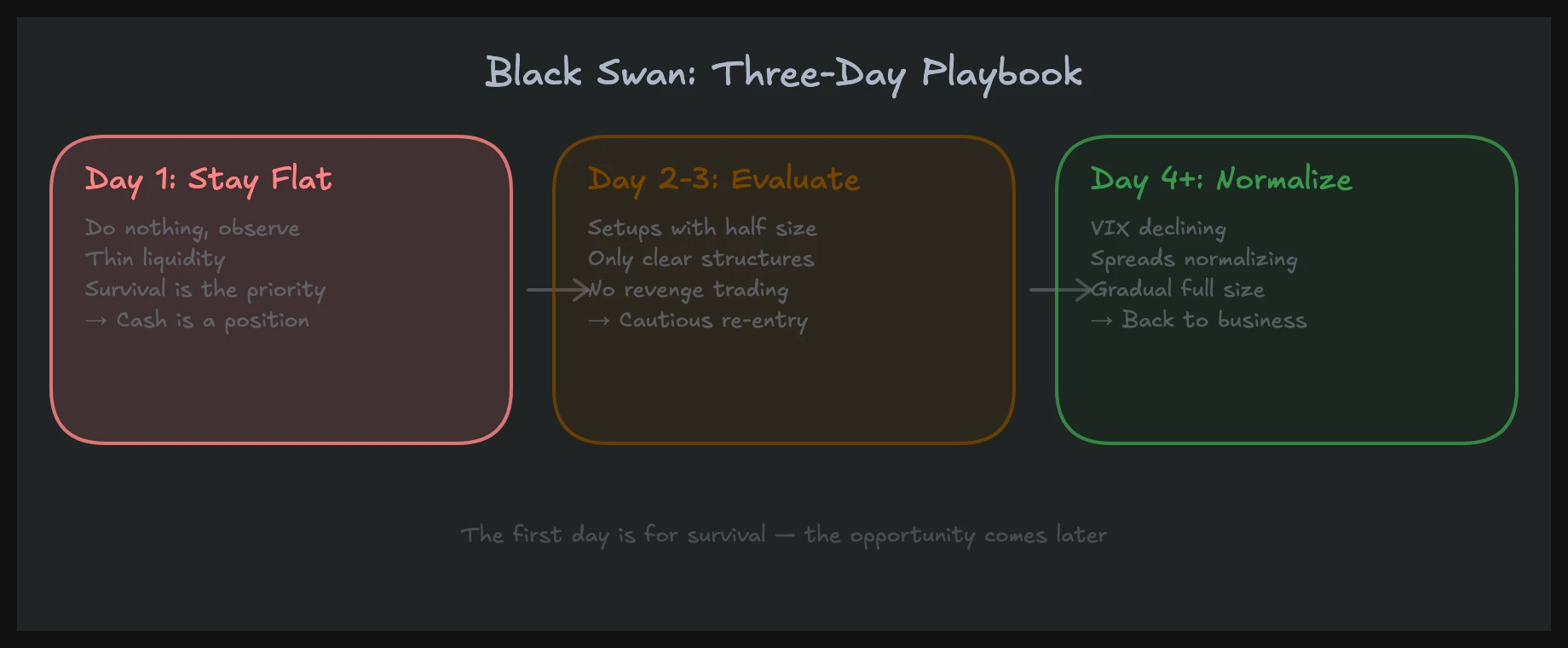
If you're flat: Do nothing on Day 1. This is the hardest advice to follow. The market is moving hundreds of points. It feels like you're missing the opportunity of a lifetime. You're not. Day 1 of a black swan is chaos. Liquidity is thin, spreads are wide, and price action is driven by forced liquidations and margin calls, not by rational market participants. The risk-reward is terrible even if you guess the direction correctly.
Day 2 to 3 is where opportunity appears. The initial panic subsides. Liquidity returns. You can identify real support and resistance levels instead of just watching freefall. The best trades after COVID's crash in March 2020 came on days 3 through 5, not on the initial drop. The same was true after the 2010 Flash Crash. Patience is the edge.
For context on how tariff-driven shocks play out differently from pure financial black swans, see our analysis of Trump tariffs and market impact.
After the Storm: Recovery Protocol
The event is over. Markets have stabilized. Now what?
Assess your damage honestly. Open your journal. Calculate your actual drawdown. Compare it to what your rules predicted. If your drawdown was close to your theoretical maximum, your risk management worked. If it was much worse, something broke down: you removed a stop, you exceeded your position size, you traded on Day 1 when you should have been flat. Identify the exact failure point.
Reduce size for two weeks. Even if your account is intact, your psychology isn't. After a black swan, traders tend toward two extremes: they become overly cautious and miss valid setups, or they become reckless trying to "make it back." Both are emotional responses. Trading at half size for 10 to 14 trading days gives your nervous system time to recalibrate. This is standard practice on institutional desks. After major market events, risk limits stay reduced even when the VIX normalizes. The reasoning is that the psychological impact lingers longer than the volatility itself.
Journal everything. Write down what happened, what you felt, what you did, and what you should have done. This isn't therapy. It's data. The next black swan is coming. You don't know when, but you know it will happen. Your journal is the playbook for next time.
Institutional reality: Every professional trading desk has circuit breakers. Automatic position cuts at defined loss levels. Mandatory size reductions after drawdowns. Cooling-off periods. These aren't signs of weakness. They're the reason those desks survive for decades. For more on how high volatility changes the rules and why the VIX is your early warning system, read our volatility cluster.
FAQ: Black Swan Events in Trading
What is a black swan event in trading?
A black swan event is an extremely rare, unpredictable market occurrence with severe financial consequences. The term comes from Nassim Nicholas Taleb's 2007 book. Examples include the 2010 Flash Crash, the COVID-19 crash in March 2020, and the Swiss National Bank removing the EUR/CHF floor in January 2015. These events share three traits: they are outside normal expectations, they carry extreme impact, and they appear "obvious" only in retrospect.
How do I protect my account from a crash?
Five permanent protections: risk no more than 2% per trade, set a daily loss limit of 3 to 5%, always use stop-losses, avoid casual overnight positions, and keep reserve capital in a separate account. These rules run every day, not just when you expect trouble. The whole point of black swan protection is that you can't predict when you'll need it.
Can you profit from black swan events?
Yes, but not on Day 1. The initial crash is driven by forced liquidations and panic. Spreads are wide, fills are bad, and direction can reverse violently. The real opportunity comes on Day 2 to 3, when liquidity returns and you can identify structural levels. Traders who stayed flat during the initial COVID drop and entered long positions on day 3 to 5 captured some of the fastest recoveries in market history. Patience, not prediction, is the edge.
Preparation Is the Only Strategy
You cannot predict black swans. That's what makes them black swans. But you can build an account structure and a set of rules that survives them. The five protections above are not optional extras. They are the foundation.
Our 30-day program 'Building a Trader' trains exactly the mental resilience you need in extreme situations. In our risk management module, you'll learn the principles institutional desks have applied for decades. At united-daytraders.com, you'll find over 1,500 video lessons from institutional traders.