
 By Marco Bösing
Building a Trading Routine: The Daily Schedule of Successful Day Traders
A trading routine is a fixed sequence of daily actions, from pre-market analysis through active trading to an evening review, that removes decision fatigue and turns disciplined behavior into automatic habit. It is the single most underrated edge a day trader can build.
Risk Disclaimer: Trading futures and other financial instruments involves significant risk of loss. Past results are not indicative of future performance. Only trade with capital you can afford to lose.
Why a Routine Matters More Than Any Strategy
Most traders spend months searching for the perfect setup, the right indicator, or the ideal entry technique. I did the same thing early on. What I eventually realized is that execution consistency matters far more than any individual strategy. A mediocre plan executed with discipline will outperform a brilliant plan executed randomly.
The reason is simple: markets are probabilistic. Your edge only materializes over a large sample of trades. If you skip prep on Monday, overtrade on Tuesday, and abandon your rules on Wednesday because you're frustrated, your sample is contaminated. No edge survives inconsistent execution.
A routine solves this by taking willpower out of the equation. You don't decide whether to prepare. You don't decide whether to journal. You just do the next step because that's what the schedule says. After a few weeks, it stops requiring effort at all.
Routine Turns Discipline Into Habit
There's a concept from our "Building a Trader" program that I keep coming back to: a routine is not something you add on top of discipline. A routine is discipline, packaged into habits. Week 2 of that program focuses entirely on habit formation, and the core insight is that willpower is a depleting resource. Every decision you make during the trading day costs mental energy. If you're spending that energy on deciding when to look at charts, whether to check macro data, or if you should journal tonight, you have less left for the decisions that actually matter: trade management.
The traders I've worked with who consistently perform well all have one thing in common. Their days look nearly identical. Not because they're boring people, but because they've automated everything that doesn't require real-time judgment.
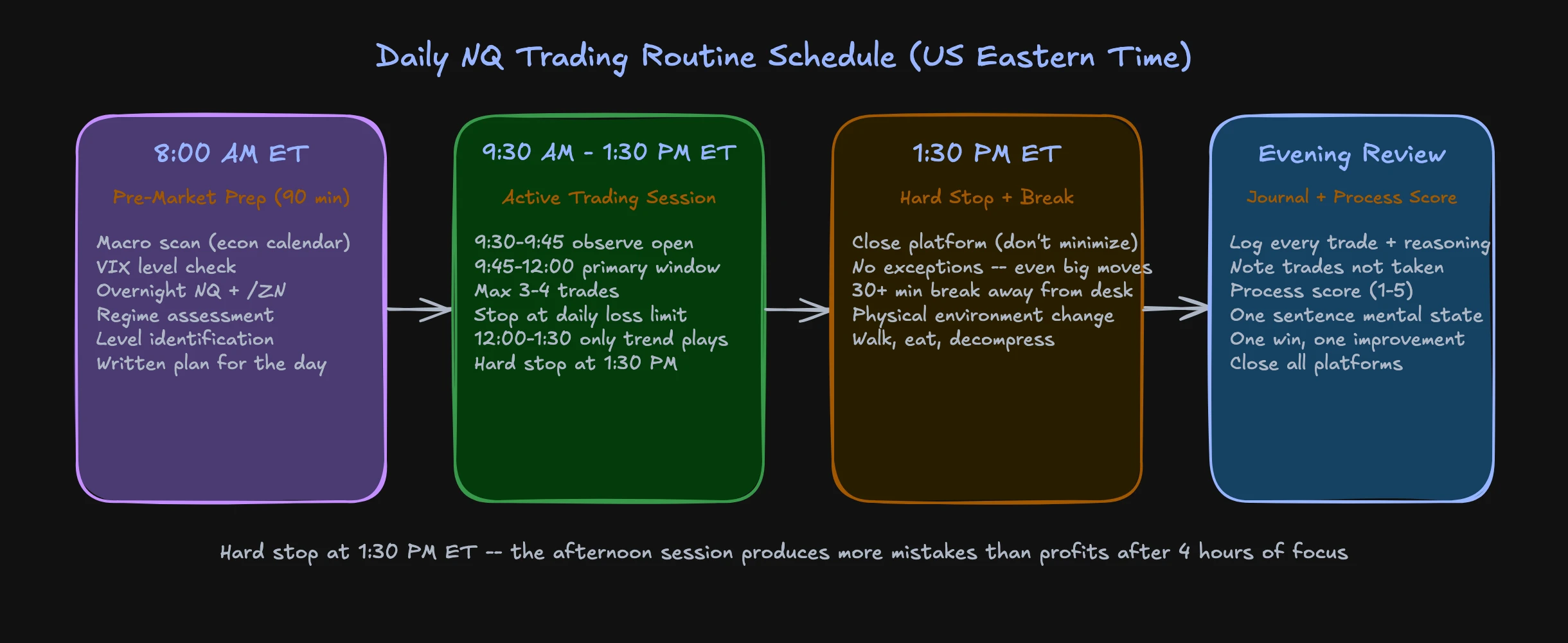
The Daily Schedule: How I Structure My Trading Day
What follows is my actual daily structure for trading NQ futures. I trade the US session from Europe, so my times are adjusted accordingly. If you're based in the US, shift everything to your local open. The principle stays the same.
Pre-Market Preparation (60-90 Minutes Before Open)
The trading day starts long before the opening bell. I sit down 60 to 90 minutes before the US cash open (so around 2:00 PM CET, or 8:00 AM ET for US-based traders) and run through a fixed checklist:
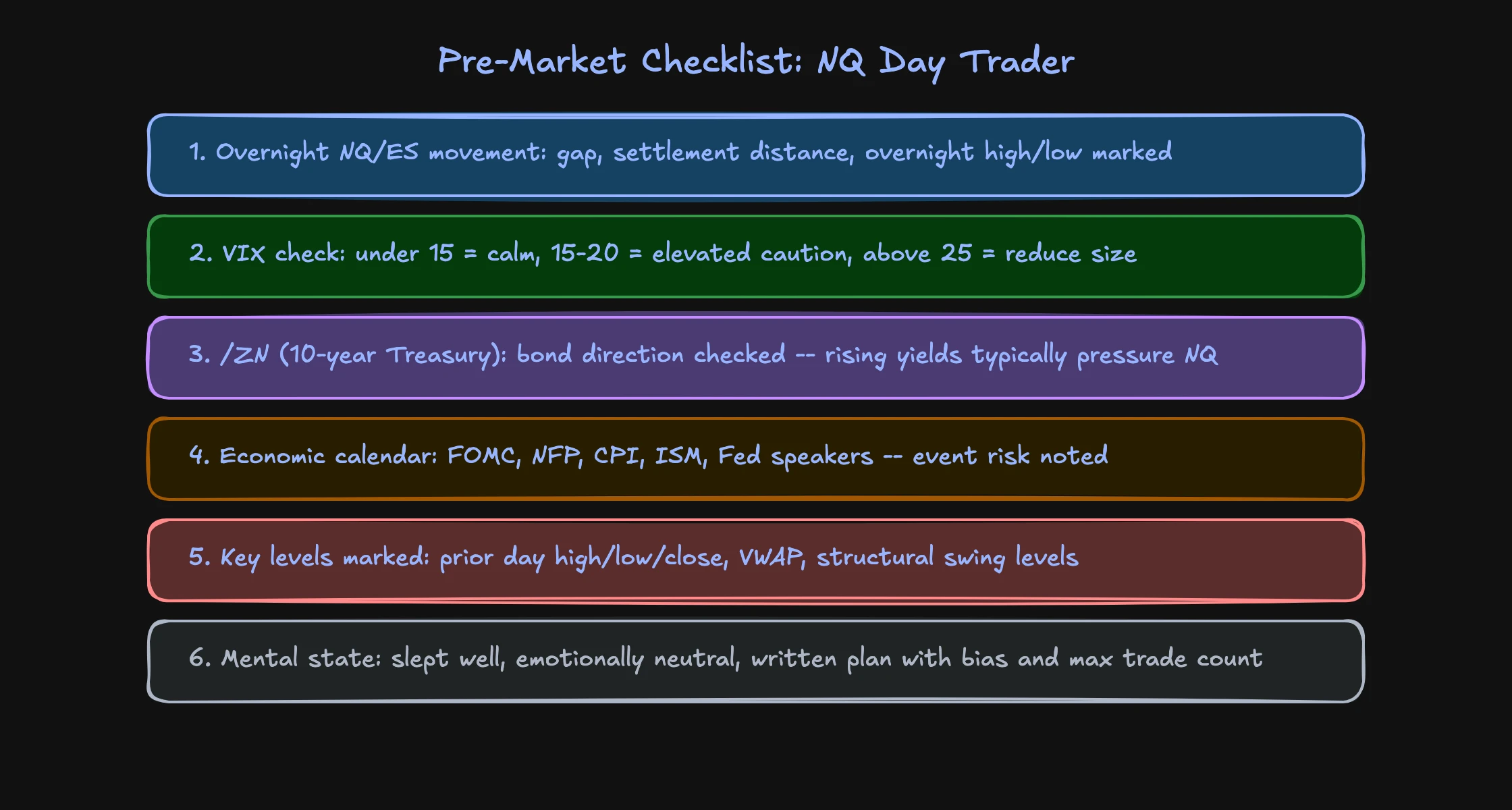
1. Macro scan (15 minutes) I check the economic calendar for scheduled releases (FOMC, NFP, GDP, ISM). I look at overnight price action in NQ, ES, and /ZN (10-year Treasury futures). I note the VIX level and whether it's rising or falling relative to the prior session. If VIX is above 25, I know I need to adjust position sizing. If there's a major data release within the first hour, I may choose not to trade the open at all.
2. Overnight context (10 minutes) Where did the overnight session trade relative to the prior day's range? Did we gap up or down? Is there a clear overnight high or low that could act as a reference? I mark these levels on my chart.
3. Regime assessment (10 minutes) This is the most important step. I determine whether the current environment is trending, range-bound, or transitional. This single decision shapes everything: which setups I look for, how aggressively I size, and how long I hold. A trending day in NQ requires completely different execution than a choppy rotation day.
4. Written plan (10 minutes) I write down, by hand or in a document, my bias for the day, the levels I'm watching, and the maximum number of trades I'll take. Writing it down matters. A plan that only exists in your head changes with every tick.
Level Identification
Levels are the backbone of my approach. Before each session, I identify three categories:
- Key daily levels: prior day high, low, and close. These are non-negotiable reference points.
- Structural levels: swing highs and lows from the past 5 to 10 sessions that have shown clear reactions.
- Dynamic levels: VWAP and its standard deviation bands for the current session.
I don't clutter my charts with 15 lines. I pick the 3 to 5 most relevant levels and focus on those. If price isn't near one of my levels, I'm not trading. This alone eliminates a huge number of impulsive trades.
For a deeper look at how risk management ties into level selection and position sizing, that article covers the framework I use.
The Trading Session (Max 4 Hours of Focus)
This is the part most traders get wrong. They sit in front of screens for 8 or 10 hours, thinking more screen time equals more opportunity. It doesn't. After about 4 hours of active focus, decision quality drops sharply. I've tracked this in my own performance data: my win rate after hour 4 drops by roughly 15%.
My active session runs from the US cash open (9:30 AM ET) through early afternoon (around 1:30 PM ET). Within that window:
- First 30 minutes: I observe. I almost never trade the opening rotation unless I have very high conviction. The open is noisy, spreads can widen, and the overnight gap resolution creates false signals.
- 9:45 AM to 12:00 PM ET: This is my primary trading window. Most of my setups trigger here. I take a maximum of 3 to 4 trades per session. If I hit my daily loss limit (which I define in dollar terms, not number of trades), I stop.
- 12:00 PM to 1:30 PM ET: The lunch hour in US markets is typically lower volume. I only trade here if there's a clear trend continuation or a setup at a major level. Otherwise, I step away from the screen entirely.
At 1:30 PM ET, I'm done. No exceptions. The afternoon session (2:00 PM to 4:00 PM ET) can produce big moves, especially around bond market close at 3:00 PM or the equity close at 4:00 PM. But I've learned that chasing those moves after 4 hours of focus leads to poor decisions. If I miss a move, I miss it.
End of Day: Wind Down and Review
After I close my platform, I take at least a 30-minute break. I go for a walk, eat something, or do anything unrelated to markets. This buffer is critical. If you go straight from trading into journaling, you carry the emotional charge of the session into your review, which corrupts your analysis.
Then I sit down for my trading journal review. This takes 20 to 30 minutes and covers:
- Every trade taken: entry, exit, reasoning, and whether it followed the plan
- Trades I considered but didn't take, and why
- My emotional state during the session (one sentence, not a novel)
- One thing I did well, one thing I'll improve tomorrow
The journal article covers the mechanics of reviewing in detail. What matters here is that the review is part of the routine, not something you do "when you have time." You always have time. You just have to schedule it.
The Three Most Common Routine Mistakes
No Fixed End Time
This is the number one killer. Without a hard stop, you will always find a reason to keep trading. "Just one more setup." "The market is moving, I can't miss this." Every experienced trader I know has a fixed end time. The market will be there tomorrow.
No Preparation, Only Reaction
Some traders open their charts at 9:29 AM and start clicking. They have no levels marked, no macro context, no plan. They're purely reactive, which means they're at the mercy of every tick. Preparation is what separates trading from gambling. If your trading psychology suffers from impulsive entries, the fix is almost always in the preparation phase, not in the execution phase.
Skipping the Journal
The journal is where learning happens. Without it, you repeat the same mistakes indefinitely. I've seen traders go years without improving because they never once sat down to review their own data. The 20 minutes it takes to journal are the highest-ROI minutes of your entire day.
FAQ: Trading Routine
How long does it take to build a trading routine?
Based on my experience and the structured approach in our "Building a Trader" program, it takes roughly 30 days of consistent practice before a routine feels automatic. The first two weeks are the hardest because you're fighting old habits. By week three, you start noticing that you sit down for prep without thinking about it. By week four, skipping a step feels uncomfortable, which is exactly what you want.
Do I need to trade every day?
No. Some of the best trading days are days you don't trade at all. If your pre-market prep reveals a low-probability environment (VIX spike with no clear direction, major news risk, or a holiday-thinned market), the correct action is to close the platform and do something else. A routine includes criteria for not trading. That's part of the discipline.
Not trading is a position. Protect your capital for the setups that actually meet your criteria, and you'll find that your overall results improve dramatically.
Our 30-day program "Building a Trader" systematically trains exactly these mental skills. From habit formation to burnout prevention, it gives you the structure to turn scattered effort into consistent performance.