
 By Marco Bösing
Trading Burnout: Why Traders Burn Out and How to Prevent It
Trading burnout is a state of chronic physical and emotional exhaustion caused by prolonged, unstructured exposure to markets. It typically develops when traders abandon sustainable routines in favor of constant screen time, tie their self-worth entirely to P&L, and lose the boundaries between trading and the rest of their life. Unlike a bad week, burnout doesn't fix itself with a single day off.
Risk Disclaimer: Trading futures and other financial instruments involves significant risk of loss. Past results are not indicative of future performance. Only trade with capital you can afford to lose.
The 5 Stages of Trading Burnout
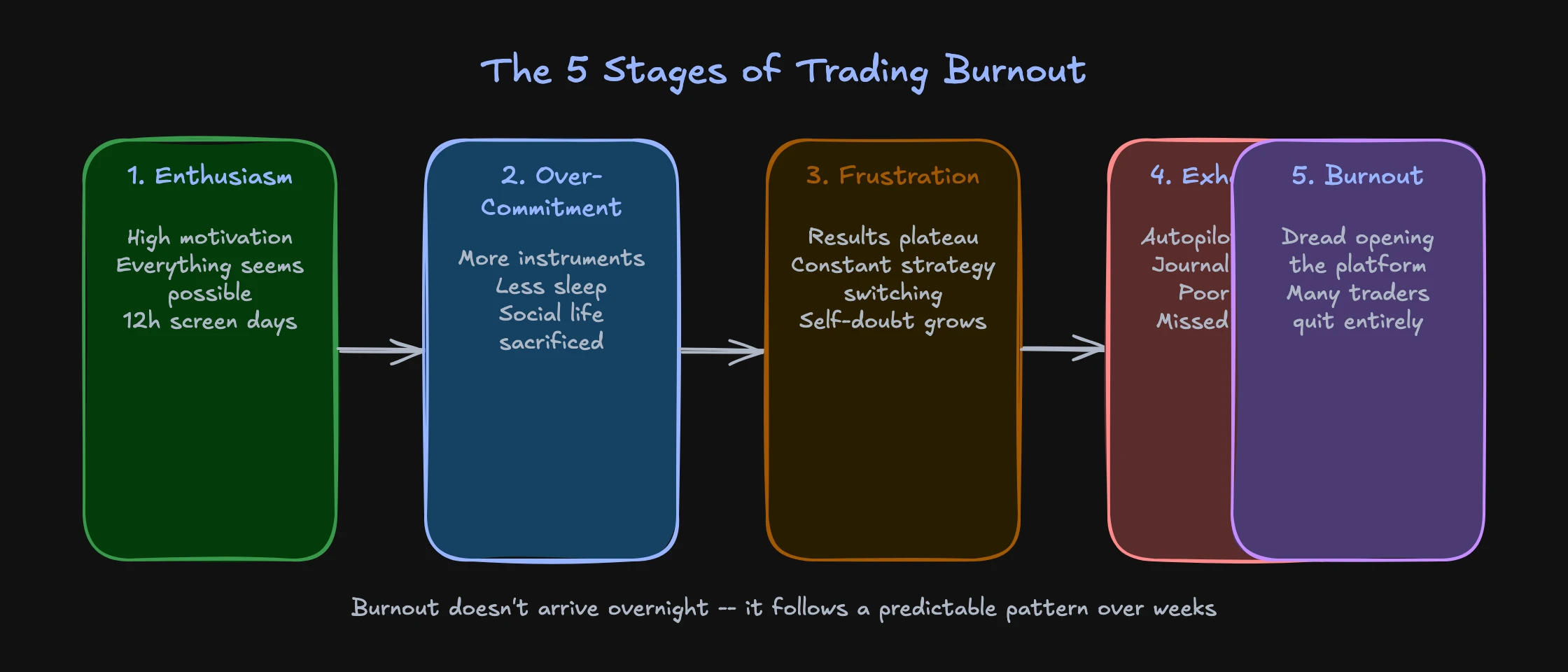
Burnout doesn't arrive overnight. It follows a predictable pattern that I've seen play out hundreds of times, both in my own career and in the traders I coach. Understanding the stages is the first step to catching yourself before you hit the bottom.
Stage 1: Enthusiasm
Every trading career starts here. You've found the markets, maybe you hit a few good trades on ES or NQ, and you're convinced this is going to work. You're watching YouTube videos until midnight, reading order flow books, back-testing setups on weekends. The energy feels limitless.
This stage is actually dangerous because it feels so productive. You're learning fast, and the dopamine hit of a green day reinforces the belief that more effort equals more results. I remember my first year trading NQ futures. I was at the screen by 7:30 AM Eastern, and I rarely stepped away before 5 PM. On weekends, I reviewed every single trade. It felt like dedication. In hindsight, it was the beginning of a pattern that nearly ended my trading career.
The problem isn't enthusiasm itself. It's that the intensity sets an unsustainable baseline. Your brain starts treating 12-hour screen days as "normal," and anything less feels like slacking.
Stage 2: Over-Commitment
This is where traders start adding complexity instead of subtracting it. You're watching three markets at once. You've added a second strategy before the first one is profitable. You're active in four Discord groups, running a trading journal, posting on social media, and trying to trade the Asian session because someone in a chat said the Nikkei setup was "free money."
The law of cause and effect applies here with perfect clarity: if you commit to a workload that no human can sustain, the outcome is predictable. It's not a question of willpower. Your body and mind have hard limits, and they don't care about your P&L targets.
I see this stage constantly in traders who are three to six months into their journey. They've had enough wins to feel confident but haven't experienced the grind of a flat or losing month. They stack commitments because they believe effort and outcome have a linear relationship in trading. They don't.
Signs you're in Stage 2:
- You feel guilty taking a day off
- You check your phone for market updates during dinner
- You've added new instruments or sessions without dropping anything
- Your trading journal entries are getting shorter or less detailed because you "don't have time"
Stage 3: Frustration
Results plateau or decline, but you're working harder than ever. This creates a cognitive dissonance that is genuinely painful. You start questioning your strategy, your edge, yourself. The internal narrative shifts from "I'm figuring this out" to "What's wrong with me?"
At this stage, traders typically do one of two things: they double down (more hours, more risk, more trades) or they start switching strategies constantly. Both responses accelerate the burnout cycle.
I went through a brutal Stage 3 period when I was trading ES. I was consistently overtrading, taking 15 to 20 trades a day when my edge was in 3 to 5 high-quality setups. My win rate dropped from 58% to around 41% over six weeks. I couldn't understand why, because I was "doing more work." The extra trades weren't just neutral, they were actively destroying my P&L. I've written more about that pattern in my piece on overtrading.
Frustration also erodes trading psychology. You start revenge trading, moving stops, increasing position sizes to "make back" losses. These aren't strategy problems. They're exhaustion problems wearing a strategy mask.
Stage 4: Exhaustion
Your body and mind start forcing the issue. Common symptoms at this stage:
- Poor sleep, even when you're tired
- Difficulty concentrating during market hours
- Physical tension (neck, shoulders, jaw clenching)
- Irritability outside of trading
- Loss of interest in hobbies or social activities
- Consistently poor execution on trades you "know" are right
This is where the damage becomes measurable. Your reaction time slows. You miss entries. You hesitate on exits. A setup you've taken 200 times suddenly feels uncertain. It's not that your edge disappeared. Your ability to execute it did.
I've spoken with traders who described this stage as "watching myself make mistakes in slow motion." They could see the right trade, but their mental and physical state wouldn't let them take it cleanly. One trader I coached was so exhausted that he fell asleep during the RTH open on NQ, missed a setup he'd been waiting three days for, and then rage-traded for the next two hours. He gave back two weeks of profit in a single session.
Stage 5: Burnout
Full burnout means you can't trade at all, or you're trading so poorly that you'd be better off not trading. The screen feels oppressive. The thought of another pre-market analysis fills you with dread. Many traders at this stage simply quit. They close their accounts, tell themselves the markets are rigged, and walk away.
The tragedy is that many of these traders had genuine edges. They didn't fail because of their strategy. They failed because they treated themselves like a machine that could run 24/7 without maintenance.
Some traders don't quit but enter a zombie state: they sit at the screen, stare at candles, and barely trade. They've lost all confidence but can't let go. This limbo can last months or even years.
Why Day Traders Are Especially Vulnerable
Day traders face a unique set of burnout risk factors that swing traders and position traders simply don't deal with. The structure of the work itself creates the problem.
The Desk vs. Home Office Gap
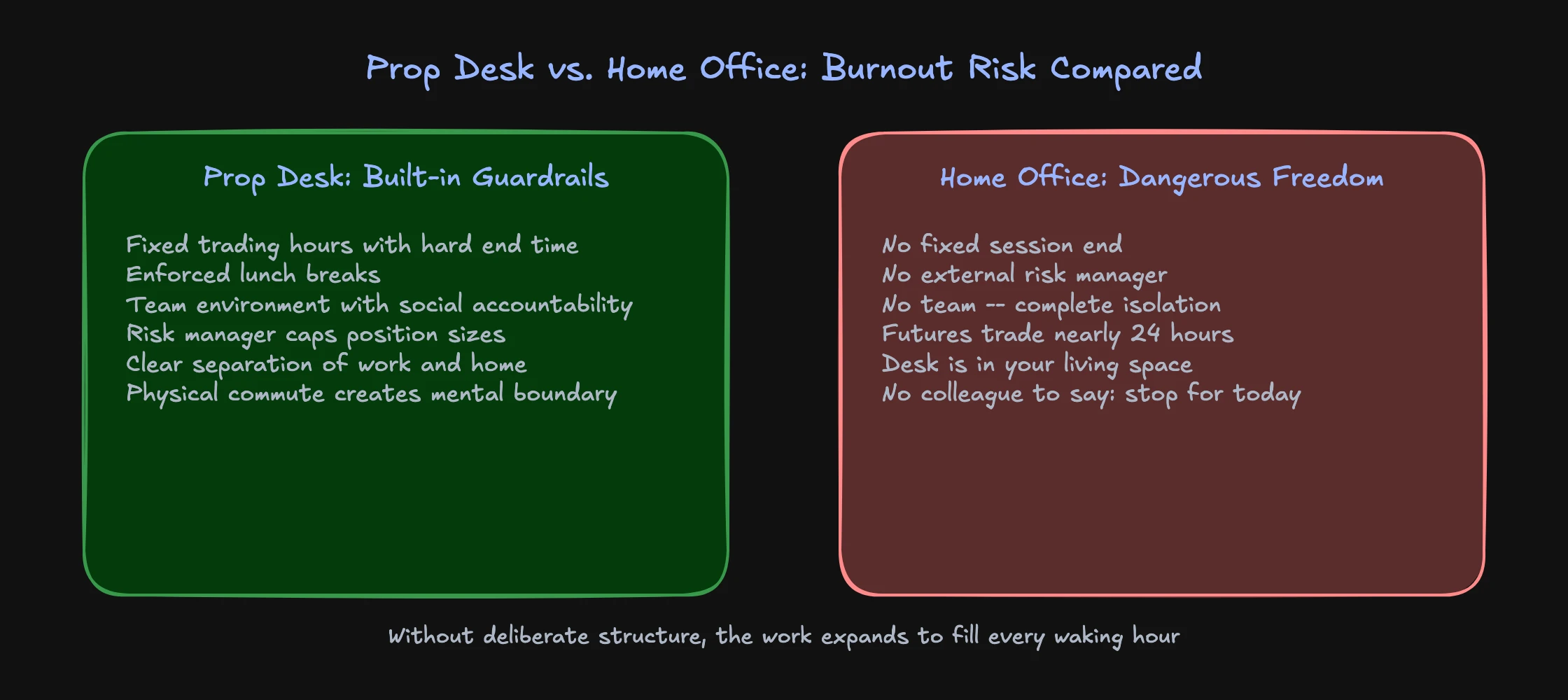
At a proprietary trading firm or institutional desk, there are built-in guardrails. The market opens, you trade, the market closes, you go home. There's a risk manager watching position sizes. Colleagues take lunch breaks together. The physical separation between the office and your home creates natural boundaries.
Solo day traders have none of this. Your desk is in your spare bedroom. The market is always accessible (futures trade nearly 24 hours). There's no one to tell you to stop. The commute is eight steps from your kitchen to your chair.
This is exactly why our program dedicates an entire week to managing distractions and creating boundaries between trading and life. Without deliberate structure, the work expands to fill all available time. And when your workplace is also your living space, "available time" means every waking hour.
I've seen traders who literally cannot eat a meal without a chart on their phone. Their partners complain about emotional absence. Their kids know not to talk to them before the market closes. This isn't discipline. It's dysfunction disguised as dedication.
The Isolation Problem
Trading is one of the loneliest professions that exists. You sit alone, make decisions alone, and experience the emotional consequences alone. A 3-point stop-out on NQ at $20 per point means you just lost $60 per contract, and nobody in your life understands why that hurts or why it matters.
The isolation compounds every negative emotion. A bad trade at a firm gets a "happens to everyone" nod from the desk. A bad trade at home gets silence, or worse, a concerned look from a partner who doesn't understand what you do.
Isolation also removes accountability. When nobody sees your screen, it's easy to skip the trading routine you know works. It's easy to trade during hours you promised yourself you wouldn't. It's easy to let "just one more trade" become five more.
How to Prevent Trading Burnout
Prevention requires systems, not motivation. You cannot willpower your way through burnout risk. You need structural guardrails that operate whether you feel like following them or not.
Cap Your Screen Time
Set a hard maximum for active trading hours. For most futures day traders, three to four hours of focused screen time per day is the realistic maximum for high-quality execution. I know traders who trade for six or eight hours straight. Their performance data almost always shows that the quality of their trades degrades sharply after hour three or four.
When I was actively trading NQ, my rule was simple: I traded the first two hours of RTH (9:30 to 11:30 AM Eastern) and then stopped. If I wanted to trade the afternoon session, I had to take at least a 90-minute break with no screens. Most days, I didn't come back. Not because I was lazy, but because those two hours contained the best setups, and adding more time didn't add more edge.
Practical implementation:
- Use a timer. When it goes off, you're done.
- Close your charting platform. Don't minimize it. Close it.
- Have a post-session activity planned (gym, walk, lunch away from your desk)
- Track your per-hour performance. The data will convince you faster than any article.
Non-Negotiable Days Off
You need at least one full day per week with zero market exposure. No charts, no financial Twitter, no "just checking the weekly close." Your brain needs complete recovery, not partial recovery.
I take Saturdays completely off. No exceptions. I don't care if NFP was on Friday and the reaction is "interesting." It'll still be interesting on Sunday when I do my weekly prep. This single habit has done more for my longevity as a trader than any indicator or strategy change.
Some traders resist this because they're afraid of missing opportunities. Here's a number that might help: there are roughly 252 trading days per year. Taking 52 days off leaves you with 200 sessions. If your edge can't survive operating on 200 sessions instead of 252, you don't have an edge. You have a lottery ticket.
Process Metrics Over P&L Obsession
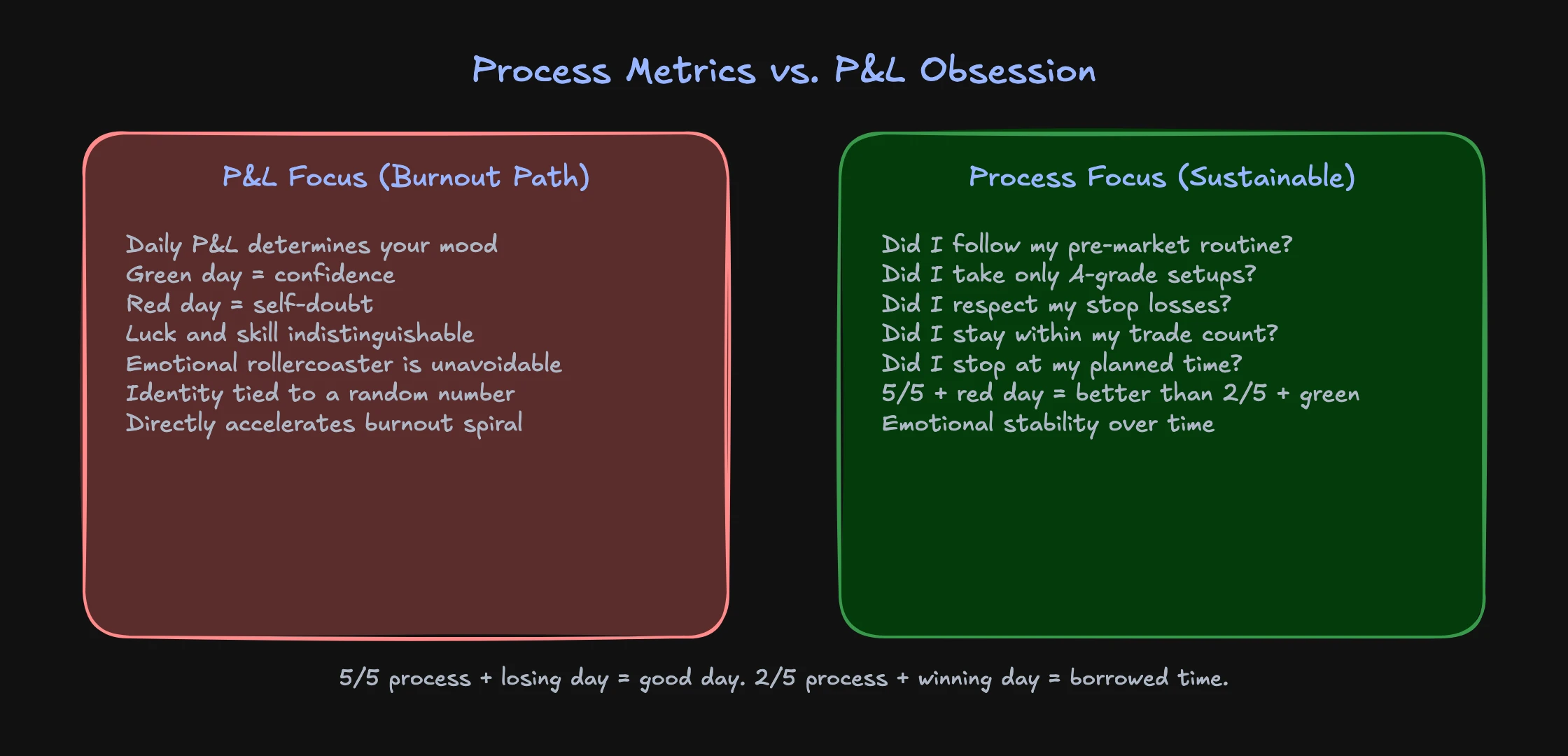
Tying your self-worth to daily P&L is the fastest path to burnout I know. Markets have variance. You can execute perfectly and lose money. You can execute terribly and make money. If your emotional state is determined by which of these outcomes occurs on a given day, you're building your mental health on a random number generator.
Switch to process metrics:
- Did I follow my pre-market routine?
- Did I take only A-grade setups?
- Did I respect my stop losses?
- Did I stay within my maximum trade count?
- Did I stop trading at my planned time?
Score yourself on these daily. A day where you scored 5/5 on process but lost $300 is a better day than one where you scored 2/5 but made $500. The first is sustainable. The second is borrowed time.
This connects directly to risk management. When your process includes strict risk parameters, the daily P&L swings become smaller and more manageable emotionally, which reduces one of the primary burnout triggers.
Physical Exercise as a Requirement
This is not optional. I treat physical exercise with the same importance as my trading setup. Sitting in a chair staring at screens for hours creates physical tension that directly impacts decision-making. Elevated cortisol from inactivity impairs the prefrontal cortex, the exact part of your brain you need for trade management.
My minimum is 30 minutes of exercise before the market opens. Usually it's a run or a gym session. On days I skip it, I can measure the difference in my trading quality. My stop discipline gets worse, my patience drops, and I'm more likely to overtrade.
A 2020 study published in the Journal of Behavioral Finance found that traders who maintained regular exercise routines had 23% fewer impulsive trading decisions compared to sedentary traders. That's not a marginal difference. That's the difference between a profitable year and a losing one for many traders.
Building a Burnout-Proof Routine
The best defense against burnout is a routine so well-designed that it protects you automatically. You shouldn't have to make the right decision every day. The routine should make the right decision the default.
Morning Routine Before the Screen
Your first interaction of the day should not be with a chart. Period. When you wake up and immediately check futures, you've handed control of your emotional state to whatever happened overnight in the Nikkei or the European session.
My morning before the screen:
- Wake up without an alarm (consistent sleep schedule makes this possible)
- Water, coffee, no phone for the first 20 minutes
- Exercise (30 to 45 minutes)
- Shower, breakfast, away from any screen
- Sit down at desk, begin pre-market analysis
This sequence takes about 90 minutes. By the time I open a chart, I'm physically alert, emotionally neutral, and mentally prepared. Compare that to the trader who rolls out of bed, grabs their phone, sees that ES gapped down 20 points overnight, and starts the day in a state of reactive anxiety.
The building a trading routine article goes deeper into designing these sequences. The key principle is that your morning routine should produce the same mental state regardless of what the market did overnight.
Session Breaks and End-of-Day Rituals
Mid-session breaks matter even during active trading hours. After a loss, take five minutes away from the screen. Not to "calm down" (that framing implies you're already dysregulated) but as a standard procedure. Win or lose, the break happens.
End-of-day rituals are equally important. When your trading day ends, it needs to actually end. My close-out process:
- Log all trades in my journal with notes on execution quality
- Record my process score for the day (the 5-point system described above)
- Write one sentence about my mental state during the session
- Close all charting platforms and trading software
- Physically leave my desk
That last step matters more than it sounds. If you "finish trading" but keep sitting at the same desk, checking the same screens, your brain never gets the signal that work is over. You need a physical transition. Walk to a different room. Go outside. Change your environment.
When Burnout Has Already Hit
If you're reading this and recognizing yourself in Stages 4 or 5, prevention advice isn't what you need. You need recovery.
Immediate Steps
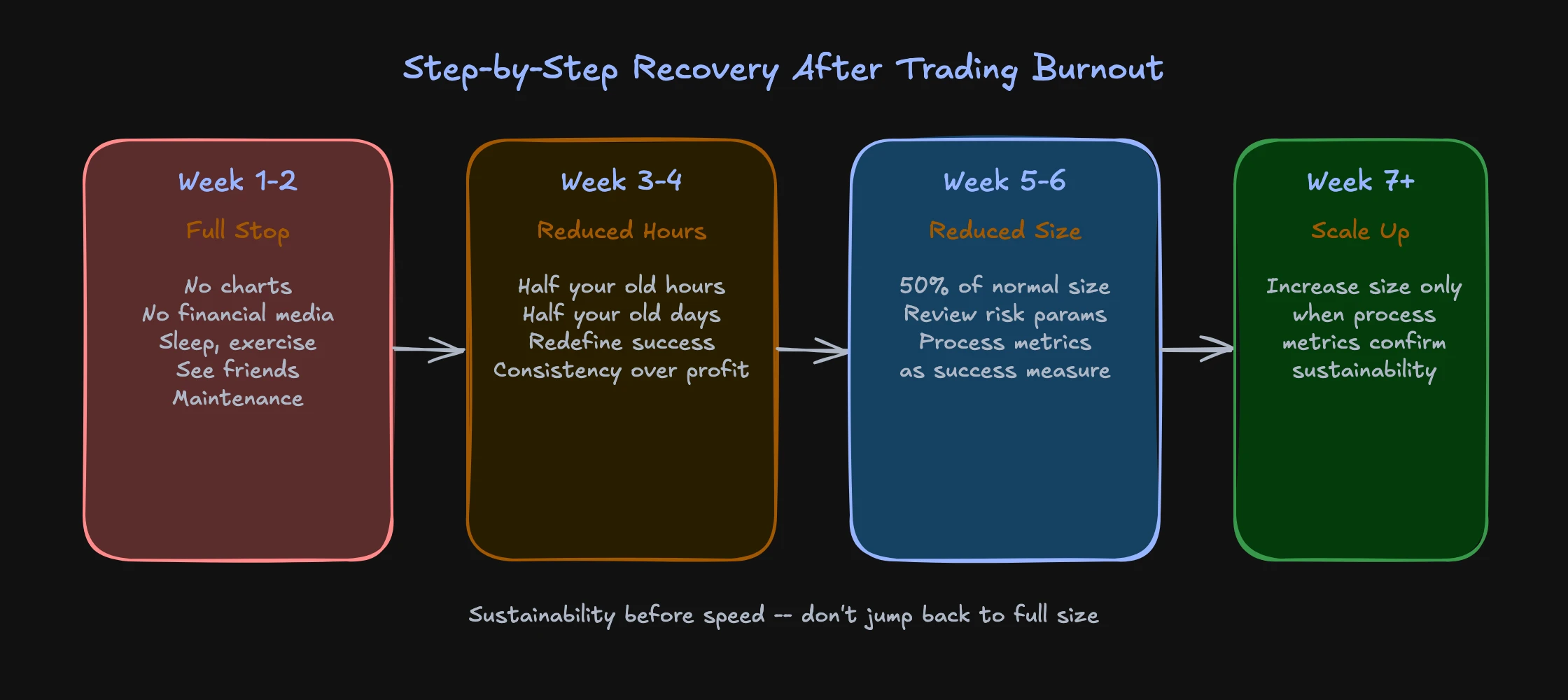
Stop trading. Not "trade smaller." Not "just watch." Stop. Close your platforms. The market will be there when you come back. Every day you trade in a burned-out state, you're doing two kinds of damage: financial (poor execution) and psychological (reinforcing negative associations with trading).
Take a minimum of one full week off. Two weeks is better. During this time:
- Do not look at charts
- Unfollow financial accounts on social media
- Do not visit trading forums or chat rooms
- Sleep, exercise, see friends, do things that have nothing to do with markets
- If you feel the urge to check prices, notice it, acknowledge it, and do something else
This is going to feel wrong. Your brain has been conditioned to equate screen time with productivity. Sitting on a park bench will feel "lazy." It isn't. It's maintenance. A Formula 1 car doesn't skip pit stops because it's "winning." It pits because that's how it keeps winning.
Talk to someone. A friend, a partner, a therapist, a fellow trader. Burnout thrives in silence. The moment you say "I think I might be burned out" out loud, you've broken the cycle of pretending everything is fine.
Long-Term Rebuilding
Coming back from burnout requires a fundamentally different structure than what caused it. If you return to the same schedule, the same habits, and the same expectations, you will burn out again. Guaranteed.
Start with reduced hours. If you previously traded six hours a day, come back with two. If you traded five days a week, start with three. Build back up slowly, and only increase when you can honestly say your current load feels sustainable.
Redefine success. Before burnout, success was probably measured in dollars. After burnout, success needs to be measured in consistency and sustainability. A month where you traded three days a week, followed your process, and broke even is a massive win if the alternative was quitting entirely.
Consider working with a mentor or joining a structured program. The accountability and external structure can replace the guardrails you need to build internally. This is one of the core reasons I designed the "Building a Trader" program the way I did: the 30-day structure forces sustainable habits before traders have a chance to develop destructive ones.
Review your risk management parameters. Burned-out traders often discover that their position sizing was too aggressive for their account size, creating unnecessary stress on every single trade. Reducing size by 50% during the rebuilding phase is not a sign of weakness. It's intelligent capital preservation.
FAQ: Trading Burnout
How do I recognize trading burnout?
The earliest signs are changes in your behavior outside of trading. If you're more irritable with family, sleeping poorly, losing interest in activities you used to enjoy, or feeling a sense of dread when you think about the next trading session, those are red flags. Inside trading, watch for declining execution quality despite knowing your setups, increased trade frequency without increased edge, and shortening or skipping your pre-market and post-market routines. If you've stopped writing in your trading journal, that's often one of the first habits to drop and one of the clearest warning signs.
How many hours a day should I trade?
For active day trading of futures (ES, NQ, CL), three to four hours of focused screen time is a practical maximum for most people. This doesn't mean you can't spend additional time on analysis, journaling, or education. But the high-intensity, real-money, real-time decision-making portion should be capped. Some of the best traders I know actively trade for less than two hours a day. They focus on a specific window (often the first 90 minutes of RTH), take their setups, and walk away. Their annual returns are consistently better than traders who sit at the screen all day. More hours does not mean more profit. It usually means more mistakes.
What can I do about acute trading stress?
First, separate acute stress from chronic burnout. Acute stress (a bad trade, a volatile session, an unexpected news event) is normal and manageable. Step away from the screen for 10 minutes. Do a physical activity, even just walking around the block. Drink water. Do not make any trading decisions while your heart rate is elevated.
If the stress is happening daily, it's no longer acute. It's chronic, and it means something structural needs to change. Common structural fixes: reduce position size until a full stop-out feels financially insignificant, narrow your trading window, trade fewer instruments, or take a planned break. The goal is to get your baseline stress level low enough that acute events don't push you into the danger zone.
Breathing exercises sound basic, but box breathing (4 seconds in, 4 seconds hold, 4 seconds out, 4 seconds hold) before the session open measurably reduces cortisol. I do it every single day. It takes two minutes and costs nothing.
Ready to build sustainable trading habits? Our 30-day program "Building a Trader" systematically trains exactly these mental skills. From structured routines to psychological resilience, the program gives you the framework to trade consistently without burning out.