
 By Marco Bösing
Trading in High Volatility: 5 Rules That Protect Your Account
Trading in high volatility is the moment that reveals who is prepared and who isn't. When the VIX rises above 25, NQ daily ranges double or triple compared to normal. The moves are faster, reversals more brutal, and every mistake costs more. These five rules aren't theory. They come directly from institutional practice, where risk limits tighten automatically as soon as volatility increases.
Risk Disclaimer: Trading futures and other financial instruments involves significant risk of loss. Past results are not indicative of future performance. Only trade with capital you can afford to lose.
Why High Volatility Demands Different Rules
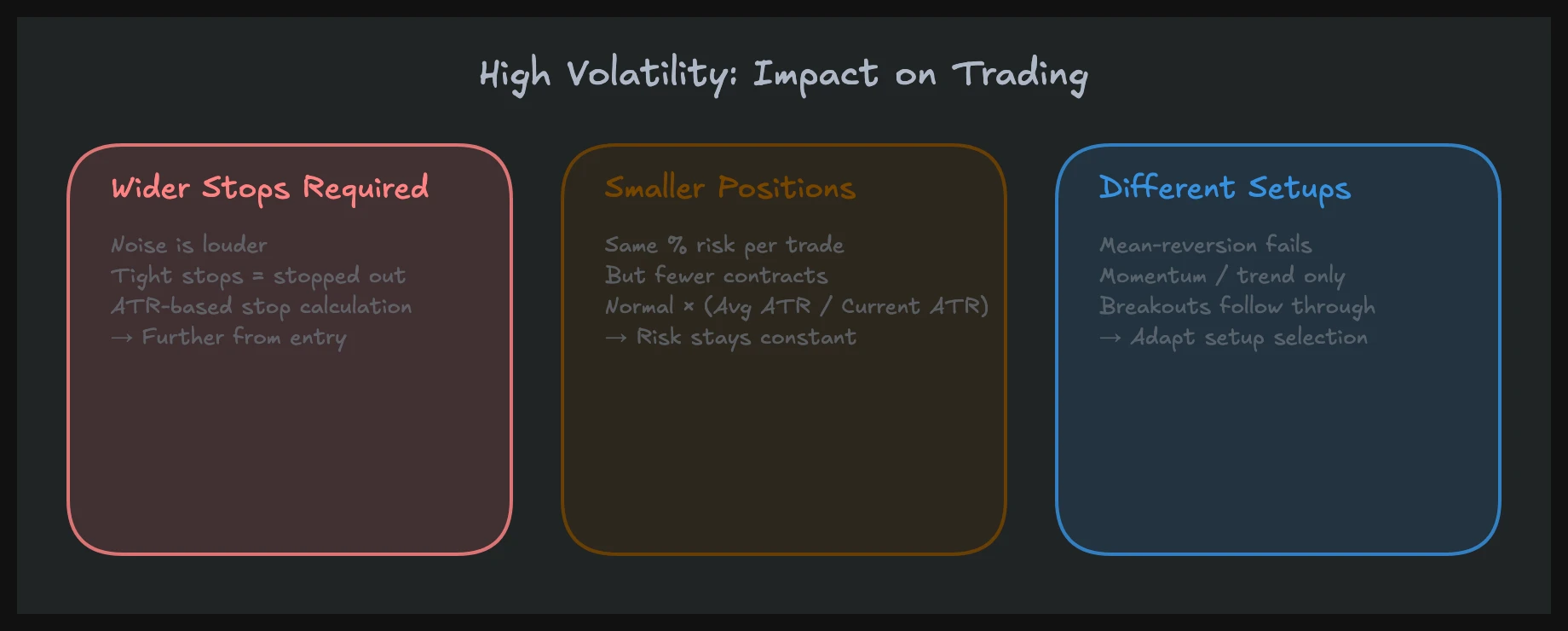
High volatility changes everything. Your familiar levels carry less weight because the market blows through them. Your normal 15-point stop gets hit within seconds, without your trade being wrong. Your mental model of what a "normal day" looks like no longer applies.
When I traded on an institutional desk, this was clearly regulated: when volatility exceeded a defined threshold, trading limits were automatically reduced. No discussion, no "I can handle it." The system knew: same size at higher volatility = more risk. Period.
Most retail traders don't have this system. They trade at VIX 35 the same way they trade at VIX 14. That's like driving through a thunderstorm at the same speed as on a sunny day. Possible, but statistically fatal eventually.
For fundamentals on VIX classification and why different regimes require different approaches, see our VIX and Volatility pillar.
Rule 1: Cut Position Size by at Least 50%
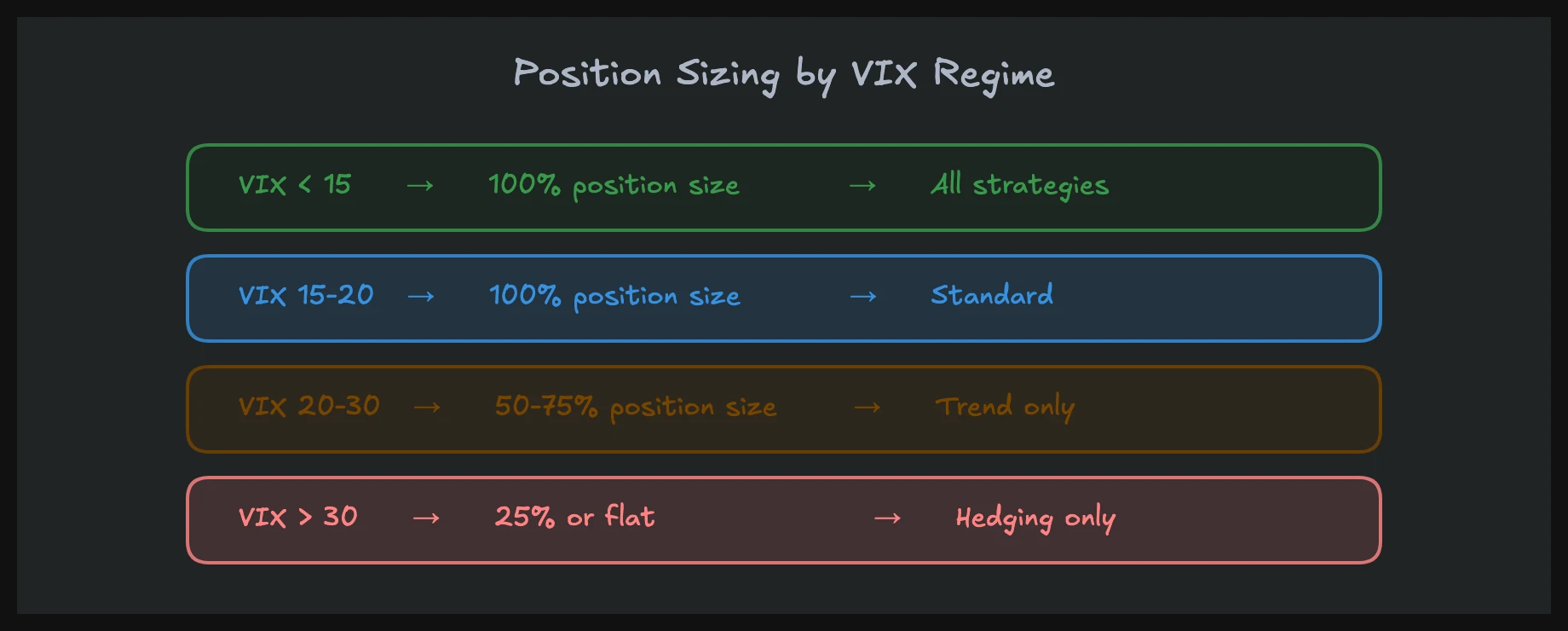
The most important rule. At VIX above 25, trade half your normal size. At VIX above 35, trade one-third. No exceptions.
The math is simple: if the average NQ ATR is 200 points and today it's 400, your risk per contract has doubled. To maintain the same dollar risk, you need half as many contracts.
| VIX Regime | Average NQ Range | Position Adjustment |
|---|---|---|
| Below 15 | 80-150 points | 100% (normal) |
| 15-22 | 150-250 points | 75-100% |
| 22-30 | 250-450 points | 50-75% |
| Above 30 | 450-1,000+ points | 25-50% |
On a professional desk, this happens automatically. The risk system calculates maximum position size based on current volatility, and the trader cannot exceed it. As a retail trader, you're responsible for this yourself. Write the number down before entering your first trade.
Rule 2: Widen Stops to Structure
Your normal 15-point NQ stop doesn't work in high volatility. Candles are 30 to 50 points tall, and normal noise will rip your stop before the trade has a chance.
The solution: set your stop at structural levels. The previous high or low, the Value Area boundary, the VWAP. At VIX 25+, these levels are typically 25 to 35 points from entry instead of the usual 12 to 18.
This means: your stop is wider, so your position must be smaller (see Rule 1). The two rules work together. Wider stop + smaller size = same dollar risk.
A common mistake is keeping the stop tight and the position large. This leads to constantly getting stopped out, frustratedly removing the stop, and then the one big move against you arrives. More on this in our risk management guide.
Rule 3: Wait 30 to 60 Minutes for the Initial Balance
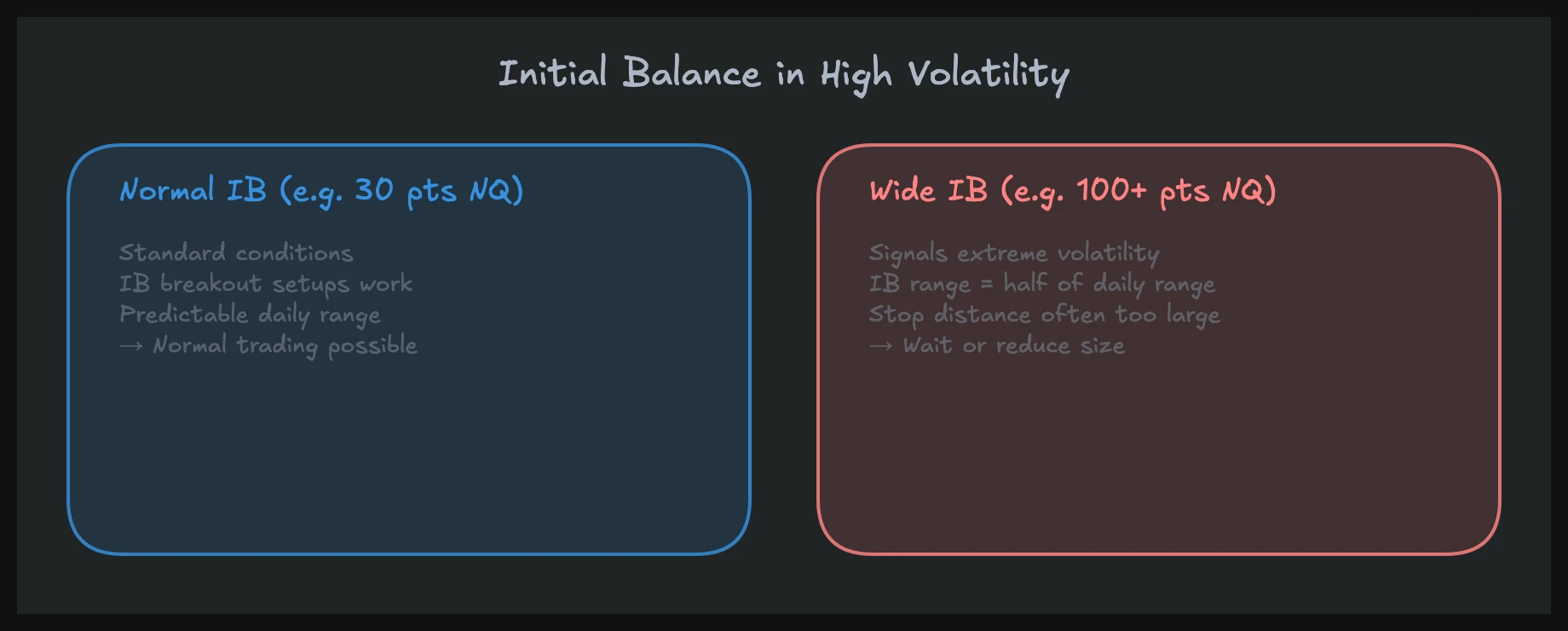
The Initial Balance (IB) is the range of the first 30 to 60 minutes after market open. In normal markets, it gives you a usable framework for the day. In volatile markets, the open is pure chaos: gap fills, stop runs, algorithmic reactions to overnight news.
Wait. Let the chaos settle. The best trades in high volatility don't come in the first 30 minutes. They come afterward, when direction clarifies.
IB width also provides information about the expected day type: a narrow IB in a volatile environment suggests a trend day (the market is building energy). A wide IB suggests most of the range is already covered. How to identify market phases is especially relevant on volatile days.
Rule 4: Trade Only Key Levels
In low volatility, you can trade "B-levels" too: minor pivot points, secondary highs and lows. In high volatility, price blows through these levels without even blinking.
Focus on the strongest levels:
- VWAP: The dynamic average price for the day. Institutions orient around it.
- Previous Day High/Low: Reference points that every professional trader watches.
- Settlement Price: The official CME closing price used for margin calculations.
- Value Area High/Low: The 70% volume boundaries from the prior day.
At these levels, reaction probability is highest, even in high volatility. Everything in between is noise. In volatile markets, fewer trades often means more profit because you only take the best setups.
Rule 5: Set an Absolute Daily Loss Limit
This is the rule that saves accounts. Before entering your first trade in the morning, set a maximum daily loss limit. When you hit it, the trading day is over. No "one more trade to make it back." No "the market has to turn now."
In volatile markets, revenge trading is especially dangerous because the moves are so large. One bad trade costs you $300. The revenge trade afterward can cost you $1,000 because the volatility produces bigger losers.
My suggestion: the daily loss limit should be 2 to 3% of your account. On a $50,000 account, that's $1,000 to $1,500. When you hit it, close the platform.
On an institutional desk, this isn't a recommendation but a hard rule. When you hit your limit, your access is locked. Period. No way around it. And that's exactly why professional traders survive for years while retail accounts vanish in weeks.
Why this discipline is so hard and how to build it is covered in our article on building trading discipline.
Understanding Volatility Regimes
These five rules apply specifically to elevated volatility (VIX 25+). But volatility changes constantly, and with it your approach. Why your strategy suddenly stops working and how to recognize it before it hits your account is covered in our article on volatility regimes.
The ability to distinguish between regimes is, in my view, the single most important skill of a day trader. Not the best indicator, not the best software, but the right adaptation to the current market state.
FAQ: Trading in High Volatility
Should I trade during a market crash?
For most traders: no. The first 1 to 2 days of a crash are extremely unpredictable. Gaps, limit moves, disrupted liquidity. If you're flat, stay flat. The opportunity comes on days 2 to 3, when the market starts stabilizing. By then, setups are clearer and risks more calculable.
How do I know if volatility is too high to trade?
Three warning signs: (1) VIX above 35, (2) the NQ range of the last hour exceeds your normal daily range, (3) you feel emotional pressure (fear or excitement). Any one of these is a reason to reduce size. All three together mean: today is not your day.
What strategy works best in high volatility?
Trend following. In high volatility, trend days dominate, and mean reversion becomes dangerous. Look for pullbacks in the trend direction at key levels (VWAP, previous high/low) and trade with the tendency. Fading the trend in a VIX 30+ environment is one of the fastest ways to lose money.
Volatility Is Not the Enemy
High volatility isn't the problem. Failure to adapt is the problem. These five rules cost you nothing and protect you from the most common mistakes traders make in turbulent markets. Implement them as a fixed routine, not an optional suggestion.
At United Daytraders, you learn these concepts in over 1,500 video lessons with real chart examples. The Money Management module with 8 lessons specifically addresses how to adjust position sizes and risk to different market conditions.