
 By Marco Bösing
How to Pass a Prop Trading Challenge: Rules That Matter
Most traders fail at prop trading challenges, not because their strategy is bad, but because they treat the evaluation like normal trading. A challenge has its own rules, its own pressure, and its own math. Anyone who wants to pass a prop trading challenge needs a clear plan. These 5 rules from institutional risk management significantly change the odds. If you're looking for the right firm for your strategy, find guidance in the Prop Trading Firms Comparison. Whether prop trading or own capital is the right path for you is shown in the comparison at Prop Trading vs Own Capital.
Risk Disclaimer: Trading futures and other financial instruments involves substantial risk and can result in loss of invested capital. The numbers mentioned in this article are for illustration purposes and do not represent profit promises. Past results are not indicative of future performance.
Why Most Traders Fail the Challenge
Estimates suggest around 90 percent of traders fail a prop trading challenge. This isn't due to unfair rules or impossible profit targets. It's due to three recurring mistakes.
Mistake 1: Blowing the maximum drawdown. One or two bad days where too much is risked, and the account is done. Most blown challenges don't end through a series of small losses, but through a single day without control.
Mistake 2: Chasing the profit target. Day 20, half the target is still missing. So position size is doubled, more trades are taken, risk is ramped up. The spiral almost always ends at the drawdown limit.
Mistake 3: Emotional decisions after losses. One losing trade leads to the next because the trader wants to "make back" the loss. Revenge trading is the fastest way to lose a challenge.
The core problem: Traders optimize for profit instead of survival. But a prop trading challenge isn't a profit game. It's a risk management test, disguised as a profit target. Anyone who understands this trades differently.
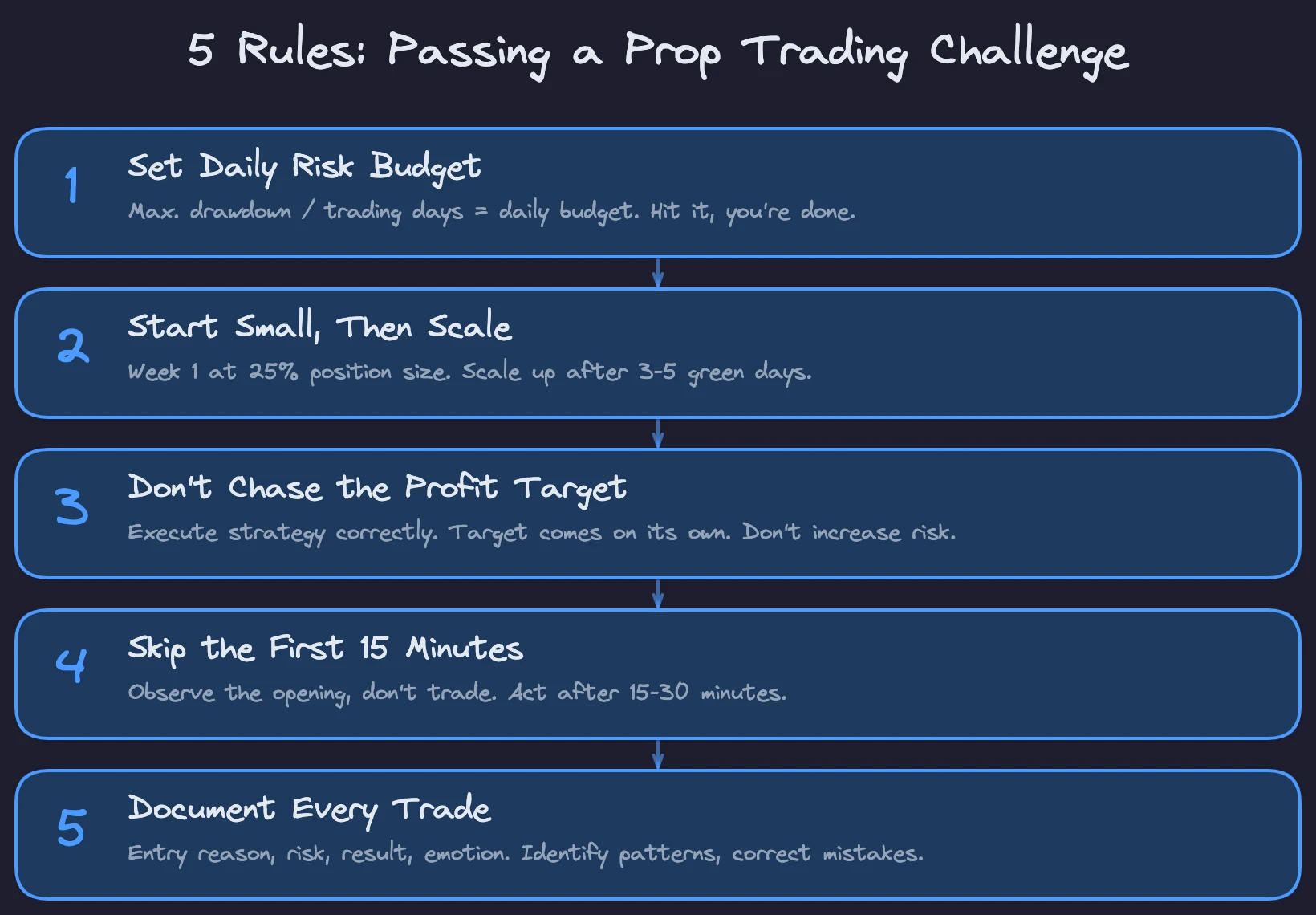
The 5 Rules for a Passed Challenge
Rule 1: Daily Risk Budget Instead of Per-Trade Risk
Most traders define their risk per trade. That's not enough. For a challenge, you need a daily risk budget.
The calculation is simple: Take your maximum drawdown and divide it by the number of trading days. With a $50,000 account with $2,500 maximum drawdown and 20 trading days, that gives a daily risk budget of $125.
$125. That's your hard stop for the day. If you've lost $125, you close the platform. No exceptions. No "one last trade." No "I just see a perfect setup." Done.
Why this works: It prevents the "one bad day" that ends most challenges. You can lose $125 for 20 days before your account is at the limit. In practice, you won't have 20 losing days in a row. You just need enough green days in between to reach the profit target.
On an institutional desk, this works identically. The risk manager gives you a daily limit in the morning. If you reach it, you're done. The online version has no risk manager, so you have to be one yourself. Solid risk management is the foundation of every passed challenge.
Rule 2: Start Small, Then Scale
Week 1 of a challenge isn't for profits. Week 1 is for consistency.
Start with 25 percent of your maximum allowed position size. With a $50,000 account that allows you a maximum of 5 NQ contracts, this means: You trade with 1 to 2 contracts. This feels slow. That's the point.
In the first week, you want to prove three things: That your strategy works in the current market environment. That you stick to your daily risk budget. That you remain emotionally stable.
If you have 3 to 5 green days in a row, you scale to 50 percent. If it continues to go well, to 75 percent. You only use full position size when you're already significantly above the profit target and can afford a larger setback.
Every institutional trader knows this principle: New portfolios aren't fully loaded on the first day. You build conviction before you build risk. Marco describes exactly this approach in the money management module: "Protect your money first. The longer you stay in the game, the more likely your result comes."
Rule 3: Don't Chase the Profit Target
The profit target of a challenge is a byproduct, not a goal.
This sounds counterintuitive. You have to reach the target, right? Yes. But not by aiming for it directly. Traders fixated on the profit target systematically make three mistakes: They overtrade, they force setups that aren't there, and they increase risk when they're behind schedule.
The better frame: "I will execute my strategy correctly for 20 days." Nothing more. If your strategy has a positive expected value and you implement it disciplined, the profit target comes on its own.
What if day 15 comes and you're only at 60 percent of the target? Then you keep trading like on day 1. You don't double your risk. You don't take extra trades. A blown account is worse than a failed challenge, because with a blown account you also have no capital for the next attempt.
The most common trigger for target chasing is overtrading. Anyone who knows this mistake can avoid it.
Rule 4: Skip the First 15 Minutes
Most blown challenge accounts have one thing in common: The biggest loss happened in the first 15 minutes after market open.
The opening is the most volatile phase of the trading day. Gaps, stop runs, fake moves, algorithmic liquidity hunts, everything compressed into a few minutes. For experienced scalpers, this can be profitable. For a trader in a challenge with limited drawdown, it's Russian roulette.
Institutional traders rarely actively trade the opening. They observe. They let the market establish a direction, identify important levels, and act only when initial volatility has flattened. Typically after 15 to 30 minutes. With ES and NQ, this pattern is particularly clear: The first quarter hour is characterized by stop runs above and below the overnight range before a tradeable structure forms.
For your challenge, this means: Sit out the opening. Observe how the market reacts to overnight gaps. See which levels hold and which don't. Then, when direction becomes clearer, you make an informed decision instead of a reactive one.
You miss trades this way? Yes. But you also miss the trades that end your challenge. Anyone who understands how stop runs work at the opening knows why patience in this phase is worth money.
Rule 5: Document Every Trade
A challenge is training for the funded account. Same rules, same pressure, same risk management. What you learn in the challenge determines how long you keep the funded account.
That's why you document every single trade. Not after the challenge, not on the weekend. Immediately. Every trade gets an entry:
- Entry reason: Why did you enter? Which setup, which signal?
- Risk: How much did you risk? Was it within your daily budget?
- Result: Profit or loss, in dollars and in R-multiples.
- Emotional state: Were you calm? Frustrated? Did you trade out of FOMO?
After 10 trades, patterns emerge. After 20 trades, you know exactly which setups work and which don't. After 30 trades, you have data instead of guesses. Marco emphasizes in the trader framework that a trading journal not only provides tracking, but above all the basis for reviews and targeted improvement.
The additional advantage: If this challenge doesn't work out, you have a complete protocol for the next attempt. You don't start from zero, but with concrete insights about what you need to change. A structured trading journal is your most important tool, during the challenge and after.
The Right Mindset: Filter, Not Obstacle
Most traders see the challenge as an obstacle between themselves and the funded account. That's the wrong perspective.
The challenge is a filter. It filters out traders who can't follow rules under pressure. And that's a good thing. Because if you can't follow the rules in a simulation, you certainly won't manage it with real capital.
The pressure of the challenge (time limit, drawdown limits, and the knowledge that every trade counts) isn't a bug. It's a feature. It simulates the stress of funded trading. Anyone who can handle this is ready. Anyone who can't saves themselves significantly more money through failing the challenge than the next attempt costs.
A failed challenge for $300 is cheaper than a blown $25,000 account. The challenge is the cheaper lesson. The ability to trade consistently under this pressure is trainable. More on this at Building Trading Discipline.
FAQ: Passing a Prop Trading Challenge
How often can you repeat a prop trading challenge?
Unlimited, as long as you pay the challenge fee. This ranges from 100 to 1,000 dollars depending on provider and account size. For common account sizes (50k to 150k), you typically pay 150 to 500 dollars per attempt. Plan realistically for 2 to 3 attempts and budget accordingly. Each attempt should start with a clear plan, based on insights from the previous one.
How long does a typical prop trading challenge last?
Phase 1 lasts 30 to 60 days with most providers. Some firms like Apex Trader Funding have no time limit for evaluation, you just have to show at least 7 trading days. Phase 2 typically has a lower profit target (often 4 to 5 percent) and similar time requirements. From challenge start to funded account, realistically 2 to 4 months pass.
Can you pass the challenge with micro futures?
That depends on the provider. Some prop firms allow micro futures (e.g. MNQ or MES), others don't. If allowed, micros are a good option to control risk per trade more granularly. The disadvantage: You need more trades or more contracts to reach the profit target. For traders who don't yet have experience with full contract size, micro futures are a sensible entry point.
At tra-mada.de/en you'll find more than 900 video lessons from institutional traders.