
 By Marco Bösing
Best Prop Trading Firms 2026: A Complete Comparison
Prop trading firms promise you access to large capital without your own risk. But most online platforms have little in common with real proprietary trading. As a former institutional trader, I compare the best-known providers, explain the differences, and tell you what really matters.
Risk Disclaimer: Trading futures and other financial instruments carries substantial risk of loss. Past results are not indicative of future performance. Only risk capital you can afford to lose.
What Prop Trading Really Is (and What It's Not)
Real prop trading works like this: A bank or trading house provides its own capital. The trader is employed, receives a salary plus bonus, and trades the firm's capital under strict risk guidelines. When you Google "prop trading," you get thousands of results for online platforms promising you $100,000 in capital. What you don't get is a realistic picture of what proprietary trading actually means. The online version and the original are two completely different worlds.
In the institutional model, there's no "challenge model." You apply, go through an assessment, get hired or not. Risk limits are set by the compliance department, not by software. Your daily limit is communicated to you in the morning, and when you reach it, you're done. No second chance, no "try again."
On an institutional desk, you sit next to other traders, have direct access to analysts and risk managers. You're trained for months before you're allowed to manage your own positions. The firm invests in you because they want to profit from your skills long-term.
Online prop firms are something completely different. You pay a fee to participate in an evaluation. If you pass the rules, you get access to a "funded" account. In most cases, this account is simulated. The firm doesn't copy your trades 1:1 into the real market. Real money only flows at payout.
This isn't automatically bad. But you should know what you're buying. You're not buying a job as a prop trader. You're buying the opportunity to trade under certain rules and get paid if successful. You get no mentoring, no training, no risk manager. You're on your own.
"On a real prop desk, you have a risk manager watching your fingers in real-time. The online version replaces this person with a set of rules. The principle is similar, the execution fundamentally different."
— Marco Bösing, founder of traMADA
How Online Prop Firms Work
The business model of online prop firms is simple: The main revenue source is challenge fees. The majority of traders fail the evaluation, and that's exactly what the calculation is based on. This sounds cynical, but it's honest.
The typical process looks like this:
Phase 1 (Evaluation): You must reach a certain profit target, for example 8-10% of the account value, without exceeding the maximum loss limit. Time pressure varies by provider. Some give you 30 days, others have no time limit. You must demonstrate a minimum number of trading days, typically 5-10 days, so the firm sees that your result didn't come from a single lucky trade.
Phase 2 (Verification, if applicable): Similar to Phase 1, but with a lower profit target (usually 4-5%). This phase is supposed to prove consistency. You're meant to show that you can deliver good results not just once, but repeatedly. Many providers like Apex and TopStep have abolished the second phase and rely on a one-phase model.
Funded Account: After passing the evaluation, you get access to the funded account. Your profit share is typically 80-90%. The firm keeps the rest. With some providers, your profit split increases over time or after several successful payouts.
The drawdown rules are critical. Every prop firm defines how much you can maximally lose before your account is closed. There are daily loss limits and overall drawdowns. With some providers, the drawdown is "trailing," meaning it moves up with your profits. This is one of the most common reasons traders lose their funded accounts.
Payouts occur every 14 days to monthly depending on the firm. Some providers require a minimum number of trading days or set a minimum for the first payout.
What "funded" really means: With most firms, you're still trading on a simulated account. The firm pays you from its revenues, not from real market gains. As long as payouts come reliably, the result is the same for you. But it explains why some firms suddenly change rules or delay payouts when too many traders are profitable at the same time.
If you want to understand the basics of how futures trading works, read our beginner's guide first.
The Best Prop Trading Firms 2026
There are dozens of prop firms on the market. New providers appear monthly, and just as quickly some disappear. I focus here on the providers we have the most feedback about from our traMADA community and that demonstrably pay out. This list is not a recommendation and contains no affiliate links. It's an honest assessment based on our students' experiences.
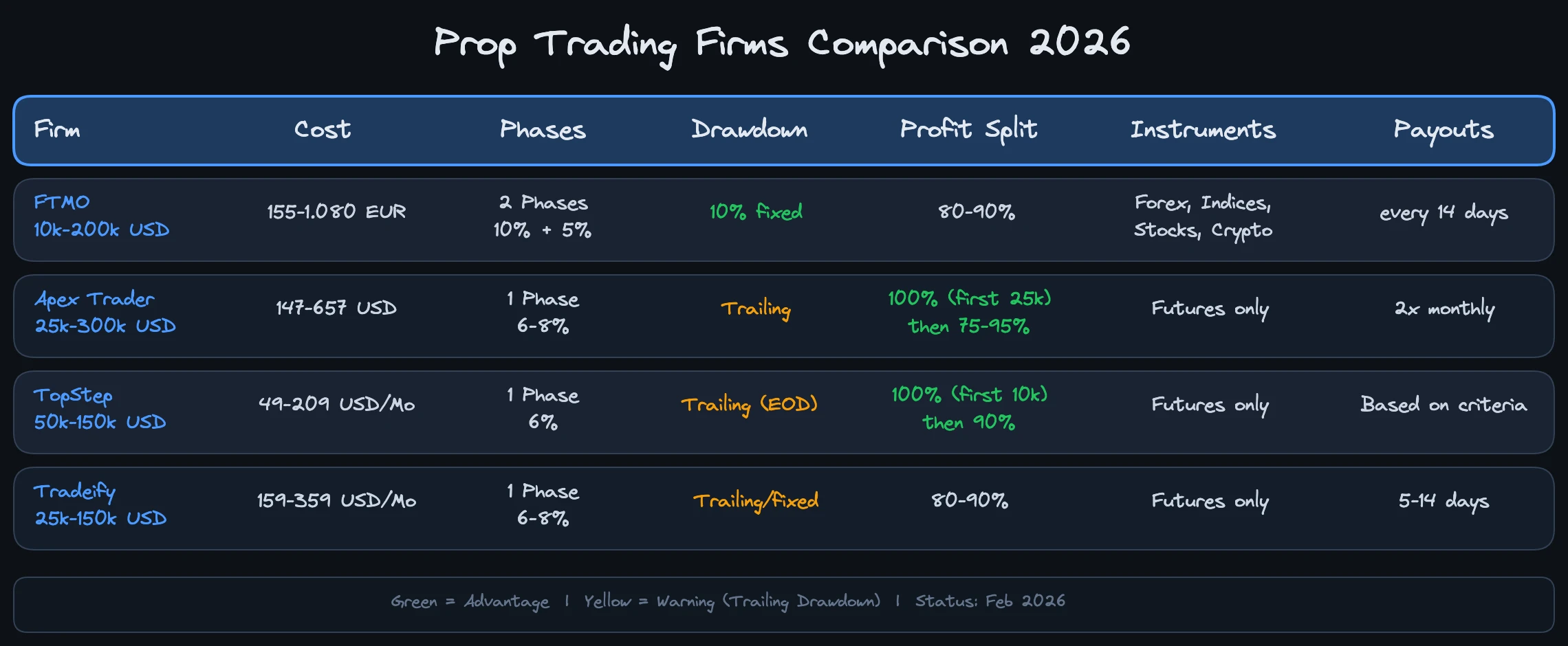
| Feature | FTMO | Apex Trader Funding | TopStep | Tradeify | FundingPips |
|---|---|---|---|---|---|
| Account Size | 10k-200k USD | 25k-300k USD | 50k-150k USD | 25k-150k USD | 5k-100k USD |
| Challenge Cost | 155-1,080 EUR | 147-657 USD | 49-209 USD/month | 159-359 USD/month | 36-499 USD |
| Phases | 2 (10% + 5%) | 1 (6-8%) | 1 (6%) | 1 (6-8%) | 2 (8% + 5%) |
| Max. Drawdown | 10% (fixed) | Trailing | Trailing (EOD) | Trailing/fixed | 10% (fixed) |
| Profit Split | 80-90% | 100% (first 25k) | 100% (first 10k) | 80-90% | 60-100% (depending on payout cycle) |
| Payout | 14 days | 2x monthly | Based on criteria | 5-14 days | Weekly |
| Instruments | Forex, indices, stocks, crypto | Futures only | Futures only | Futures only | Forex, indices, commodities |
| Platforms | MT4/5, cTrader, DXtrade | NinjaTrader, Tradovate, Rithmic | NinjaTrader, Tradovate | NinjaTrader, Tradovate, TradingView | MT5, cTrader, Match-Trader |
FTMO
FTMO is the best-known provider and has been on the market for years. The firm was founded in 2015 in Prague and has established itself as the industry standard. The rules are strict but fair and transparent. Two-phase evaluation with 10% profit target in Phase 1 and 5% in Phase 2, combined with a fixed drawdown of 10%.
FTMO pays out reliably and has a good track record. Payouts occur every 14 days, and the firm offers scaling up to $2,000,000 for consistently profitable traders (with 25% account increase every four months when targets are met). The profit split starts at 80% and can rise to 90%.
The downside: Challenge costs are comparatively high, especially for larger accounts (up to 1,080 EUR for a 200k account). The rules leave little room for aggressive strategies. But you get a provider that has proven over years that it pays out. FTMO also offers a free challenge retry if you break a rule, as long as you haven't hit the loss limit.
Important to know: FTMO doesn't offer futures trading. The instruments run via CFDs and include forex, indices, stocks, commodities, and cryptocurrencies. Platforms are MT4, MT5, cTrader, and DXtrade.
Best for: Experienced traders who prefer clear rules and proven structures. Particularly suitable if you want to trade forex or multiple asset classes.
Apex Trader Funding
Apex is purely specialized in futures and regularly attracts customers with strong discounts on challenge fees. Discount promotions of 50-80% are not uncommon, which significantly reduces effective costs. The model is based on a single evaluation phase, which makes entry easier.
The catch that most beginners overlook: the trailing drawdown. Your maximum loss trails with your profits. If you're up $2,000, your stop level also moves up $2,000. This means you have to secure profits instead of just letting them run. In practice, this leads to you having to close positions after good days instead of letting them run. Anyone who doesn't understand this often loses their funded account within the first weeks.
Apex offers a 100% profit split on the first $25,000 of profits, then 90%. This sounds attractive, but is put into perspective by the strict trailing drawdown rules. Payouts occur twice monthly. Also note the additional costs: 85-105 USD per month for the funded account plus data fees.
Best for: Futures traders looking for a lower entry barrier who understand trailing drawdown.
TopStep
TopStep is one of the oldest prop firms in the futures space and was founded in 2012 in Chicago. The "Trading Combine" model is a one-phase evaluation with a 6% profit target and a trailing drawdown (end-of-day calculation). Costs range from 49-209 USD per month depending on the subscription model.
The platform is technically mature and supports NinjaTrader and Tradovate. The community is active, and there are regularly verifiable payout proofs from real traders. TopStep has the advantage of a long history: You know the firm has paid out reliably for over a decade, which isn't guaranteed with newer providers.
After passing the evaluation, you get an Express Funded Account. A one-time activation fee of 149 USD applies (in the standard subscription model). On the first $10,000 of profits you receive 100% profit split, then 90/10. A special plus: TopStep offers training materials and performance coaching. This doesn't replace real mentoring, but shows the firm has an interest in traders succeeding, not just in challenge fees.
Best for: Futures traders looking for a proven, stable provider with long history and good infrastructure.
Tradeify
Tradeify is a newer provider with competitive pricing and uncomplicated rules. Challenge costs are 159-359 USD per month depending on account size (Select model). Tradeify offers both trailing and fixed drawdown options, which provides flexibility. As a newer provider, Tradeify has less track record, but so far positive feedback from the community. Payouts occur every 5-14 days depending on account type.
Tradeify supports NinjaTrader, Tradovate, and TradingView as platforms. As an alternative to the evaluation model, there's "Lightning Funded" (instant funding) for a one-time fee of 349-729 USD.
Best for: Beginners who want to approach the prop trading model with a cheaper challenge.
FundingPips
FundingPips is focused on forex, indices, and commodities and offers a fixed drawdown of up to 10% depending on the program (2-Step Standard). Challenge costs start at 36 USD for a 5k account (2-Step Standard) and go up to 499 USD for a 100k account (Zero/Instant Funding). The biggest plus is weekly payouts, which is significantly faster than many other providers. FundingPips is based in Dubai and has reportedly paid out over $180 million to traders.
Platform support includes MT5, cTrader, and Match-Trader (no MT4). The profit split is tiered by payout cycle: 60% for weekly payouts, 80% for bi-weekly, and 100% for monthly. In the Hot-Seat program, it permanently rises to 100%. For orderflow traders, the platform selection is a disadvantage since no futures-specific tools are supported.
Best for: Forex traders who prefer fast payout cycles and a fixed drawdown.
What to Look for When Choosing a Prop Firm
The table above gives you an overview. But the most important decision criteria aren't in the table.
Payout is the only metric that counts. A prop firm can have the nicest website and cheapest challenges. If it doesn't pay out, everything else is irrelevant. Check payout proofs on Reddit, Trustpilot, and Discord. Not the firm's marketing screenshots, but real posts from real traders.
Understand drawdown rules. The difference between trailing and fixed drawdown is the most common reason traders lose their funded accounts. With a fixed drawdown of 10%, you can lose 10% of the starting value regardless of how high your account stands. With a trailing drawdown, the limit shifts with every new high. This completely changes your strategy.
Watch for rule changes. Firms that regularly change rules after traders are funded are a red flag. If the conditions under which you passed the challenge suddenly no longer apply, something is wrong with the business model.
Platform compatibility. If you work with orderflow tools like ATAS or Bookmap, check beforehand whether the prop firm supports the necessary integration. Not every firm allows every platform. Our orderflow software comparison helps with selection.
Data feed quality. Pay attention to whether the prop firm delivers real exchange data or only delayed or simulated feeds. For orderflow-based trading, you need Level-2 data in real-time.
Hidden costs. Some firms charge a monthly fee after funding, activation fees, or costs for real-time data. A challenge for $150 sounds cheap until you realize that after funding, $85 per month for data and a $149 activation fee are added. Calculate these costs into your decision before you choose a challenge.
Community feedback. Before you decide on a firm, invest an hour in research. Search Reddit for the firm name plus "payout" or "withdrawal." Read Trustpilot reviews, but pay attention to verified purchases. Search Discord servers for real experience reports. The effort is worth it before you spend 300 EUR on a challenge.
Red Flags: When to Avoid a Prop Firm
Not every prop firm deserves your money. There are clear warning signs to watch for.
Frequent rule changes. If a firm tightens drawdown rules or introduces new restrictions every few months, it's a sign the business model is under pressure. Serious firms have stable rules.
Payout delays without explanation. A delay of a few days can happen. If payouts regularly take 30 days or longer and no one provides an explanation, be cautious.
No verifiable payout proofs. If you can't find real reports from traders who were actually paid out on Reddit, Trustpilot, and forums, the most important proof of trust is missing.
Unrealistic promises. "Become a funded trader in 24 hours" or "99% profit split" sound good, but usually have a catch hidden in the fine print.
Proprietary platforms without data export. If you can't verify your trades on an independent platform and the firm only offers its own software, transparency is lacking.
Marketing over infrastructure. If a firm spends more on YouTube influencers and Instagram ads than on server stability and customer support, that says a lot about priorities. Pay special attention to firms that advertise with lifestyle content: Lamborghinis, beach photos, "From 0 to 100k in a week." Serious prop firms don't need such marketing.
No clear legal form. Check where the firm is registered and under what regulation it operates. Firms without clear legal form, without imprint, or based in jurisdictions without financial supervision deserve special skepticism. This doesn't mean every firm in an offshore jurisdiction is fraudulent, but you should know what legal recourse you'd have in a dispute.
The Uncomfortable Truth About Prop Trading
Here's what the advertising doesn't show: The majority of traders fail at prop trading challenges. Not because the rules are unfair, but because discipline and risk management are lacking.
The challenge doesn't primarily test your strategy. It tests whether you can limit losses. Whether you don't double down after a losing day. Whether you respect your daily limit. Whether you can stop when it's enough. Whether you can close the platform on a day when nothing is working instead of "making back the loss."
This is no coincidence. On a real prop desk, risk limits are even stricter. When you reach your daily limit, the risk manager closes your position. No discussion. No "one last trade" mentality. The online version at least gives you the chance to pull the stop yourself, but that requires more discipline, not less. Because no one is looking over your shoulder.
The numbers are sobering: Estimates suggest over 90% of traders fail the challenge. Not because the rules are impossible, but because most traders haven't learned to accept losses and consistently follow rules.
If you don't pass a challenge, you probably would have lost even more with your own capital. The challenge is actually a useful filter. It shows you ruthlessly whether you're ready. A failed challenge costs you 200-500 EUR. A blown own account costs you 5,000-25,000 EUR. The challenge is the cheaper lesson.
Prop trading is no shortcut. It doesn't replace learning risk management. It doesn't replace building trading discipline. It only gives you the opportunity to trade with larger capital if you master the basics. You can find out how to approach the evaluation in the article How to Pass a Prop Trading Challenge.
And that's exactly where the opportunity lies: If you have the discipline to pass a challenge, you also have the discipline to trade profitably long-term. The challenge isn't the obstacle. It's the proof that you're ready.
Prop Trading and Taxes
Prop trading payouts are not capital gains, and yet almost all beginners ignore this topic. You're not trading with your own capital, so the 25% withholding tax generally doesn't apply. Instead, prop trading income is likely classified as income from business operations or as other income.
This means: Your profits are subject to the progressive income tax rate, which can be significantly higher than the flat withholding tax depending on total income. Above a taxable income of around 68,500 euros, the top tax rate of 42% applies.
Additionally, a business license may be required if the tax office classifies the activity as commercial. This brings trade tax, which is partially credited against income tax.
The advantage: Challenge fees and other operating expenses are potentially tax-deductible, which wouldn't be possible with withholding tax.
Important: The tax classification of prop trading isn't legally finalized yet. There's no explicit case law or administrative instruction specifically addressing the model of online prop firms. Therefore, individual advice from a tax advisor with trading experience is indispensable.
You can find a detailed breakdown of various tax scenarios in our article on trading taxes.
Prop Trading vs Own Capital: A Brief Comparison
At first glance, the calculation looks clear:
Own capital, 25,000 EUR: You trade with 25k and make 5% per month. That's 1,250 EUR that belongs entirely to you (before taxes). Your account is yours, you determine the rules, and no one can revoke your access.
Prop account, 150,000 USD: You trade with 150k and make 5% per month. That's 7,500 USD. At 80% profit split, 6,000 USD remains for you. But you have to follow the firm's rules.
Even after the profit split, you earn almost five times as much with the prop account. But the calculation has catches:
You have to pass the challenge, which costs fees and time. On average, traders need 2-3 attempts, which drives costs to 400-1,500 EUR before a funded account is even in place. You have to adhere to drawdown rules, which can limit your strategy. Trades you'd normally let run, you might have to close to protect the trailing drawdown. And you're dependent on the prop firm. If the firm changes rules or ceases operations, you lose your "account" overnight.
The psychological difference is also real. With your own capital, you feel every loss directly. That hurts, but can also function as a natural brake. With prop capital, you have the "house money" effect: It feels easier to take risks. This can be an advantage if it leads to calculated risk. It can be a disadvantage if it leads to carelessness.
There are also tax differences: Profits from own capital are subject to withholding tax (25% + solidarity surcharge), while prop trading profits are subject to the progressive income tax rate. With high profits, the tax rate with prop can be significantly higher.
The smartest approach is often a hybrid model: Use prop trading to build your capital faster, while you grow an own account in parallel. The prop payouts partially flow into your own account. This way you build your own capital base long-term and aren't dependent on a single income source. You can find the complete calculation with taxes and psychology in Prop Trading vs Own Capital. For an overview of every path to trading with capital that isn't yours (prop firms, margin, securities-backed credit), see Trading with External Capital.
FAQ: Prop Trading Firms
Are prop trading firms legitimate?
Established providers like FTMO, Apex, and TopStep are legitimate and demonstrably pay out. But not every firm on the market is trustworthy. Always check payout proofs from independent sources like Reddit, Trustpilot, and trading forums before investing money.
How much does a prop trading challenge cost?
Depending on account size and provider, you pay between 50 and 1,000 EUR for an evaluation. Most firms refund the fee after the first successful payout. Watch out for hidden additional costs like data fees, activation fees, or monthly subscription costs for the funded account.
Can you make a living from prop trading?
Yes, but it requires consistent profitability over months. You need multiple funded accounts or large account sizes to generate reliable income. Most successful prop traders combine multiple accounts at different providers. Also remember you need to build reserves for months when you lose accounts and have to buy new challenges. Prop trading as the only income source only works with a solid financial cushion.
Which prop firm is best for futures?
For futures, Apex Trader Funding and TopStep are the best-known options. Apex offers simpler evaluation with only one phase, TopStep has more history and a more stable track record. Tradeify is a cheaper alternative with flexible drawdown options. FTMO doesn't offer futures trading, but trades forex, indices, and stocks via CFDs.
Do I have to pay taxes on prop trading profits?
Yes. Prop trading profits are taxable, likely as income from business operations or other income. Withholding tax generally doesn't apply since you're not trading with your own capital. Get advice from a tax advisor who knows trading.
At tra-mada.de/en you'll find more than 900 video lessons from institutional traders.