
 By Marco Bösing
Prop Trading vs Own Capital: Which Path Makes More Sense?
The question of prop trading vs own capital comes up for every trader at some point. In my work with traders, I see both paths, and in most discussions, opinions like "prop is better" or "own money is safer" dominate. This article does the actual math. Same strategy, different account sizes, different tax treatment, different psychology. The numbers speak for themselves. You can find an overview of providers in the Prop Trading Firms Comparison.
Risk Disclaimer: Trading futures and other financial instruments involves substantial risk and can result in loss of invested capital. The numbers mentioned in this article are for illustration purposes and do not represent profit promises. Past results are not indicative of future performance.
The Calculation: Own Capital vs Prop Firm
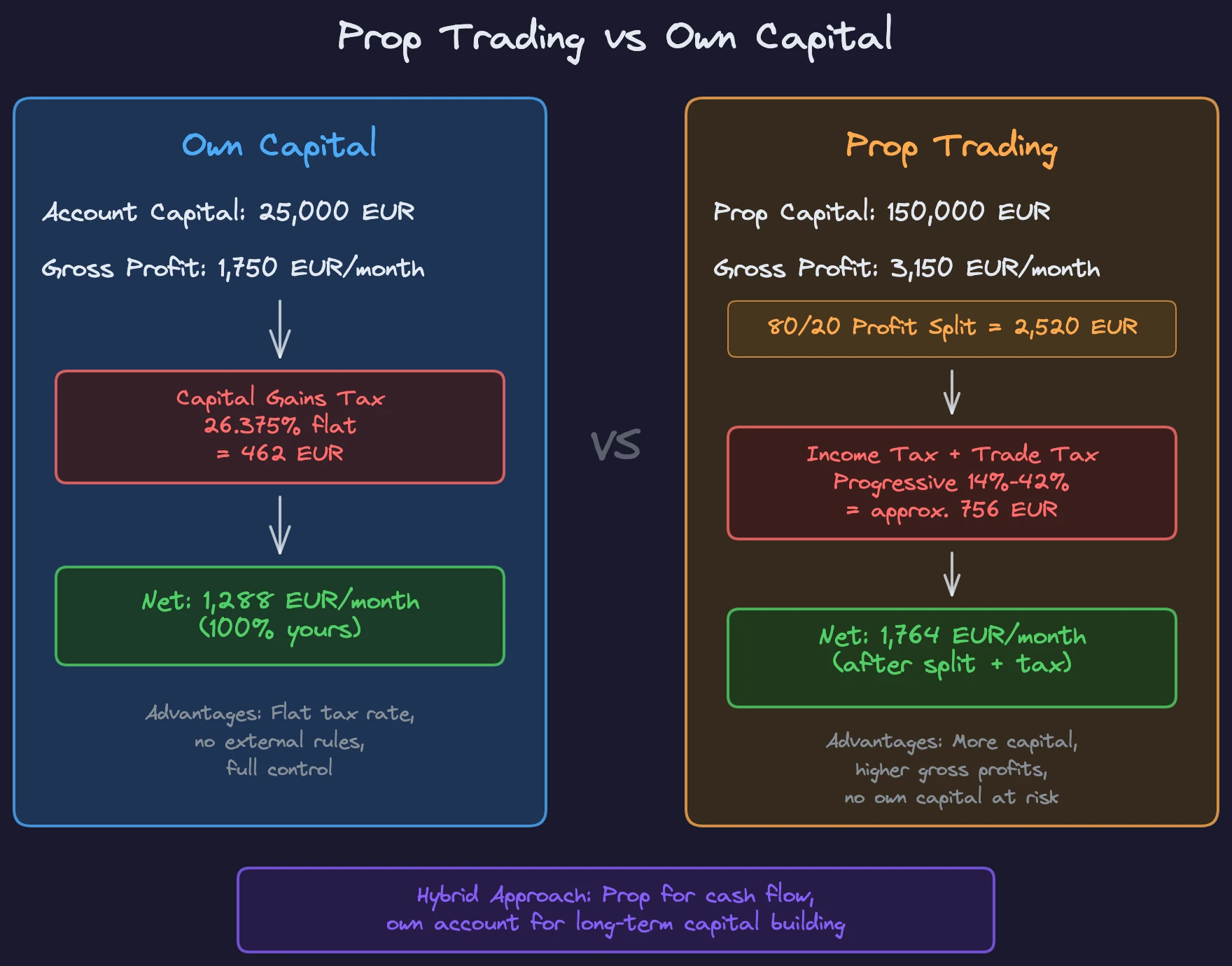
Two paths, one trader. Path one: You trade with your own capital, 25,000 euros in the account. Path two: You trade via a prop firm with a 150,000 euro account after passing the challenge. Same trader, same strategy, same skill level. The difference is purely structural: access to capital, profit split, risk, and tax treatment. You can find concrete rules for evaluation in the article How to Pass a Prop Trading Challenge.
Own Capital: 25,000 Euros
You trade 2 Micro Nasdaq futures (MNQ, multiplier $2 per index point) and risk a maximum of 1% per trade, so 250 euros per position. Your strategy has a positive expected value profile with a win ratio of about 1:2.
Let's take a realistic month: 20 trading days, on average one trade per day. With a hit rate of 45% and an average profit of 500 euros with an average loss of 250 euros, the picture looks like this:
- 9 winning trades: 9 x 500 EUR = 4,500 EUR
- 11 losing trades: 11 x 250 EUR = 2,750 EUR
- Gross profit: 1,750 EUR
Tax: On capital gains, the flat withholding tax of 26.375% applies (25% capital gains tax plus 5.5% solidarity surcharge on it, without church tax). This results in approximately 462 EUR tax.
Net profit: approximately 1,288 EUR
This is solid, but slow. At 1,288 euros monthly net growth, it takes years to get from 25,000 to an account where you can trade significantly larger positions. The math of compound interest works for you, but in this range you need patience. Solid risk management is mandatory here, because a 20% drawdown on 25,000 euros sets you back to 20,000 euros and the smaller position size additionally slows recovery.
Prop Firm: 150,000 Euros Account Capital
The challenge cost about 300 euros. You trade 12 Micro Nasdaq futures (MNQ), because with more capital you have more room.
Same strategy, same hit rate, but the absolute numbers are higher:
- 9 winning trades: 9 x 900 EUR = 8,100 EUR
- 11 losing trades: 11 x 450 EUR = 4,950 EUR
- Gross profit: 3,150 EUR
Now comes the profit split. Most prop firms keep 20%, you get 80%.
- Your share: 2,520 EUR
Sounds significantly better than the 1,750 euros with own capital. But the calculation isn't finished yet.
Hidden costs: Few traders pass the challenge on the first attempt. Realistically, two to three attempts before you have a funded account. At about 300 euros per challenge, that's 600 to 900 euros investment before the first euro of profit flows. Add monthly data fees and platform costs.
Taxes: Here it gets interesting. Prop trading income is generally not capital gains in the tax sense. You're not trading with your own capital, but providing a service. The tax office typically treats your profit participation as income from business operations (Schedule G), and thus progressive income tax with rates from 14% to 42% applies (2026: top rate from 69,879 EUR). Additionally, from business income of 24,500 euros, trade tax may apply, which is partially (up to 4 times the assessed amount) credited against income tax.
At 2,520 euros monthly (30,240 euros annually), you're at an effective tax rate of about 30% including trade tax. That's about 756 euros tax.
Net profit: approximately 1,764 EUR
More than with own capital, but the gap is smaller than expected.
The Tax Comparison in Detail
The tax difference deserves a closer look because it can completely reverse depending on income level.
Own capital: Flat 26.375% withholding tax (without church tax). Whether you earn 5,000 or 500,000 euros per year, the rate stays the same. Simple, calculable, and the bank usually withholds the tax directly.
Prop trading: Progressive income tax from 14% to 42%, plus solidarity surcharge and possibly trade tax. This means:
- At low income (below approx. 17,000 EUR): Prop trading is tax-advantageous because your marginal tax rate is below 26.375%
- At medium income (approx. 25,000 to 50,000 EUR): Roughly equal, depending on trade tax multiplier
- At high income (above 60,000 EUR): Prop trading is tax-wise significantly more expensive, up to 42% instead of 26.375%
Anyone who earns well as a prop trader and simultaneously has a normal salary can quickly slide into the top tax bracket. The flat advantage of withholding tax for own trading then becomes enormous. A possible optimization: the trading LLC. But that only pays off at significantly higher amounts and brings its own complexity.
Psychology and the Hybrid Approach
Other People's Money vs Your Own
Apart from the numbers, there's a factor no calculator can capture: psychology. The moment the account isn't yours, behavior changes. From the work I do with traders, the same pattern shows up over and over: a funded account starts to feel like an extended demo, the one-time challenge fee is mentally written off, and the account stops being treated as real money. That cuts in two directions.
Some traders perform better with prop capital. Losses don't hit personal wealth, emotional pressure is lower, and decisions are made more rationally. In my mentoring sessions, I see this regularly: The money feels less "personal," and that can be liberating.
Other traders become more careless. They don't respect the capital as much as their own, take unnecessary risks, and treat the prop account like a play account. The evaluation rules (time limits, drawdown limits, daily loss limits) create additional stress that further burdens performance.
With own capital, there are no external rules. No challenge, no profit split, no risk of someone locking your account. But every loss hits your wealth directly, and that can be paralyzing. The ability to trade consistently and build discipline decides here between profitable and unprofitable.
Combining Both Paths
In my experience, the smartest solution is often not either-or. Many successful traders combine both paths.
The model: You use a prop account for current income, monthly cash flow that covers your living expenses. At the same time, you slowly build capital with an own account. Profits from the own account aren't withdrawn but reinvested. Compound interest works in the background while the prop firm finances daily life.
From own capital of 50,000 to 100,000 euros, it's worth reevaluating the situation. Is the account size large enough to cover your standard of living? Then you can step by step reduce the prop firm. The transition from prop to own capital is a typical path I've observed with many institutional traders.
FAQ: Prop Trading vs Own Capital
Can you make a living from prop trading alone?
Yes, but it's risky as the only income source. Prop firms can change their rules, delay payouts, or cease operations. Anyone who relies exclusively on prop trading has no control over the platform through which their entire income runs. An own account as backup is strongly recommended.
How much own capital do I need to trade?
At least 5,000 euros for micro futures, with that you can trade 1 MNQ or MES and still practice sensible risk management. Better is 15,000 to 25,000 euros to have enough buffer for drawdowns and trade multiple contracts. Below 5,000 euros, position size becomes too small to justify fees sensibly.
Is prop trading worthwhile for beginners?
As a learning tool conditionally, as income source no. Most beginners fail at challenges and burn money they would have better invested in education. First become profitable on a demo account and then with small own capital. Only when you demonstrably achieve consistent profits over several months is a prop firm challenge a sensible option.
At tra-mada.de/en you'll find more than 900 video lessons from institutional traders.