
 By Marco Bösing
ChatGPT for Traders: 7 Practical Ways to Improve Your Workflow
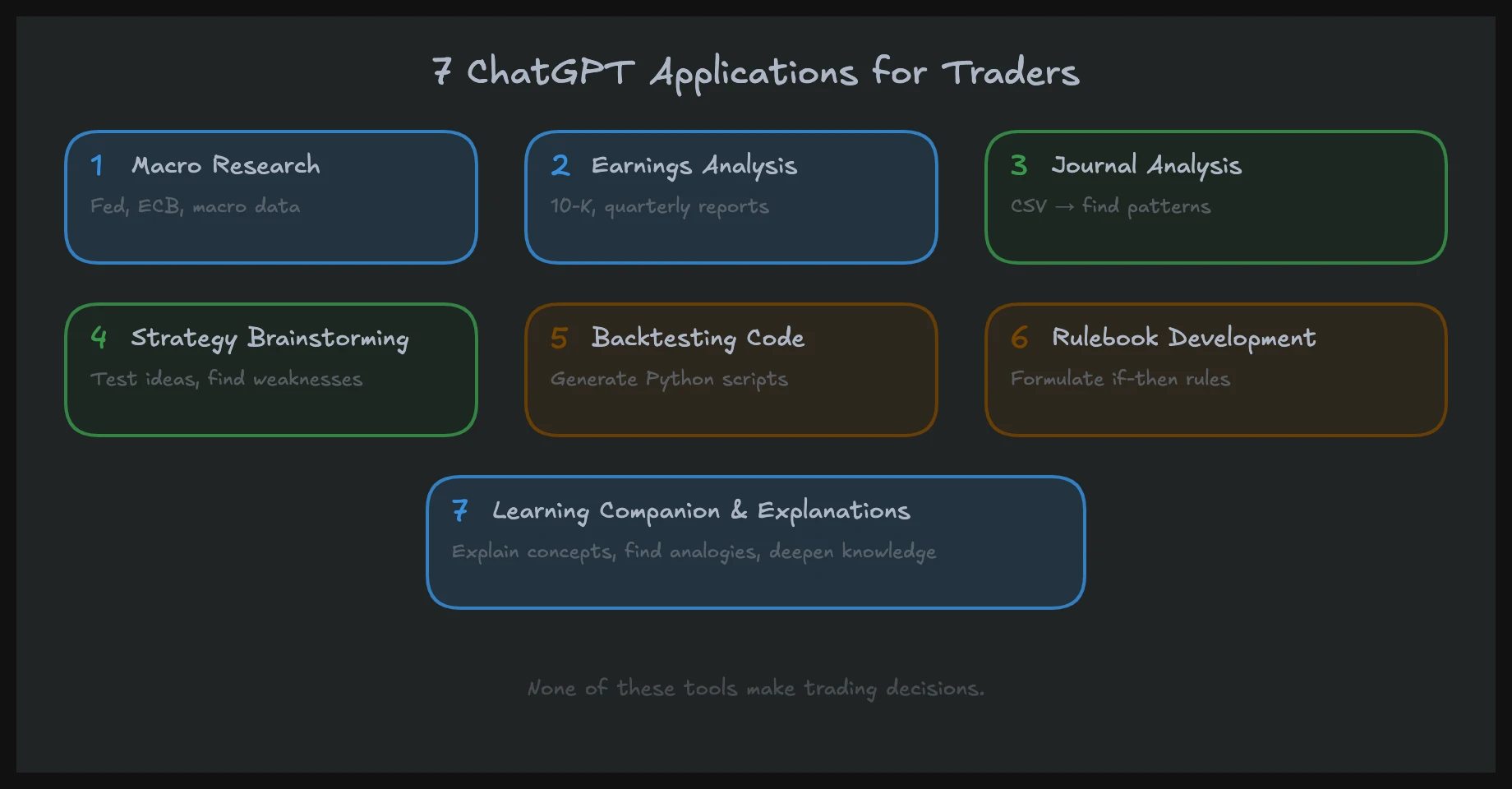
ChatGPT is the most useful research tool traders have ever had. It doesn't replace market understanding and it doesn't make trading decisions, but it compresses tasks that used to take hours into minutes. In my complete guide to AI in trading, I covered where the limits are. This article is about the practical side: seven applications that will immediately improve your workflow.
Risk Disclaimer: Trading futures and other financial instruments involves significant risk of loss. Past results are not indicative of future performance. Only trade with capital you can afford to lose.
1. Pre-Market Macro Summary
Before the US session opens at 9:30 AM ET, you need a picture of the landscape: what happened overnight, what data is scheduled, where NQ sits relative to yesterday.
Instead of spending 30 minutes reading Bloomberg, Reuters, and Twitter, you feed ChatGPT the relevant information and get a structured briefing.
Example prompt:
Here are today's key overnight headlines (paste 3-5 headlines).
Economic calendar: CPI at 8:30 AM ET, expectation 3.2% YoY.
NQ closed at 21,450 yesterday, overnight range 21,380-21,520.
VIX at 18.5.

Create a 200-word pre-market briefing: What's moving the market today?
Which levels matter? What should I watch for?
The result isn't a trade recommendation. It's a structured summary that saves time. The actual analysis is still yours. For a deep dive on working with the economic calendar, I have a dedicated article.
2. FOMC and ECB Minutes Analysis
Central bank minutes run 20-30 pages of dense jargon. The critical question is always: what changed since the last meeting? This is exactly what ChatGPT answers well.
Example prompt:
Here are the FOMC Statements from January and March 2026 (paste both).
Compare the language. What was added? What was removed?
What was rephrased? What do the changes imply for monetary policy?
In my macroeconomic analysis work, I regularly compare central bank communications. ChatGPT has compressed this process from an hour to five minutes. The interpretation stays with me, but the text comparison is handled by the model.
Key limitation: Always upload the actual documents. Never ask "What did the last FOMC statement say?", because ChatGPT will confidently fabricate language that was never used.
3. Trading Journal Mining
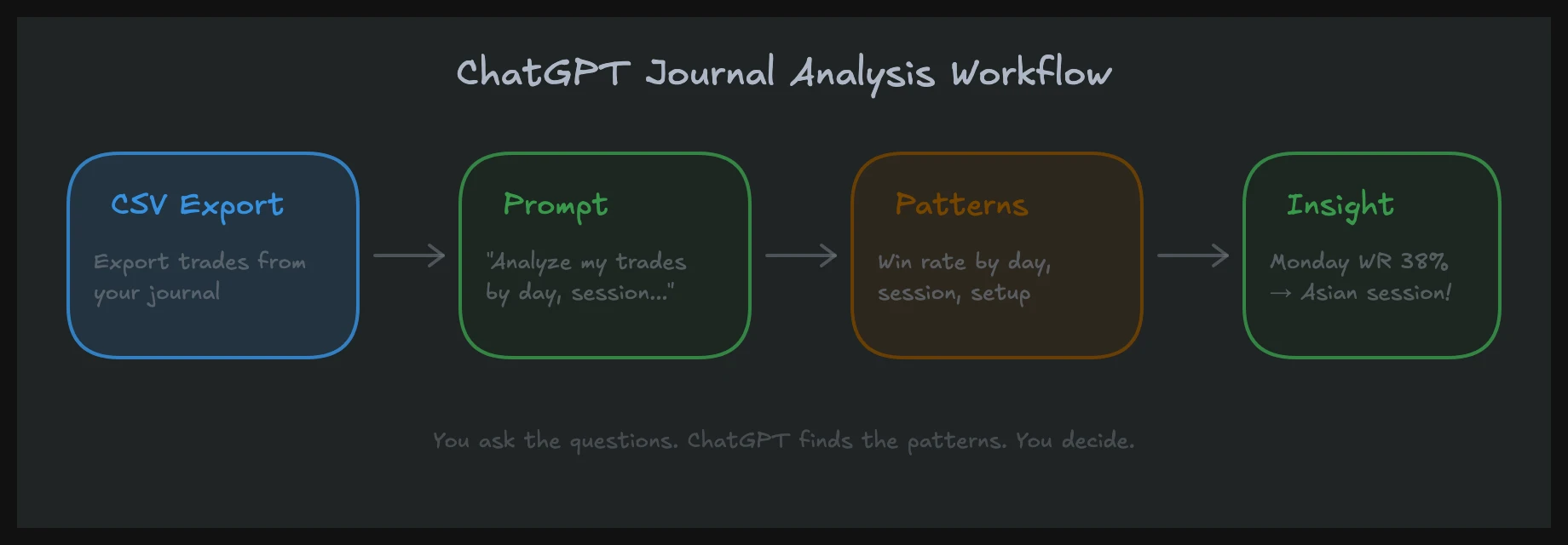
Your trading journal contains patterns you can't see because you're too close to the data. Export your trades as a CSV (date, instrument, direction, entry, exit, P&L, setup type, day of week, time) and let ChatGPT search for patterns.
Example prompt:
Here are my last 100 trades as CSV (paste data).
Analyze:
1. Win rate by day of week
2. Average P&L by setup type
3. Best and worst time of day
4. Average hold time for winners vs. losers
5. Any correlation between losing trades and specific times of day?
A trader in our mentoring discovered that his win rate on Mondays was 38%, while Tuesday through Thursday it was 62%. On Mondays he was trading the Asian session, which carries significantly less NQ volume. Without the data analysis, he would never have spotted the pattern.
4. Backtesting Code Generation
If you have a hypothesis to test but can't write Python, ChatGPT is the fastest path from idea to test.
Example prompt:
Write Python code (pandas, numpy) that tests the following:
- Data: NQ 5-minute OHLCV (I'll upload a CSV)
- Strategy: If price crosses VWAP from below AND
  current bar volume > 1.5x average volume of last 20 bars,
  buy at next bar close
- Stop: 15 points below entry
- Target: 30 points above entry
- Output: win rate, average win/loss, profit factor, equity curve plot
The code is usually 80-90% correct. You'll need to review and adjust, but the framework is built in seconds. Without programming skills, this test wouldn't be possible at all.
Important: The backtest validates a hypothesis. It doesn't generate a strategy. "Write me a profitable strategy" doesn't work because profitable strategies come from market understanding, not from code.
5. Risk Scenario Analysis
Before major events, you can use ChatGPT to research historical reactions and walk through scenarios.
Example prompt:
CPI release tomorrow. Expectation: 3.2% YoY.
What happened to NQ (Nasdaq-100 Futures) in the last 5 CPI releases
when the number came in above expectations? And below expectations?
Summarize the reaction in the first 30 minutes and the rest of the day.
Warning: ChatGPT hallucinates historical data. Use the response as a starting point and verify the numbers through the CME website or your charting software. The structure of the analysis is valuable. The specific numbers need verification.
6. Concept Explanations and Tutoring
Trading has a steep learning curve. Bond math, options pricing theory, the relationship between interest rates and bonds, duration, convexity: these concepts take time.
ChatGPT is a patient tutor that will explain concepts until you understand them. And you can start at your own level.
Example prompt:
Explain the inverse relationship between bond prices and yields.
Use a concrete example with a 10-year US Treasury.
Explain it so a trader without a finance background can understand.
If I have follow-up questions, answer them.
This doesn't replace a structured course, but it complements one perfectly. When a concept from a lesson doesn't click immediately, you can have ChatGPT explain it in different words.
7. Structured Journaling Prompts
Most traders know they should keep a journal. Few do it consistently because they don't know what to write. ChatGPT can provide structured questions that take your journaling to another level.
Example prompt after a trading day:
I had 3 trades in NQ today. For each trade, ask me:
1. What was my thesis BEFORE the trade?
2. What signal triggered my entry?
3. Did I follow my plan or deviate?
4. If I deviated: why?
5. What would I do differently next time?
6. Emotional state on a 1-10 scale before and after the trade.
The questions are simple. But they force you to think about your process instead of just the result. That's the core of trading discipline: process focus over outcome focus.
The Limits of ChatGPT for Traders
Despite the enthusiasm for these tools, there are clear boundaries you need to know.
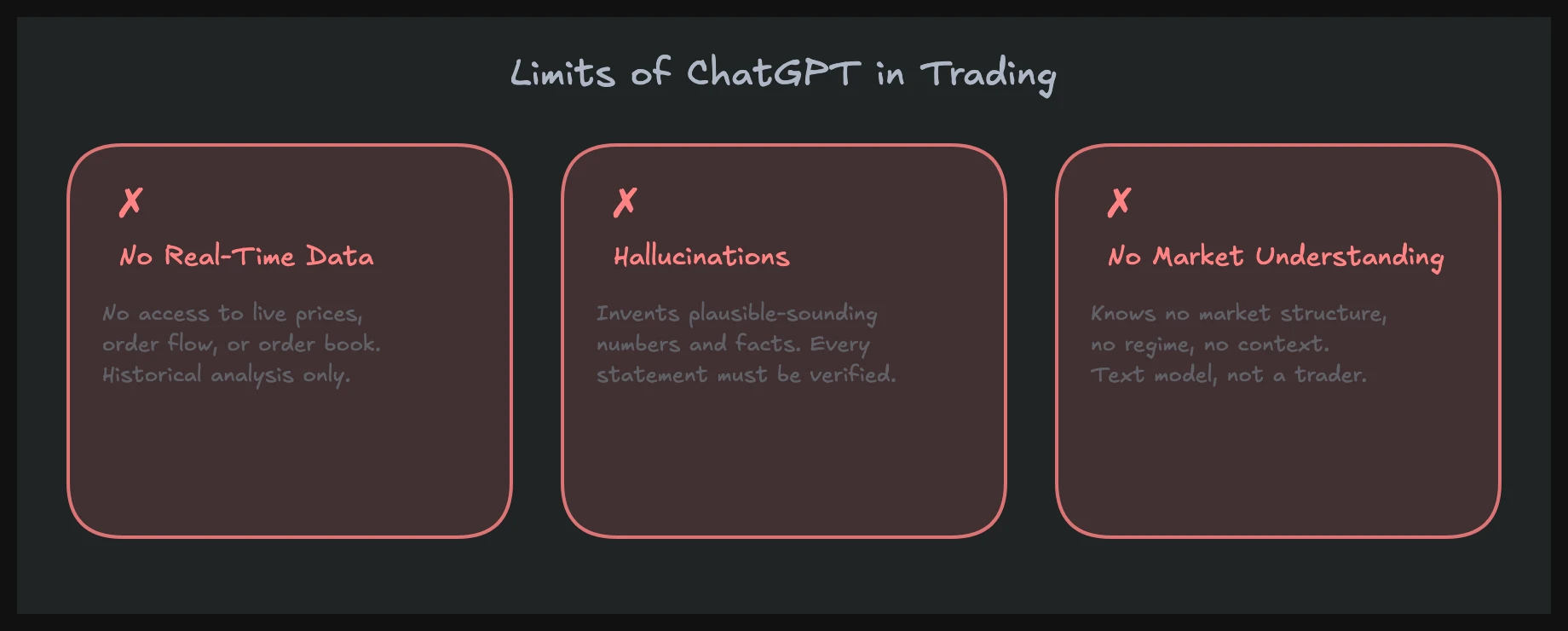
No real-time data. ChatGPT doesn't know where NQ is trading right now. It has no access to live market data. Questions like "Should I buy NQ right now?" are meaningless.
Hallucinations. Language models fabricate statistics, sources, and historical data. Every specific number ChatGPT gives you needs verification.
No market understanding. ChatGPT understands language, not markets. It can explain what a footprint chart is, but it can't read one. Interpreting real-time order flow requires experience that no language model has.
Not a replacement for education. The seven applications in this article only work if you know which questions to ask. And the knowledge to ask the right questions comes from solid education.
FAQ: ChatGPT for Traders
Can ChatGPT tell me when to buy or sell?
No. ChatGPT has no real-time market data and no understanding of market microstructure. It's a research and analysis tool, not a signal generator. Use it for preparation and review, not for real-time decisions.
Which ChatGPT model is best for trading?
GPT-4 or comparable models (Claude) deliver the best results for complex analysis and code generation. The free version works for simple summaries, but for journal analysis and backtesting code, the paid version is worth it.
How do I avoid hallucinations with finance questions?
Always upload the source documents instead of asking ChatGPT for historical facts. Verify every specific number through primary sources (CME, FRED, BLS). Use ChatGPT for structure and analysis, not as a reference for statistics.
At United Daytraders, you'll find over 1,500 video lessons from institutional traders. The combination of structured knowledge and AI tools as a productivity multiplier is the most efficient path to learning trading. Learn more at united-daytraders.com.