
 By Marco Bösing
AI in Trading: What ChatGPT, Trading Bots and AI Can Actually Do
AI in trading is the most searched trading topic in 2026. Artificial intelligence can speed up certain parts of your trading workflow, from macro research summaries to journal pattern analysis. But AI is not a trading system. It does not replace learning how markets work. Anyone telling you otherwise is selling something.
Risk Disclaimer: Trading futures and other financial instruments involves significant risk of loss. Past results are not indicative of future performance. Only trade with capital you can afford to lose.
The Instagram Promise: AI Trading Bots That Make Money While You Sleep
Every other Instagram ad in 2026 sells you the same fantasy: an AI trading bot that trades around the clock and prints profits while you're asleep. The narrative has changed. The playbook hasn't. Five years ago it was "secret indicators." Three years ago, "Smart Money Concepts." Now it's "AI Trading." New packaging, same product.
During my time as an institutional trader, I watched every technology wave create the same dynamic: a real kernel of truth (algorithms do execute a large portion of market volume) gets inflated by a marketing machine until reality becomes unrecognizable.
Why the Promises Don't Add Up
The futures market is a zero-sum game. For every winner, there's a loser. If an AI trading bot were consistently profitable, the operator would have no incentive to sell it for $99 per month. The bot's returns would dwarf any subscription revenue by orders of magnitude.
This isn't theory. It's basic math. If a bot generated 5% per month on a $100,000 account (as commonly advertised), that's 60% annually. Renaissance Technologies, the most successful hedge fund in history, achieves roughly 66% before fees with a team of physicists and mathematicians and billions in infrastructure. Your $99 bot is going to replicate that? Not a chance.
What AI in Trading Actually Does Well
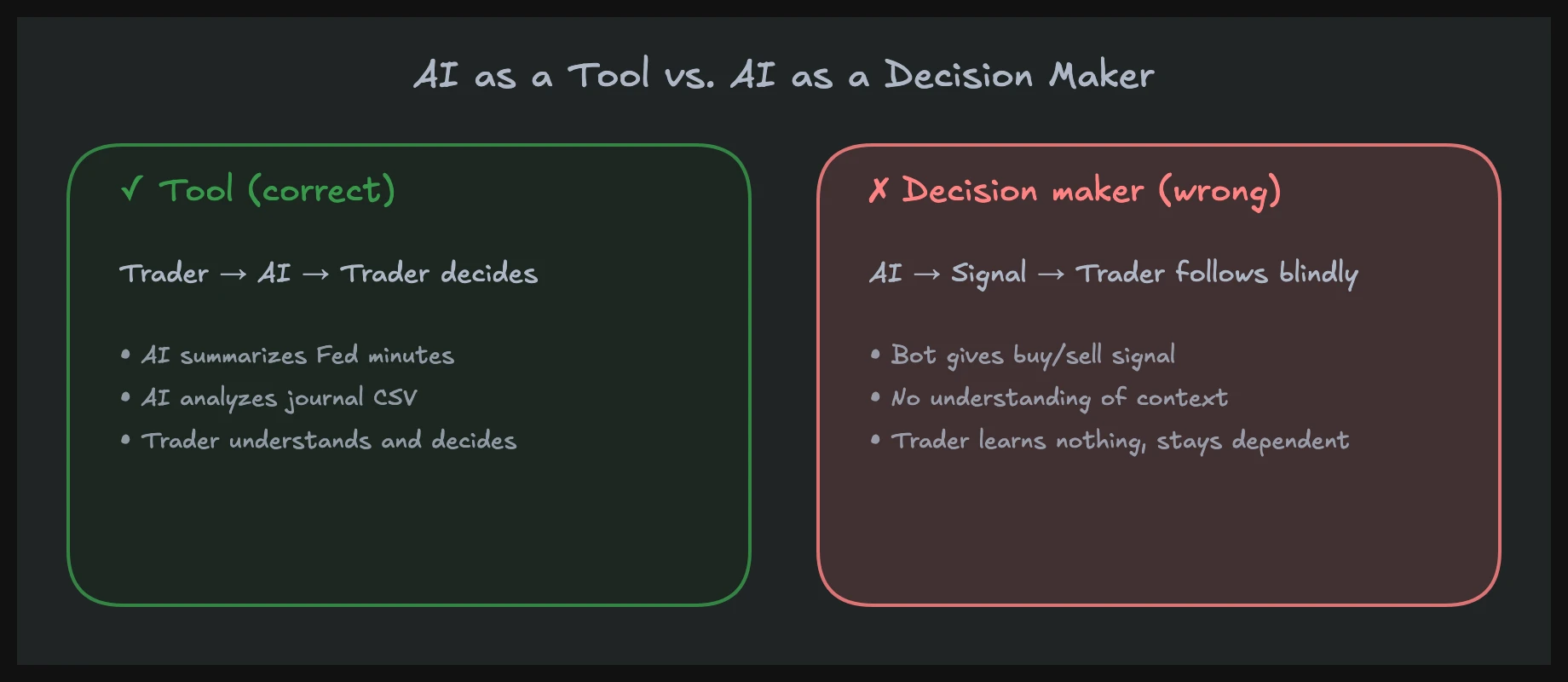
AI is not a trading system. It's a tool that performs certain tasks faster and better than you could manually. The distinction matters: a tool supports your process. A system replaces it. AI can improve your workflow. It cannot trade for you.
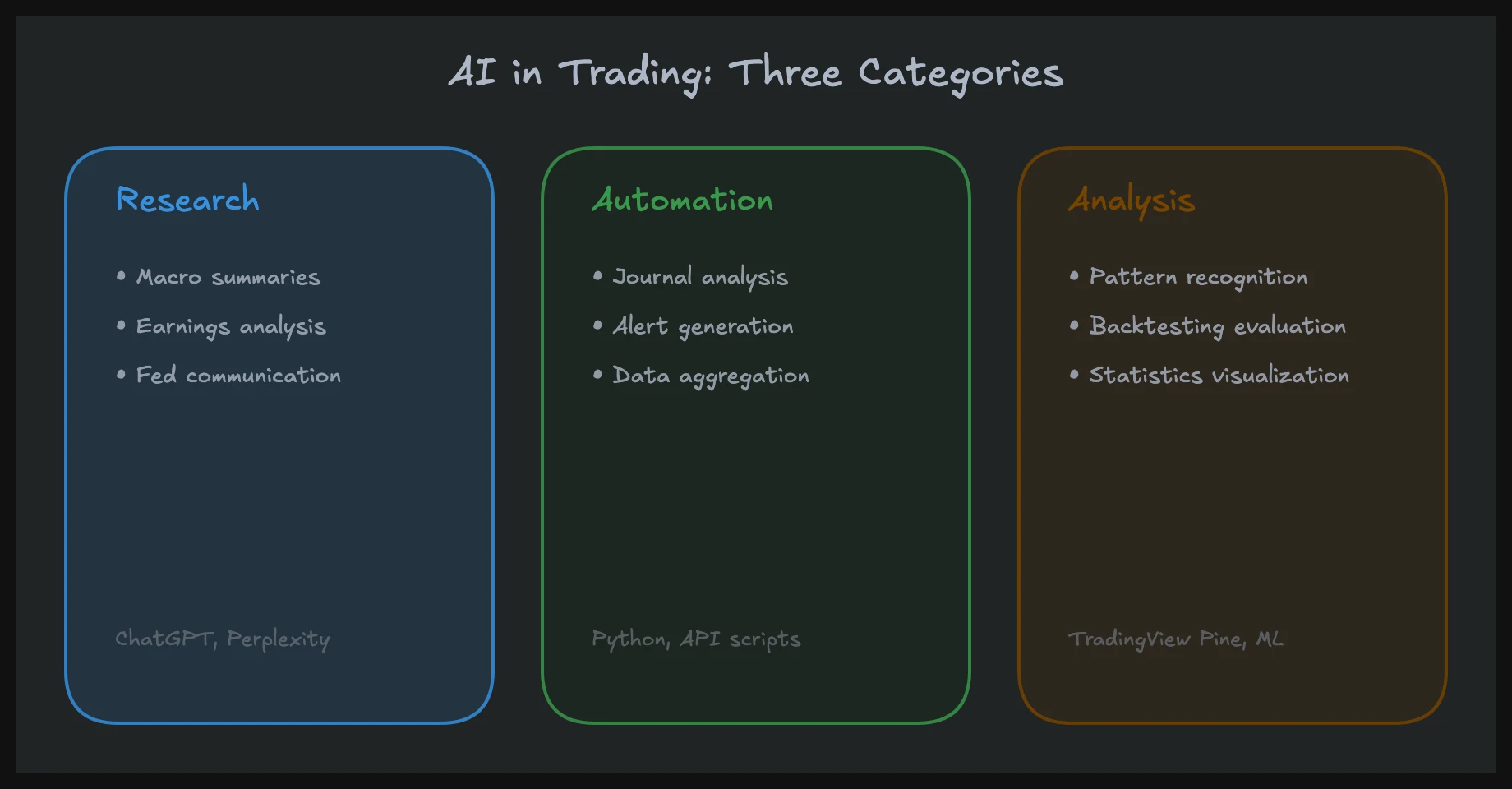
Macro Research and Data Synthesis
This is where current language models shine for traders. You can feed ChatGPT the last five FOMC minutes and get a summary in 30 seconds showing you what language shifted. That's work that used to take hours.
Practical application: I upload the current FOMC statement and the previous one and ask: "What changed in the wording? Which terms are new? Which were removed?" The answer arrives in seconds and is mostly accurate. For macroeconomic analysis, it's a genuine productivity boost.
Journal Pattern Analysis
Your trading journal contains patterns you can't see because you're too close to the data. Export 100 trades as a CSV and ask ChatGPT: "On which day of the week do I have the highest win rate? Which setup costs me the most money?" The answers will surprise you.
This doesn't replace deep self-understanding. But it accelerates pattern recognition and gives you specific areas to work on.
Backtesting Code Scaffolding
If you can describe a strategy in plain language, ChatGPT can write the Python code to test it against historical data. This saves days of programming work. The code quality is usually good enough as a starting point, and you can iterate from there.
The catch: "AI, write me a profitable strategy" doesn't work. "AI, test this specific hypothesis on NQ data from the last 5 years" works very well. The code is only as good as your understanding of the strategy behind it.
News Sentiment and Calendar Prep
Language models can analyze news feeds and deliver a summary before the US session opens. You input overnight news and the day's economic calendar and get a structured briefing: what happened, what's coming, what could move NQ today.
This isn't an oracle. It's a research assistant that saves you 30 minutes of reading time. In our article on ChatGPT for traders, I walk through seven specific applications with example prompts.
What AI in Trading Cannot Do
And here's where we get honest. Because the interesting part isn't what AI can do. It's what it can't do, and why that won't change anytime soon.
Discretionary Order Flow Trading
In the NQ Masterclass, I show how experienced traders make real-time decisions based on a combination of macro context, volume profile, footprint data, and psychological state. This is a multi-dimensional decision process that changes constantly.
Picture this: it's 9:45 AM ET. NQ has been building a tight range since 8:30. The volume profile shows a narrow bell curve. Delta is slightly negative. VWAP is flat. Ten-year Treasuries (/ZN) just started selling off. And jobless claims data drops in 15 minutes.
What do you do? The answer depends on a dozen variables that can change in the next seconds. This kind of contextual real-time interpretation is beyond any current AI system. Not because the computing power is missing, but because the problem isn't formalizable. The context is too fluid, too ambiguous, too dependent on experiential knowledge.
Recognizing Institutional Campaigns
When a large market participant builds a position, they don't do it in one trade. They distribute their buying across hours, sometimes days. They use different algorithms, different venues, different times. The pattern is never identical. Recognizing it requires thousands of hours of screen time and an intuitive sense for what looks "normal" versus what doesn't.
AI can find historical patterns. But the futures market is adaptive. Once a pattern is recognized, it changes. Participants react to each other. That's the fundamental difference between a static dataset and a living market.
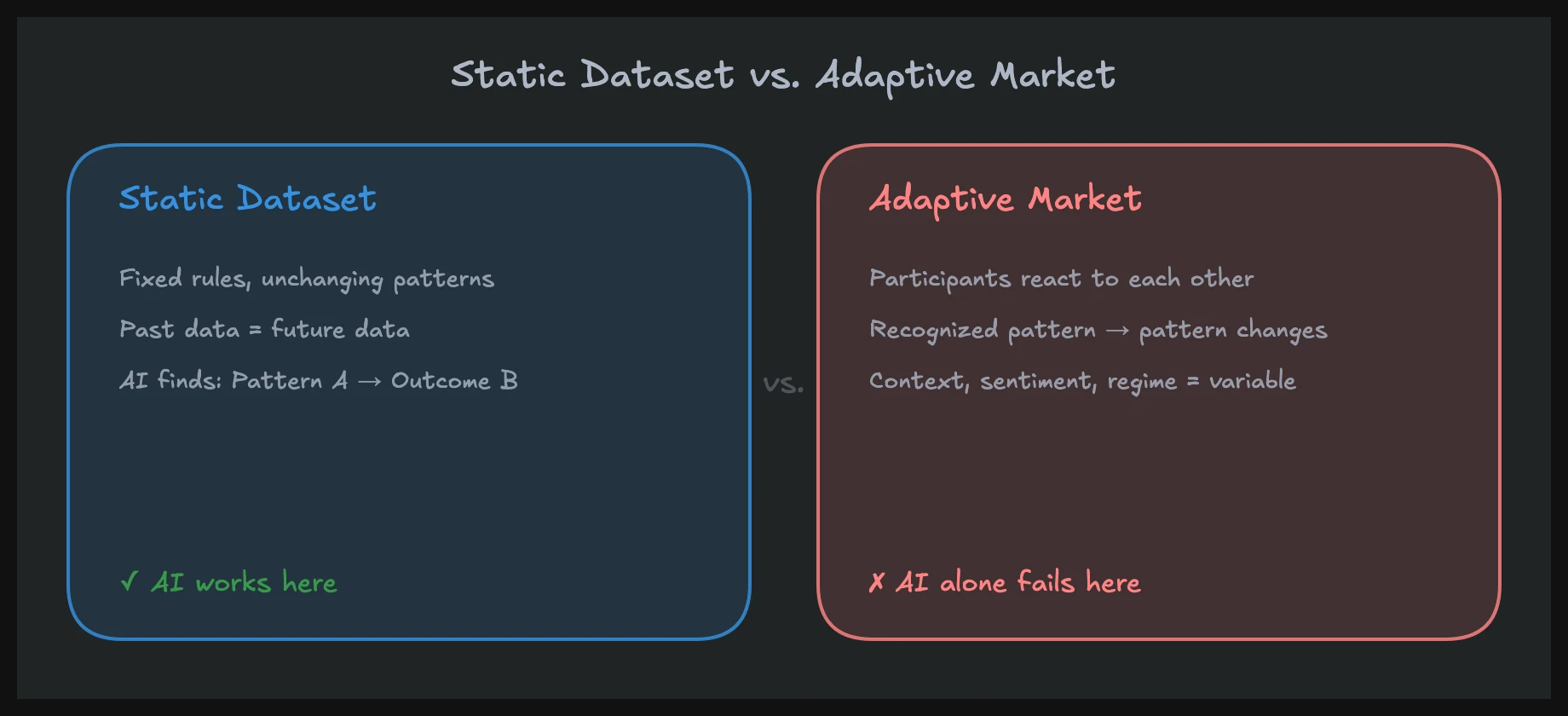
Psychological Real-Time Adjustment
Trading is 80% psychology. Your state after three losing trades is different from your state after three winners, even if the next setup is identical. A professional trader recognizes when their judgment is impaired and adjusts position size or stops trading. No bot can do that for you because the problem isn't in the market. It's in you.
The Scam Ecosystem: AI Trading Bots on Telegram and Instagram
The market for "AI trading bots" in 2026 is a billion-dollar industry. The vast majority of it is fraud dressed up as technology.
How the Scam Works
Step 1: A polished Instagram account shows screenshots of winning trades. "Our AI bot made 47% this week." The screenshots are from demo accounts or fabricated. Every trading platform allows demo accounts with arbitrary starting capital.
Step 2: You pay a subscription ($99-$499/month) and get access to a Telegram channel with "signals." The signals are either random or generated by a simple moving average crossover that any free platform provides.
Step 3: When you lose money, you're told to deposit more or upgrade to the premium package. If you make money, it's due to randomness, not the bot.
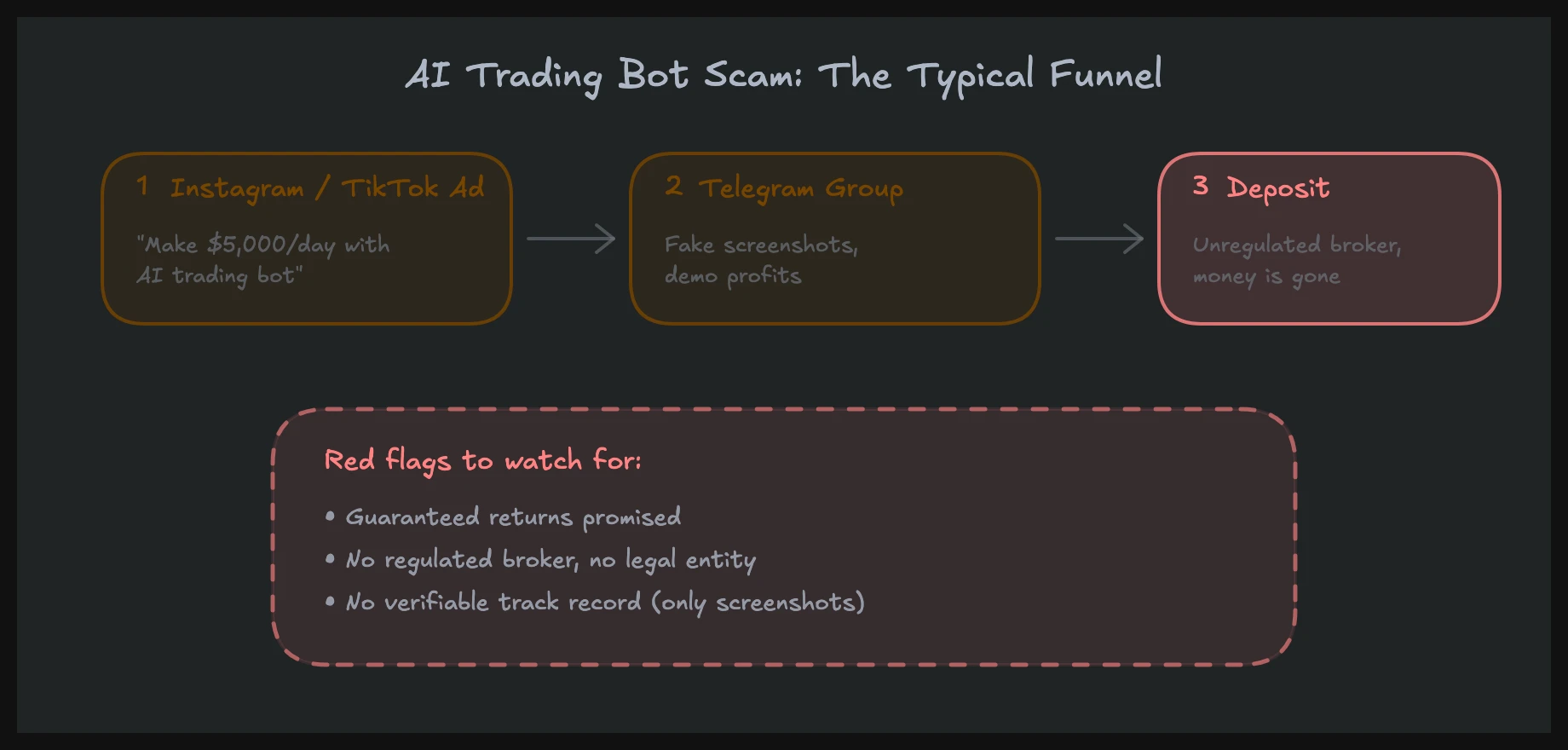
Red Flags to Watch For
Each of these is a warning sign:
- Guaranteed returns are promised ("10% per month guaranteed")
- No verifiable track records on third-party platforms (Myfxbook, TraderVue)
- Screenshots only, no live account connections
- Affiliate structures: you get a discount for recruiting others
- No losing trades are ever shown
- Urgency pressure: "Only 3 spots left" or "Price increases tomorrow"
- No company registration, no regulation, no real entity
Curve-Fitting: The Technical Problem
Even when a bot isn't a scam, there's a fundamental technical issue: curve-fitting. An algorithm is optimized on historical data until it performs perfectly on that data. In live trading, it fails because the future doesn't look like the past.
Professional quantitative traders at firms like Citadel or Two Sigma use in-sample/out-of-sample testing, walk-forward analysis, and thousands of hours of validation. A Telegram bot operator does none of that. They show you the optimized backtest and call it "AI."
AI vs. Real Market Understanding
The irony of the AI revolution in trading is this: the more people believe a bot can trade for them, the more important real market understanding becomes. Because the bots don't make the market easier. They make it faster, more efficient, and less forgiving for uninformed participants.
What AI Has Changed
The information advantage any single trader could have has shrunk. News is processed in milliseconds. Simple patterns are arbitraged instantly. Reaction times are shorter than ever.
What hasn't shrunk: the advantage that experience and context provide. The ability to interpret ambiguous situations. The discipline to make the right decision after a losing trade. The knowledge of when NOT to trade.
The Human Edge That Remains
In my experience, the lasting advantage of a discretionary trader lies in three areas:
- Contextual interpretation: reading ambiguous market data against a broad experiential foundation
- Adaptivity: adjusting to changing conditions within a single session
- Risk awareness: recognizing your own state and managing risk accordingly
No current AI system can do any of these three things. And these are precisely the skills that enable profitable trading over the long run.
What AI Tools Do Professional Traders Actually Use?
Professional traders use AI as a research assistant, not as a decision maker. The tools I see in daily use fall into clear categories:
| Category | Example | Benefit | Limitation |
|---|---|---|---|
| Macro summary | ChatGPT, Claude | FOMC comparisons, data analysis | Hallucinates statistics |
| Journal analysis | ChatGPT + CSV export | Finding patterns in trade data | No causal analysis |
| Code scaffolding | ChatGPT, Copilot | Generating backtesting code | Bugs require manual review |
| News aggregation | Specialized NLP tools | Sentiment analysis of news feeds | No real-time data in LLMs |
| Concept tutoring | ChatGPT | Bond math, options theory | Can produce wrong formulas |
None of these tools make trading decisions. They all save time on preparation. The difference between a trader who uses AI productively and one who becomes dependent on it is the same as with any other tool: do you understand what you're doing, or are you just pressing buttons?
FAQ: AI in Trading
Can I trade with ChatGPT?
No. ChatGPT has no real-time market data, no understanding of market microstructure, and no ability to execute trades. You can use ChatGPT to speed up your preparation, analyze data, and understand concepts. But as a trading system, it's unsuitable. ChatGPT regularly hallucinates statistics and historical data that you cannot rely on.
Do AI trading bots work?
The vast majority of products marketed as "AI trading bots" are either fraud (demo account screenshots, Ponzi structures) or simple automated strategies with an AI label. Real algorithmic trading systems exist at institutional firms like Citadel, Two Sigma, or Renaissance Technologies, but these cost hundreds of millions in development and aren't available for $99 per month.
What AI tools do professional traders use?
Professional traders use language models (ChatGPT, Claude) for macro research, journal analysis, and code generation. They use specialized NLP tools for news sentiment analysis. And they use backtesting frameworks where AI writes the code but the trader defines the strategy. The common thread: AI as a tool, not as a decision maker.
Will AI replace traders?
Certain areas of trading are already automated: market making, statistical arbitrage, high-frequency trading. Discretionary trading based on contextual real-time interpretation is unaffected. The ability to read ambiguous situations, adapt to changing conditions, and manage your own risk remains a human advantage.
Is trading education still worth it with AI?
Precisely because of AI, structured education is more valuable than ever. AI accelerates information processing but doesn't replace understanding. Traders who understand the fundamentals of order flow trading, market structure, and risk management can use AI as a productivity multiplier. Those who lack this foundation won't benefit from AI tools. They'll just make mistakes faster.
At United Daytraders, you'll find over 1,500 video lessons from institutional traders. The combination of structured knowledge and AI tools as a productivity multiplier is the most efficient path to learning trading. Learn more at united-daytraders.com.