
 By Marco Bösing
Options Expiration (OPEX) Trading: Mechanical Patterns Most Traders Miss
Options expiration, commonly called OPEX, is one of the most underestimated drivers of short-term market movement. Every third Friday of the month, equity and index options expire. On that day, billions in open contracts settle, and market maker hedging activity creates price behavior that follows mechanical rules rather than narrative. OPEX day trading gives you an edge because the patterns are repeatable and explainable.
Risk Disclaimer: Trading futures and other financial instruments involves significant risk of loss. Past results are not indicative of future performance. Only trade with capital you can afford to lose.
What Actually Happens at Options Expiration
On OPEX day, options contracts cease to exist. Every option a market maker sold was hedged through a corresponding position in the underlying (delta hedging). When the option expires, the hedge is no longer necessary. It gets unwound.
Picture a market maker who sold 10,000 SPX call options and hedged by going long futures. If those calls expire worthless, the futures position must be liquidated. That creates selling pressure, not because anyone has a directional opinion, but because a mechanical obligation exists.
The scale is staggering. Monthly OPEX regularly sees trillions in notional options value expire. Quarterly triple witching (March, June, September, December) compounds this by expiring equity options, index options, and futures contracts simultaneously. Volume on these days often doubles compared to normal trading sessions.
Monthly vs. Quarterly Expiration
Monthly OPEX primarily affects equity and ETF options. The impact is noticeable but contained. Quarterly triple witching is a different animal: equity options, index options, and futures contracts all expire on the same day. Volume spikes dramatically, and price dislocations are proportionally larger.
I plan around these dates weeks in advance. Not because I necessarily want to trade on OPEX day itself, but because the day after often produces the biggest moves.
GEX: Why Market Makers Move the Market
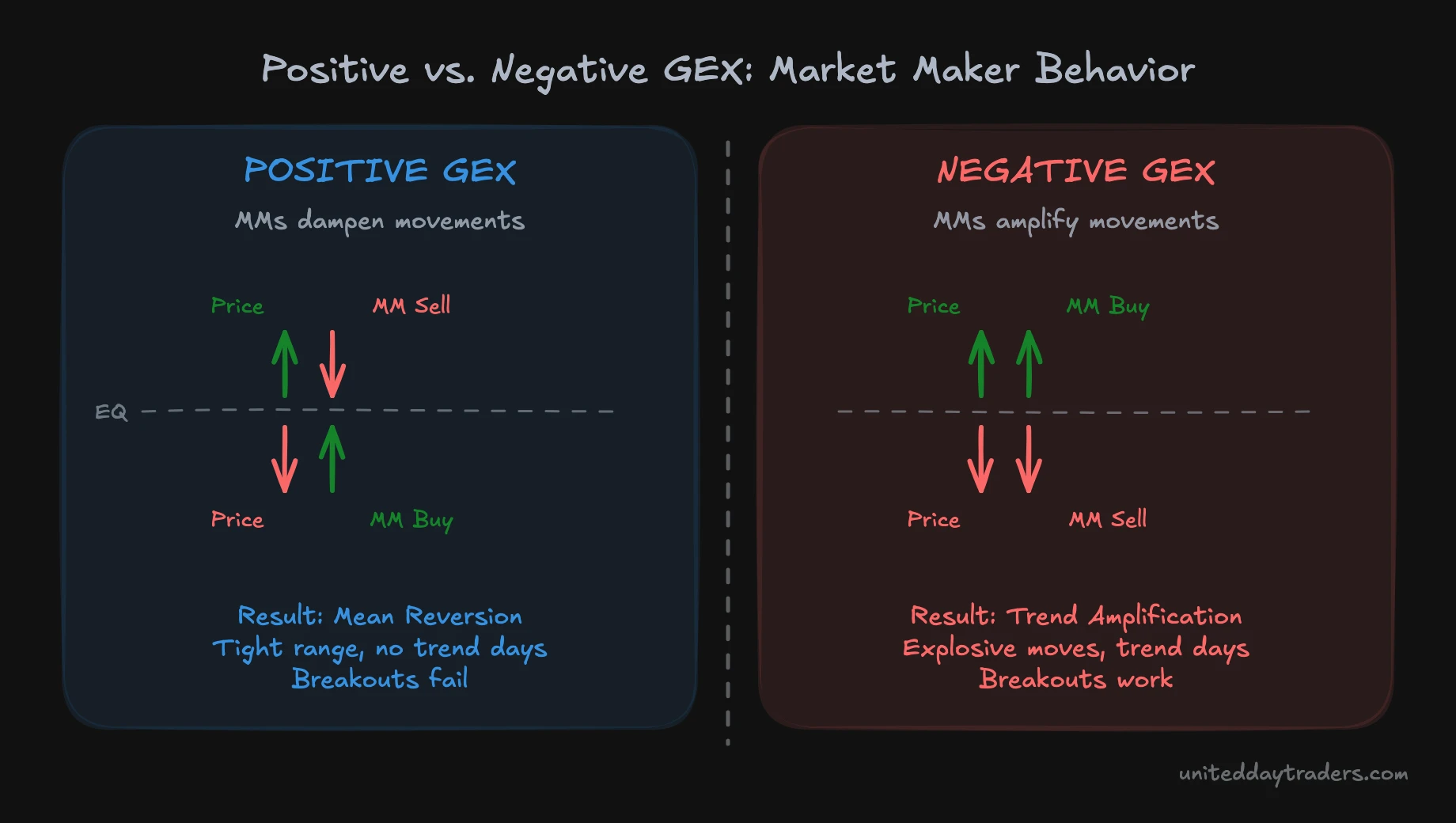
Gamma Exposure (GEX) is the concept that separates informed OPEX trading from guesswork. GEX measures how much hedging activity market makers must execute for every one-point move in the underlying. Positive GEX means market makers dampen moves. Negative GEX means they amplify them.
Positive GEX: The Shock Absorber
When GEX is positive, market makers' aggregate hedging forces them to counter price movement. Price goes up, they sell. Price goes down, they buy. They act as a built-in mean-reversion mechanism.
The result: tight ranges, frequent reversions, almost no trending days. If you try trading breakouts on a positive GEX day, you will get stopped out repeatedly. Market makers mechanically push price back toward equilibrium.
Negative GEX: The Amplifier
Negative GEX flips the dynamic. Now market makers must trade in the same direction as the move: price drops, they sell; price rises, they buy. Every move gets reinforced instead of dampened.
These are the days with explosive directional moves, gap-and-go trends, and sharp reversals. If you track VIX and volatility, you will notice that negative GEX periods frequently coincide with elevated VIX. That is not coincidence: both reflect heightened market uncertainty and repricing of risk.
Max Pain: The Magnetic Price Level
Max pain is the price level where the most options expire worthless. At this point, option buyers collectively lose the most money, and option sellers (predominantly market makers and institutional desks) retain maximum premium.
This sounds like conspiracy, but it is straightforward mechanics. When price sits far from max pain, many options are in the money and require hedging. As price approaches max pain, hedges get unwound, directional pressure fades, and price gravitates naturally.
I do not use max pain as a standalone target. I use it as a filter. If price opens near max pain on OPEX morning and GEX is positive, I expect a range day. If price opens far from max pain, there is a magnetic force pulling it closer, especially during the first half of the session.
Combined with supply and demand zones, this creates a strong confluence picture. When a supply zone sits near max pain, it gets respected more reliably on OPEX days.
The OPEX Day Pattern: Morning Compression, Afternoon Direction
OPEX days follow a characteristic intraday structure that I have observed consistently over years. The morning session (9:30 AM to roughly 12:00 PM ET) is dominated by volatility compression. Final hedging adjustments play out, price oscillates in a tight range, often anchored near max pain. Many retail traders describe this phase as "boring" or "directionless."
The picture changes in the early afternoon (around 2:00 PM ET). Most options have now expired worthless or been exercised. Hedges are being unwound at scale. From this point, a directional move often develops that extends into the close. These afternoon moves tend to be clean and tradeable.
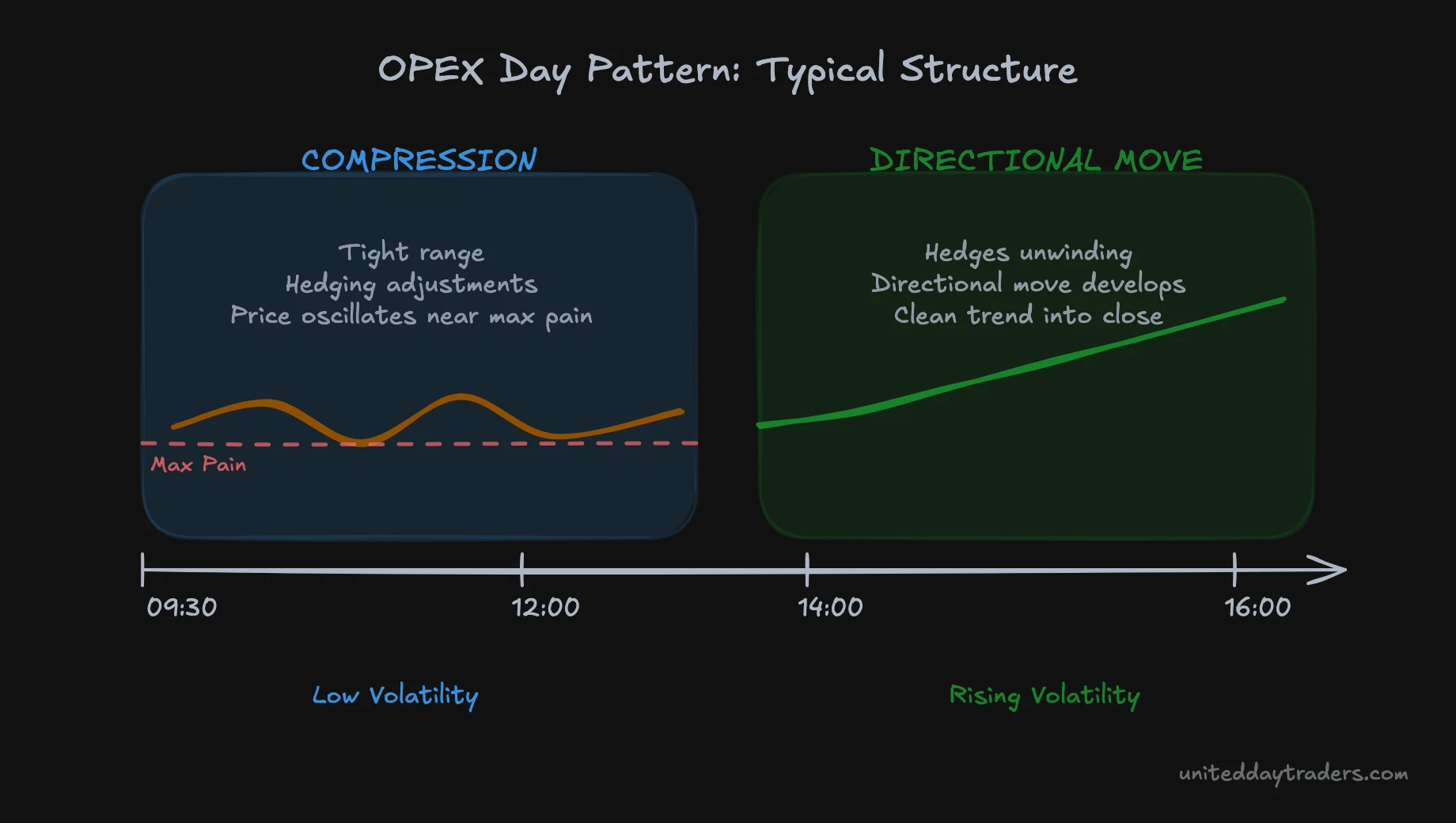
For your trading, this translates into a concrete plan: reduce position size during the OPEX morning and trade reversions. In the afternoon, wait for the directional move and position with the trend. A multi-timeframe analysis approach helps identify the afternoon direction early.
The Day After OPEX: Where the Real Opportunity Lives
The Monday after options expiration is statistically one of the most volatile days on the monthly calendar. The reason: "pinning" (the magnetic effect of strikes and max pain) disappears. The market is free from the hedging dynamics that constrained it on Friday. Institutional flows that were deferred through OPEX now enter the market.
I call this the "unpin effect." The market on Monday after OPEX frequently moves in the direction it was trying to go all week but could not on Friday. This aligns with the concept of market phases: the compression phase on OPEX resolves into an expansion phase.
This effect is especially pronounced after quarterly triple witching. The Mondays following September and December triple witching are historically among the highest-range trading days of the year.
The OPEX Decision Tree for Your Trading
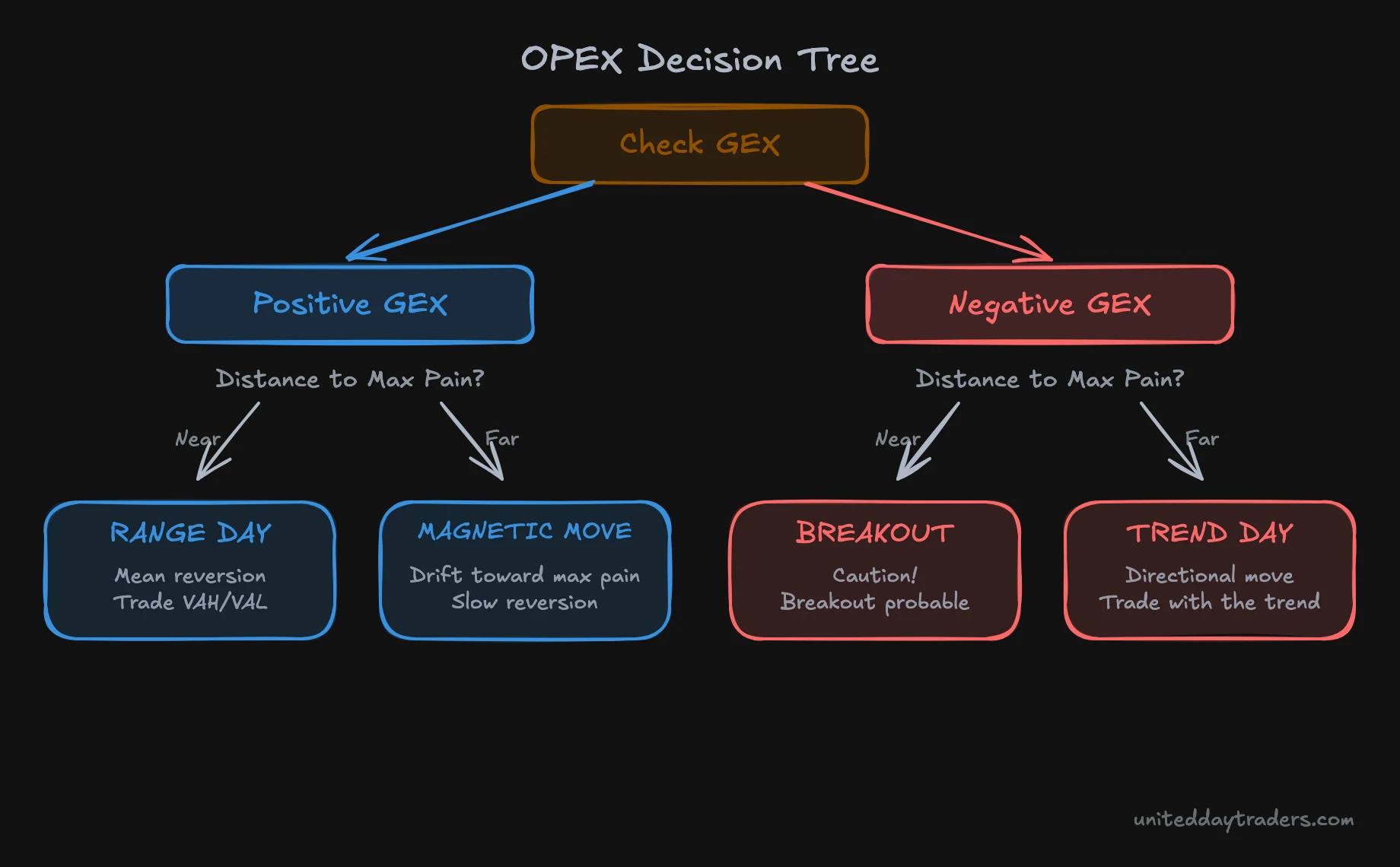
My approach on OPEX day follows a clear decision framework:
- Check GEX: Is gamma exposure positive or negative?
- Measure distance to max pain: Is price close (within 0.5%) or far (over 1%)?
- Read the combination:
- Positive GEX + near max pain = range day, trade mean reversion
- Positive GEX + far from max pain = magnetic move toward max pain
- Negative GEX + near max pain = caution, breakout likely
- Negative GEX + far from max pain = trend day, directional move
For Nasdaq futures, this framework carries extra weight because NQ's tech concentration makes it particularly sensitive to options flows. The largest NQ options positions tend to cluster at round levels (18,000, 18,500, 19,000), and these levels act as magnets on OPEX day.
0DTE: The Daily Mini-OPEX
Since the explosion in 0DTE options (zero days to expiration), we experience a mini-expiration every single trading day. The same mechanics of GEX, hedge unwinding, and magnetic strikes play out daily, just at a smaller scale. 0DTE options on SPX now generate daily volume that dwarfs what monthly OPEX produced just a few years ago.
The implication: OPEX mechanics are no longer a once-a-month event. You can apply the principles of GEX and max pain every day, particularly in the final 90 minutes of the session when 0DTE options expire.
FAQ
When is the next OPEX?
Monthly OPEX falls on the third Friday of every month. Quarterly triple witching occurs on the third Friday of March, June, September, and December. Mark these dates on your trading calendar. The CME publishes exact dates on their website. Plan for at least the OPEX Friday and the following Monday as potentially unusual trading days.
Where can I find current GEX and max pain data?
GEX data is available through specialized providers like SpotGamma, GEX Indicator, or Unusual Whales. Max pain can be calculated for free on sites like maximum-pain.com or through your broker's options chain. For SPX and Nasdaq options, data updates daily. Check values before the US open as part of your pre-market routine.
Should I trade on OPEX day or wait?
It depends on your style. If you trade mean reversion, the OPEX morning with positive GEX is ideal territory. If you prefer trend following, wait for the afternoon session or, even better, the Monday after OPEX. Personally, I trade selectively with reduced size on OPEX mornings and get more aggressive in the afternoon once direction reveals itself.
In our mentoring program, you learn these concepts across 1,500+ video lessons with real chart examples. At uniteddaytraders.com, we show you how to integrate GEX, max pain, and options levels into your daily trading.