
 By Marco Bösing
S&P 500 vs Nasdaq: Which Index Should You Trade?
S&P 500 vs Nasdaq: many traders starting with index futures ask themselves this question. ES and NQ are the two most traded index futures in the world. Both run at the CME, both have micro variants, both are highly liquid. Still, they're fundamentally different.
Which one fits you better doesn't depend on which is "easier," but on your trading style. In this article, I compare both indices in detail so you can make an informed decision. If you don't have an overview of NQ yet, read the main article Trading Nasdaq Futures first.
Risk Disclaimer: Trading futures and other financial instruments carries substantial risk of loss. Past results are not indicative of future performance. Only use capital you can afford to lose.
The Fundamental Difference
ES tracks the S&P 500: 500 companies across all eleven GICS sectors. Technology, healthcare, finance, energy, industrials, everything is represented. It's the broadest diversification of all US indices.
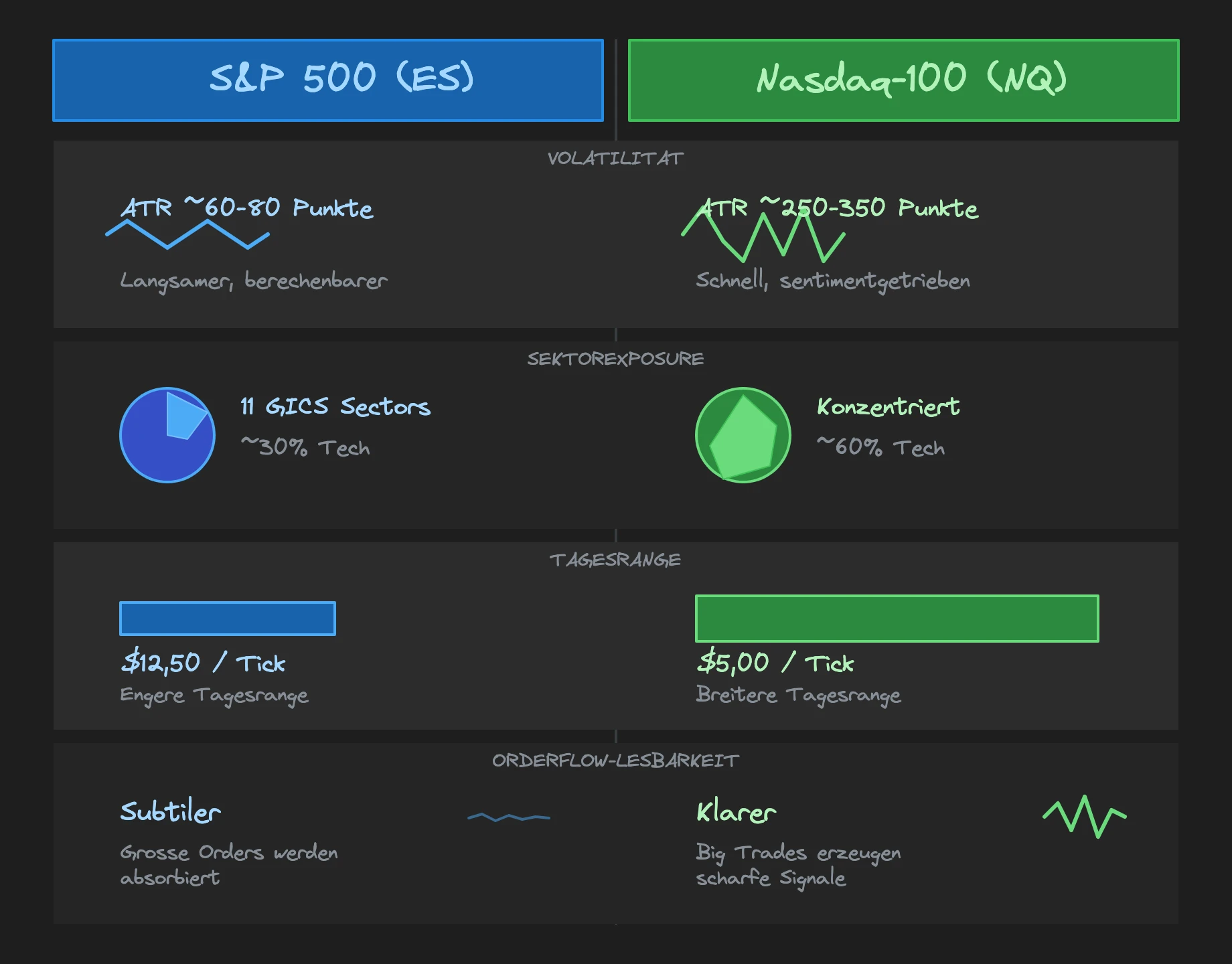
NQ tracks the Nasdaq-100: 100 companies, massively tech-heavy. Apple, Microsoft, Nvidia, Amazon, and Meta alone make up a significant share. About 60% of the index falls in the technology sector. In ES, this share is about 30%.
This concentration has direct consequences. A single Nvidia earnings can move NQ by 300+ points. In ES, the same event has a dampened effect because 450 other companies cushion the impact. An Apple downgrade moves NQ noticeably. In ES, it's a footnote.
NQ is a sentiment market. When tech optimism rises, NQ explodes upward. When fear of rising interest rates emerges, it falls faster than the broader market. ES is a macro market. It reacts to the overall economy, to NFP, CPI, and Fed decisions, broader, slower, more dampened. This difference determines everything else.
ES vs NQ Direct Comparison
| E-mini S&P 500 (ES) | E-mini Nasdaq-100 (NQ) | |
|---|---|---|
| Point value | $50 per point | $20 per point |
| Tick size | 0.25 points | 0.25 points |
| Tick value | $12.50 | $5.00 |
| Micro variant | MES ($5/point) | MNQ ($2/point) |
| Micro tick value | $1.25 | $0.50 |
| Daily range (ATR) | ~60 to 80 points | ~250 to 350 points |
| Sectors | All 11 GICS sectors | ~60% technology |
| Intraday margin (Micro) | ~$50 (MES) | ~$50 (MNQ) |
| Overnight margin (Micro) | ~$1,500 to $2,500 (MES) | ~$1,700 to $2,000 (MNQ) |
| Correlation to each other | ~0.85 to 0.90 | ~0.85 to 0.90 |
The table shows: NQ moves significantly more per day. But movement alone says nothing about profitability. An instrument with more range gives you more opportunities, but also more ways to lose money. What counts is how well you understand the instrument.
Three Differences That Change Your Trading
1. Volatility: Opportunity and Risk
NQ has an average daily range of ~300 points. ES comes in at ~70 points. That's a factor of over four.
What does this mean in practice? A 20-point stop in ES costs you $1,000 per E-mini contract. A 50-point stop in NQ costs you likewise $1,000 per E-mini contract. But NQ reaches its target with the same R:R more often on trend days because the range is simply larger. Where ES might run 50 points on a trend day, NQ runs 200.
The downside: on range days, volatility in NQ can stop you out faster. Two, three fake moves of 30 points each, and your account has three losers before ES would have even triggered its first trade.
2. Market Regime: Mean Reversion vs Trend
ES tends more toward mean reversion. On many days, it trades in a tight range and repeatedly returns to VWAP. This makes it more predictable, but also more boring for traders waiting for larger moves.
NQ has sharper trend days. When tech sentiment flips (through earnings, through an AI hype surge, through rate speculation), NQ moves aggressively in one direction and doesn't come back. These days are extremely profitable if you're on the right side.
For VWAP reversion setups, both indices work, but ES is more "forgiving." If your entry isn't perfect, ES often gives you a second chance. NQ is less forgiving.
For trend trades, NQ is superior. The moves are larger and the order flow signals are clearer because aggressive buyers and sellers leave stronger footprints in the concentrated index.
3. Order Flow Readability
NQ reacts more strongly to individual large orders. Big trades in NQ create clearer signals because the concentrated index has less "noise" from uncorrelated sectors. When an institutional trader throws 200 NQ contracts into the market, the price moves.
In ES, large orders often get absorbed by the broad diversification. A large buyer in the tech sector gets balanced by sellers in the energy sector. The reactions are subtler and harder to read.
Those who work with footprint charts see sharper imbalances and clearer exhaustion patterns in NQ. The delta between aggressive buyers and sellers draws a clearer picture in NQ because market movements are less diluted.
When ES Is the Better Choice
ES isn't a "worse" index. There are good reasons to trade it:
For beginners. The slower price movement gives you more time to react. A trade in ES develops more slowly, you have more room to verify your analysis before the market punishes your decision. Anyone just learning futures trading can make fewer mistakes with ES.
For mean-reversion traders. If your strategy is based on fading extremes back to the average, ES offers more opportunities. The index reverts more frequently and more reliably.
For macro traders. NFP, CPI, and Fed decisions affect ES more directly. If you specifically trade macroeconomic events, ES is the more honest instrument because it reflects the overall economy, not just one sector.
For smaller accounts. The MES tick value ($1.25) is higher than the MNQ tick value ($0.50), but NQ moves 4x as much. Effectively, the risk per micro contract is similar. ES still feels more controllable because moves come more slowly.
Why We Trade NQ
In our trading, NQ is the main instrument. Not because it's "better," but because its characteristics match our approach. In my time as an institutional trader, I traded both indices intensively and learned where the differences really lie:
Volatility creates larger moves with the same setup. A good entry in NQ delivers more points than the same entry in ES. With profitable strategies, this increases expected value.
Sentiment-driven markets are ideal for order flow analysis. When a market is driven by emotions and concentrated capital, participants leave clearer traces in the tape.
Stop runs are more aggressive in NQ and therefore more readable. NQ seeks liquidity more targeted because the concentrated structure offers fewer alternative liquidity pools.
NQ rewards depth over breadth. Someone who truly understands one index has an advantage over traders who trade five instruments superficially. Concentration on one instrument enables an intuitive understanding that builds over months.
This doesn't mean everyone should trade NQ. It means NQ returns the most when you're willing to invest in understanding it.
FAQ: S&P 500 vs Nasdaq
Can I Trade ES and NQ at the Same Time?
Technically yes, but the correlation is ~0.85 to 0.90. If you trade both in the same direction, you double your risk without diversifying it. On most days, ES and NQ move in the same direction, just with different intensity. Choose one index and get really good at it.
Is ES Better for Beginners?
Yes, tendentially. The slower price movement gives you more time to react, and the more frequent mean reversion is a more predictable behavior. But "slower" doesn't mean "easier." You still lose money in ES if your risk management isn't right. For starting with a small account, micro futures work for both indices.
Which Index Should I Trade in a Prop Challenge?
The index you know best. Many choose ES because of lower volatility, but if you can read NQ better, it's the better choice. The challenge tests discipline and consistency, not the instrument. Choose the index where you have the most screen time.
In our mentoring program, you'll learn these concepts in more than 900 video lessons with real chart examples. The NQ Masterclass focuses on understanding the Nasdaq-100 in detail, and in the Trader Framework you learn the basics of all futures products before you specialize.